“An era of AI agents carrying out transactions on our behalf ... ‘decentralization’ is the next cycle’s buzzword”
- Input
- 2026-11-02 18:15:31
- Updated
- 2026-11-02 18:15:31
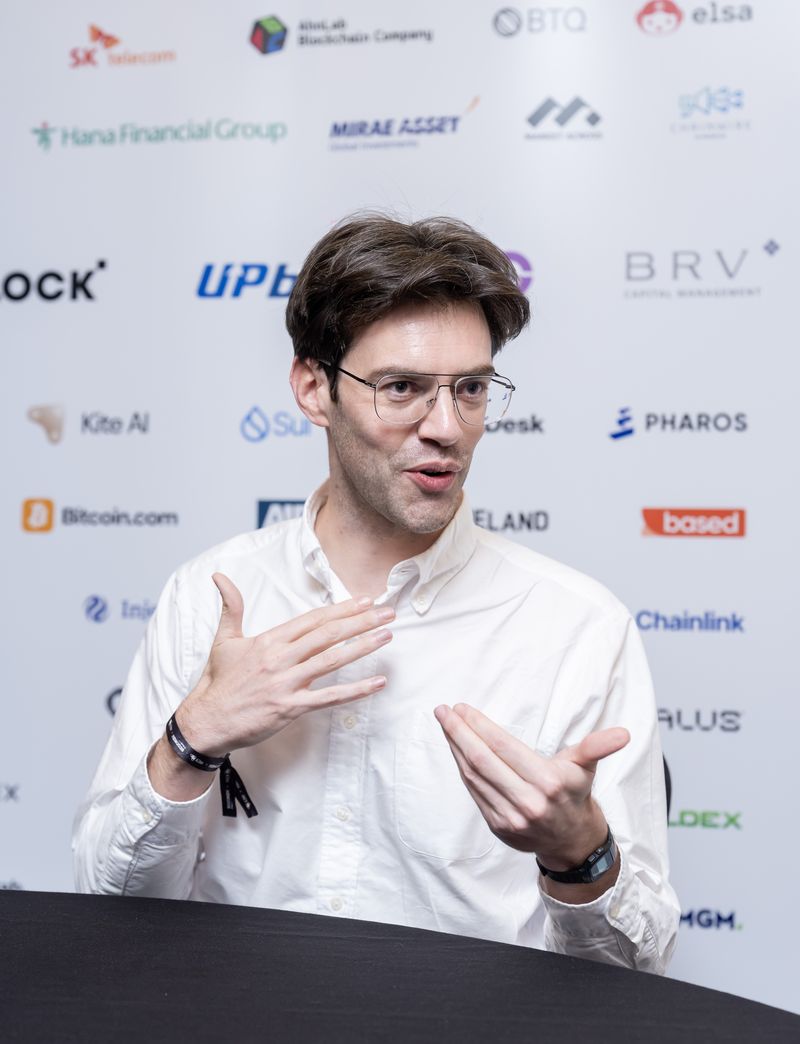
“As AI agents begin carrying out transactions on people’s behalf, the range of things individuals can handle on their own has expanded dramatically. The next cycle’s buzzword, ultimately, is ‘decentralization.’”
Tom Schmidt, general partner at Dragonfly (Photo) said this when he met with Financial News on the 2nd: “It’s impossible to make a perfect prediction, but if I had to name where capital will go next, it would be the decentralized sector.” Dragonfly is a global venture capital firm that has focused on digital assets since the early days of the industry in 2018. It has grown its assets under management from $4 billion (about KRW 5.4 trillion) to $6.5 billion (about KRW 8.7 trillion). It was also an early investor in the prediction-market platform Polymarket.
The vision Schmidt has in mind goes beyond simple automation. “AI agents have created an environment where payments and transactions happen automatically, without people having to handle every step,” he explained. “When AI assistants can take care of multiple tasks on their own, there is less reason to rely on centralized businesses or organizations.” In other words, functions once held by centralized platforms are being dispersed to individuals.
He cautioned, however, that “we are still at an unstable stage with significant risks.” In his view, timing matters more than whether an idea is good or bad. “Even the things taking off now are ideas that have been around for a long time,” Schmidt said. “Polymarket didn’t even have a category of its own before 2024. It’s not about whether an idea is good or bad; it takes off when the time is right.”
Venture capitalists have also changed how they assess projects: they look at the people using them, not the price of the coin. Citing Polymarket as an example, Schmidt said, “People there don’t use a native token; payments are made after an automatic conversion into stablecoins.” He added, “The fact that people bring money to use a service, and that money gathers there, is itself evidence of preference.”
Regulation was one area where his predictions missed the mark. Schmidt, who wrote a paper on Bitcoin’s regulatory path while studying at Stanford University, said, “At the time, speculation was a stronger motive than use, so I thought it would eventually be pushed into the realm of illicit trading. But now the establishment is actually accelerating its legalization and commercialization.” He added, “I didn’t foresee the U.S.’s active involvement.”
He focused on the real-world asset tokenization trend as a new system for raising funds. “Traditional fundraising has set limits, such as KRW 100 million or KRW 30 billion, but with tokens, the amount that can be raised is open-ended and grows with demand,” Schmidt said.
By contrast, he expects a harsh period for small projects. “Tokens with weak revenue foundations lose demand, and without institutional backing, there’s no way to prove their stability,” Schmidt said. “Ultimately, they are pushed into a state where they go unused and disappear.”
His advice for Korean projects followed the same logic. “Funds I and II had strong sourcing in Korea, while III and IV were focused mainly on the U.S., where regulations had been put in place. No one knows where Fund V will be,” he said. “Digital assets are built on the premise that they will spread around the world from the outset. Korean founders, too, should design for the global market from the start, rather than focusing on any one country.”
[email protected] Han Young-jun, Seok Jeong-eun Reporter