In wake of the ‘Ovantgarde incident,’ discussions on easing restrictions on dancing at live clubs gain momentum
- Input
- 2026-11-02 18:31:27
- Updated
- 2026-11-02 18:31:27
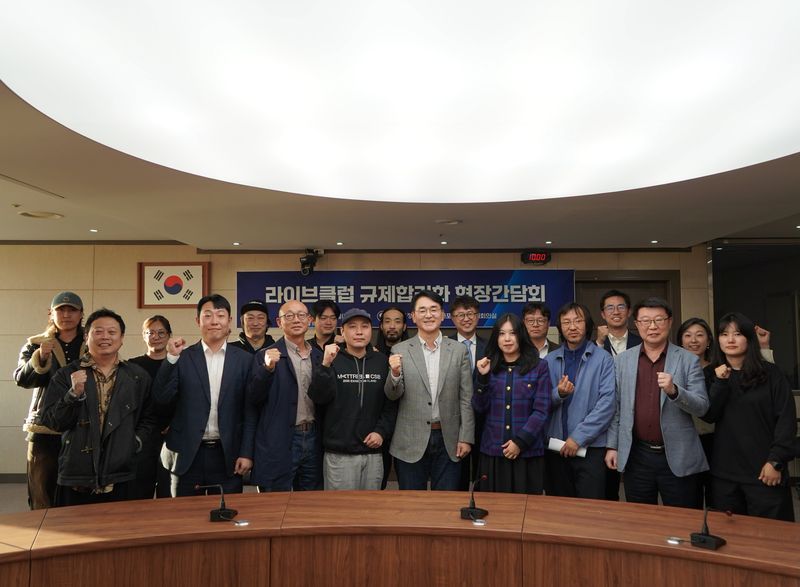
[Financial News] The Presidential Regulatory Rationalization Committee held an on-site meeting to prevent a recurrence of the so-called ‘Ovantgarde incident.’ Under current law, dancing is prohibited at live clubs registered as general restaurants. The aim is to treat this as an “outdated regulation” and pursue reasonable improvements.
Park Yong-jin, vice chair of the Regulatory Rationalization Committee, held an on-site meeting on rationalizing regulations on live clubs at Mapo-gu Office in Seoul on the 2nd. In addition to people who operate live clubs, officials from the Ministry of Culture, Sports and Tourism, the Ministry of Food and Drug Safety, and Mapo-gu Office attended.
Under the current Enforcement Rule of the Food Sanitation Act, operators of general restaurants are prohibited from allowing customers to cheer or dance. Accordingly, customers are also not allowed to dance at live clubs, which are performance venues equipped with sound systems. In fact, last August, Ovantgarde, a well-known live club in Busan, received a two-month business suspension for allowing its audience to dance. The decision sparked controversy because the club was a symbolic venue regarded as a mecca of Busan’s indie culture.
Mapo-gu, where live club culture thrives, has allowed dancing in clubs under an exception to the Food Sanitation Act through an ordinance enacted in 2015. At the meeting, Mapo-gu Office shared relevant views and difficulties, the status of live club operations in the district, and feedback from the field.
Representatives of live clubs, including the National Live Club Alliance and Ovantgarde’s representative, reportedly stressed the realities of running clubs and the need to improve on-site regulations. Asurai Band, which attended as a representative of indie music, expressed the view that regulations should be revised in a way that does not hinder the development of indie music.
Vice Chair Park Yong-jin stressed, “Live clubs are places where young musicians take the stage for the first time and new music is born. They may also be precious spaces that are the roots of all the music we enjoy. We should not see this issue simply as a question of whether to allow dancing. We need to examine whether existing business classifications and regulatory approaches fit today’s changed cultural realities. We also need to consider new forms of cultural spaces that will emerge in the future.”
He went on to pledge, “While upholding the original purposes of regulation—hygiene and safety—we will work with the relevant ministries to pursue reasonable institutional improvements so that people creating music and culture on the ground do not face difficulties because of unreasonable regulations.”
[email protected] Lee Hae-ram Reporter