“Policy Support to Continue After U.S. Midterms”... Hopes Rise for Korea Zinc’s $7.4 Billion Smelter
- Input
- 2026-11-02 17:48:03
- Updated
- 2026-11-02 17:48:03
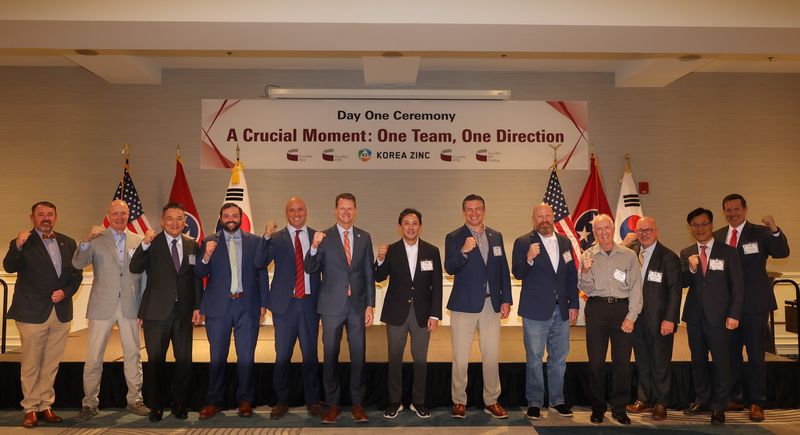
[Financial News] Expectations are rising that Korea Zinc will benefit from continued policy support for building critical-mineral supply chains after the U.S. midterm elections. The company is expanding its U.S. supply chain, including by pursuing construction of an integrated smelter worth $7.4 billion (about 9.93 trillion won) in partnership with the U.S. government.
On the 2nd, Park Gwang-rae, an analyst at Shinhan Investment & Securities, said in a report, “Nonferrous metals and critical minerals are the most stable areas for potential benefits, given that building U.S. supply chains independent of China, expanding the power grid, and government equity investments are policy goals that transcend party lines.” The analysis is that there will be no major change in the policy direction of strengthening critical-mineral supply chains even if the Democrats win majorities in both the House and Senate in the U.S. midterm elections on the 3rd (local time).
Park cited the introduction of the Critical Minerals Commission Act on October 1 by seven lawmakers from both parties. He said, “A blue wave (Democratic control of both the House and Senate) would change only the tools of support, such as subsidies, stockpiling and price floors; the goal of securing refining capacity outside China would remain unchanged,” adding, “Equity investments in critical-mineral companies and stockpiling policies are also likely to continue even if the balance of power in Congress changes, as they are pursued at the executive branch’s discretion and on the basis of existing budgets.”
The report said this is also why expectations are rising for Project Crucible, which Korea Zinc is pursuing in Tennessee.
With a total investment of $7.4 billion, the project involves building an integrated smelter jointly with the U.S. government. It aims to begin construction in earnest in 2027 and start operations in phases from 2029. The smelter is expected to produce 13 strategic minerals, including germanium, gallium and antimony, as well as the company’s existing core metals such as zinc, lead and copper. It is considered to have significant strategic value because it will establish a U.S. production base for critical minerals on which the country is highly dependent on China.
Benefits from the U.S. Advanced Manufacturing Production Tax Credit (45X) are also expected. The United States relies on net imports for 100% of its gallium and indium needs, while the figures for bismuth and antimony are 92% and 91%, respectively. This is cited as one reason why securing domestic production facilities for critical minerals is becoming increasingly important. Park said, “The 45X tax credit will be phased down starting in 2031 and expire in 2034, so the initial operating period of the integrated smelter in 2029–2030 will be when it receives the greatest benefit.”
Whether the company’s value is re-rated going forward will depend on the project’s actual pace of progress, the report noted. In the short term, silver and gold prices and zinc treatment charges (TC) will determine earnings, while the start of commercial germanium sales is expected to provide a new source of revenue.
Korea Zinc previously reorganized its project execution structure by establishing the Crucible Division, a dedicated project unit directly under Chairman Choi Yun-beom. At the time, Choi indicated through the organizational restructuring that he intended to oversee every stage of the project himself, from initial negotiations through completion of construction.
In a shareholder letter last September, Choi also emphasized, “Project Crucible is a business that will put Korea Zinc at the center of the global critical-minerals supply chain and serve as the foundation for sustainable medium- to long-term growth.”
[email protected] Jung Won-il Reporter