Applying Humanities Research in Jeju Province to National Policy Design ... Talks on Cooperation with Government-Funded Research Institutes
- Input
- 2026-11-02 17:02:24
- Updated
- 2026-11-02 17:02:24
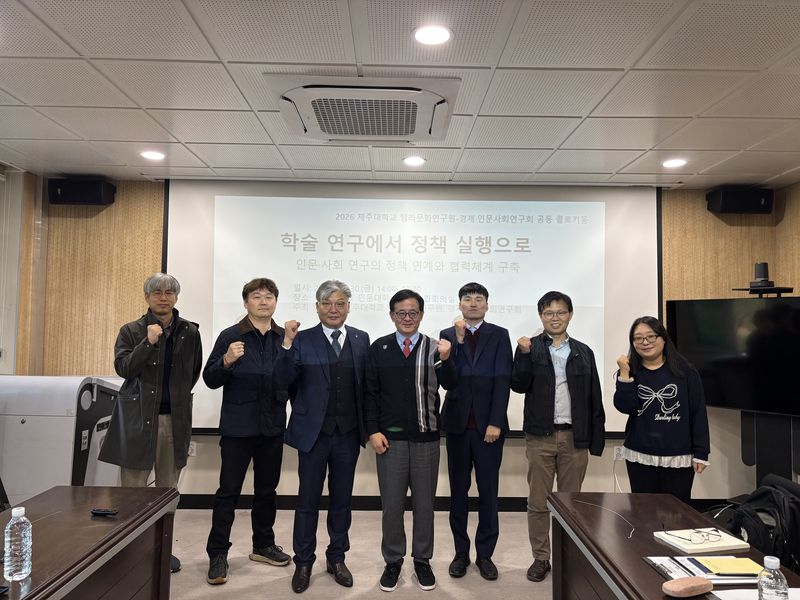
【Financial News, Jeju = Reporter Jeong Yong-bok】 Ways to apply humanities and social sciences research in Jeju Province to the design of policies on artificial intelligence (AI) ethics, care and welfare, and local communities were proposed. Policy experiments in which residents directly take part in solving local problems, as well as joint research among government-funded research institutes, were also discussed as areas for cooperation.
On the 2nd, the Tamla Culture Research Institute at JNU said it held a colloquium on the 30th of October in the conference room of Building 1 at JNU’s College of Humanities, in collaboration with the National Strategy Research Division of the National Research Council of Economics, Humanities and Social Sciences. The theme was “From Academic Research to Policy Implementation.”
The event was organized under a memorandum of understanding signed in June 2023 by the Tamla Culture Research Institute and the Research Support Division of the National Research Council of Economics, Humanities and Social Sciences. It focused on connecting humanities research accumulated in the region with national policymaking and the resolution of local issues, and on developing a concrete framework for joint research.
The central theme was “Humanities in Policy.” Kim Sun-jong, head of the General Affairs and Accounting Department at the National Research Council of Economics, Humanities and Social Sciences, raised the need to shift perspective from the conventional “policy for the humanities” to “humanities in policy (2.0).” The idea is that the humanities should not only propose policy alternatives but also take part from the stage of examining and defining social problems.
Humanities-based value judgments and ethical reviews to complement technology-centered policy approaches in the AI era were also discussed as key agenda items. Participants considered ways to combine data-based policy research with humanities analysis of human life and social equity.
Ways to apply research in Jeju Province to policymaking were also proposed. Kim Jin-seon, an HK research professor at the Tamla Culture Research Institute, presented a “Research Agenda for Qumda Humanities in an Era of Global Anomie” and outlined a research direction connecting island regions across the Asia-Pacific, based in Jeju.
The plan is to study the values of coexistence and inclusion through Qumda, which means “to embrace” in the Jeju language, and to address local issues through a resident-participatory “Qumda Living Lab.” A living lab is an approach in which researchers, residents and others identify problems in everyday settings and test possible solutions together.
Participants also discussed a cooperative-centered circular system of production and consumption to invigorate local communities, job creation in care and welfare, and policy foundations for inclusive finance and the realization of a basic society. Emphasis was placed on reflecting local residents’ experiences and everyday realities in national policy research.
Expanding cooperation among research institutions was also identified as a task. Proposals included policy living lab cooperation with the Korea Institute of Public Administration (KIPA) and building a joint research network with overseas institutions, including social science academies in China and Vietnam.
The panel discussion was chaired by Yoon Du-seop, head of the National Strategy Research Division at the National Research Council of Economics, Humanities and Social Sciences. It covered links between national future strategies and humanities research, the policy application of research findings, and cooperation among domestic and international research institutions.
Kim Chi-wan, director of the Tamla Culture Research Institute, emphasized that “ongoing cooperation among relevant research institutions is needed to conduct policy humanities research linked to national strategies.”
[email protected] Jeong Yong-bok Reporter