Deputy Prime Minister Lee Hyeong-il visits Hyundai Motor Company's Namyang Research Institute; industry united in calling for production tax credits for EVs too
- Input
- 2026-11-02 17:10:39
- Updated
- 2026-11-02 17:10:39
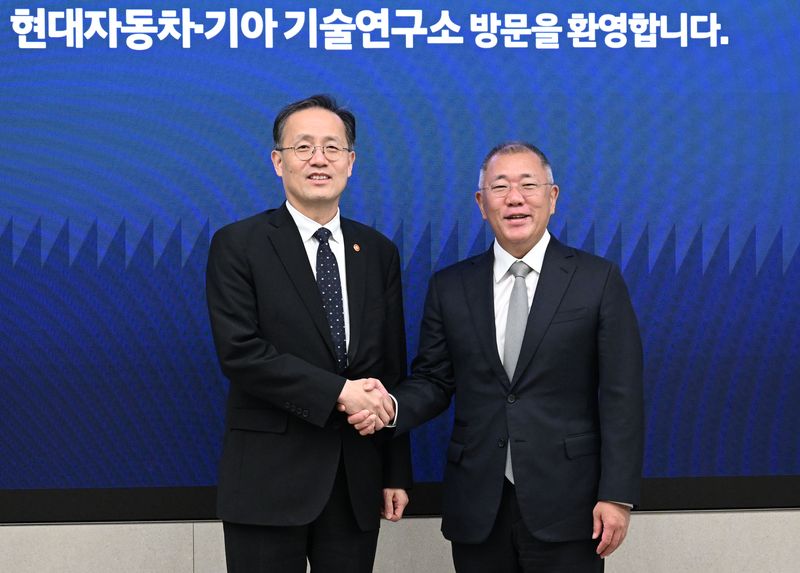
According to the Ministry of Economy and Finance, Lee chaired a meeting with industry representatives on strengthening the competitiveness of the EV industry that day at Hyundai Motor Company and Kia Corporation's Technical Research Institute in Hwaseong City, Gyeonggi Province. Government attendees included the vice minister of the Ministry of Trade, Industry and Energy, the second vice minister of the Ministry of Climate, and the second vice minister of the Ministry of Land, Infrastructure and Transport.
“The next battleground for a rebound in the potential growth rate is EVs,” Lee said. He explained that businesses urgently need to change quickly and innovate technologically, as they must secure technological capabilities on par with those of leading global countries within the next two to three years to survive.
Business leaders called for support through production tax credits for EVs to survive intensifying global competition. In the 2026 Tax Reform Plan announced in August, the government decided to establish a domestic production tax credit that reduces taxes in proportion to domestic output. However, support is limited to six sectors: semiconductors, secondary batteries, solar power, wind power, key materials, and AI robotics components. The scheme excludes fully assembled EVs and supports only secondary batteries, a key component.
Industry demands have continued. The Korea Automobile & Mobility Association (KAMA) argued at a National Assembly forum on the 26th of last month that fully assembled EVs should also be eligible for support, citing the cost burden on domestic manufacturers competing with Chinese-made EVs. The government discussed possible supplementary measures at a recent economic issues meeting, but whether to add EVs remains under review.
Hyundai Motor Group is expanding its domestic production base for vehicle electrification. Hyundai Motor Company invested about 2 trillion won to build the Ulsan Electric Vehicle Dedicated Plant, with annual capacity of 200,000 vehicles. It is the first new plant built in Korea in 29 years, since the Hyundai Motor Asan Plant opened in 1996. The group also announced plans to invest 125.2 trillion won in Korea from this year through 2030.
“Regarding support through production tax credits for EVs, the government will actively participate in the National Assembly's discussions and engage in in-depth discussions,” Lee said. He added that, reflecting industry feedback, the government would announce competitiveness measures this month that include strengthening autonomous-driving technology and expanding R&D in core parts and technologies. [email protected] Reporter Kim Dong-chan
[email protected] Kim Dong-chan Reporter