Gwangju Military Airport Relocation: Year-End Deal Targeted Through a Comprehensive Agreement Covering All Five Domestic COBs
- Input
- 2026-11-02 16:47:04
- Updated
- 2026-11-02 16:47:04
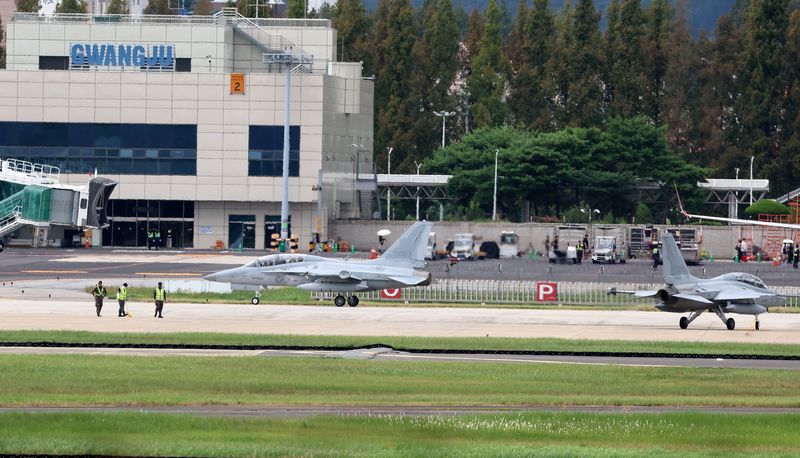
At a regular briefing on the 2nd, Ministry of National Defense spokesperson Jeong Bit-na said, “We are coordinating with the U.S. side on including the temporary relocation of USFK facilities located within Gwangju Military Airport in the comprehensive agreement on COB relocation that has been under discussion.” Jeong added, “We are maintaining close communication with the U.S. military to ensure there are no disruptions to the development of a national industrial complex in the Honam region,” and said, “Once consultations are complete, we plan to promptly seek the National Assembly’s ratification consent for the comprehensive agreement and proceed with relocating U.S. military facilities and returning the areas made available to U.S. forces.”■Progress in talks on South Korea-U.S. “COB comprehensive agreement”; discussions also cover suspending U.S. military facility construction work valued in the 60-billion-won rangeA COB (Combined Operating Base) is a key military facility where U.S. Air Force assets deploy in the event of a contingency on the Korean Peninsula and operate alongside South Korean forces. Even in peacetime, the U.S. military uses some areas within the bases that have been made available for its use. Five air bases in the country are currently designated and managed as COBs: Daegu, Gwangju, Cheongju, Gimhae and Suwon.
South Korean and U.S. working-level officials provisionally agreed on the text of the comprehensive agreement in October 2024. However, talks had remained stalled until recently, as the two countries were unable to bridge their differences over a revised draft returned by the U.S. State Department in November 2025. Recent reports say progress has been made in negotiations over the wording.
In this connection, Wi Sung-lac, head of Cheong Wa Dae’s Office of National Security (ONS), also supported the government’s optimistic outlook at a press briefing on the 30th of last month, saying, “Agreement in principle on the broad framework of the comprehensive agreement between South Korea and the United States on military airport relocation is almost complete.” Wi said, “The U.S. also hopes to include Gwangju Base in the proposed comprehensive agreement and address it at the same time, and our government has no objection,” adding, “Given the recent progress on several key issues that had been delayed, once the agreement is concluded, a broad institutional framework will be in place for the overall relocation of military airports, including Gwangju Base.”
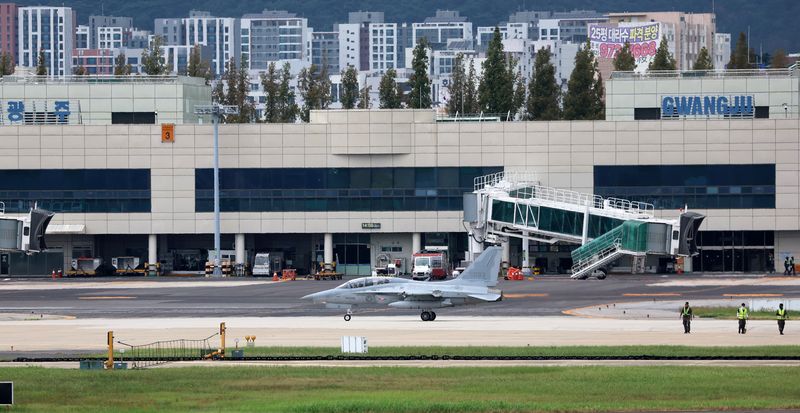
The government is currently pursuing the relocation of Gwangju Military Airport to Muan County in order to secure a site early for a semiconductor cluster in the Honam region, one of its three mega-projects. To move the project forward quickly, it has set a timeline to temporarily relocate facilities at Gwangju Base to other bases by mid-2028. This makes the temporary relocation of U.S. military facilities at the base unavoidable, and the specific procedures and conditions are expected to be included in the text of the comprehensive agreement.
The parties have also taken up how to handle ongoing facility upgrade work at U.S. military facilities within Gwangju Military Airport, with a total project cost in the 60-billion-won range. The project, established before the announcement of the national industrial complex site selection, is an in-kind support project under the defense cost-sharing arrangement. Work currently underway includes construction of an aviation-fuel refueling facility (58.6 billion won), repairs to an engineer storage facility (3.6 billion won), and repairs to a steel water tank (1.3 billion won).
The spokesperson said, “The work is at an extremely early stage, with progress currently at around 0.2%,” adding, “To prevent the waste of valuable public funds and avoid disrupting the industrial complex schedule, we are discussing various options with the U.S. side during negotiations on the comprehensive agreement, including suspending construction.”
In a phone interview with this publication, an expert at a foreign affairs and security research institute noted, “The government is moving quickly with the aim of wrapping up negotiations on the text of the comprehensive agreement by year-end. But for it to take root institutionally, it must go through demanding legal procedures on the U.S. side, so it is important to take a long-term view to avoid public misunderstanding or false impressions.”
The expert drew particular attention to the control over overseas base budgets under the U.S. National Defense Authorization Act (NDAA). Under U.S. law, changes to, closures of or relocations of facilities at overseas U.S. military bases, as well as adjustments to related budgets—including in-kind support under the defense cost-sharing arrangement—must satisfy U.S. congressional hearing requirements and the approval or reporting procedures under the NDAA. This could make it structurally difficult to align U.S. legal procedures with the South Korean government’s unilateral schedule for advancing the industrial complex project early, the expert said.
The U.S. administration’s detailed internal legal review is also seen as a variable. In the past, reviews of agreement texts by the State Department’s Office of the Legal Adviser and internal deliberations among relevant departments alone have often taken more than a year when South Korea and the United States have concluded agreements on base relocation or defense cost-sharing. This is also part of the reason talks on the current comprehensive agreement had stalled for a year until recently, following the U.S. State Department’s return of a revised draft in November 2025.
The expert advised, “The United States conducts its review by giving top priority to considerations such as the ‘Operational Flexibility’ of USFK and the efficiency of base operations.” The expert added, “Given this sensitive period, when key issues across the South Korea-U.S. alliance, including the transition of wartime operational control, are intertwined, the government and military authorities should objectively assess the U.S. Congress’s prerogatives and procedural timelines and maintain a carefully calibrated response to minimize diplomatic risks.”
Meanwhile, the COB comprehensive agreement, which will be concluded in the form of a treaty between countries, will enter into force only after the National Assembly of the Republic of Korea gives its consent to ratification. The government is expected to begin the process of seeking the Assembly’s consent as soon as negotiations on the text are completed by year-end.
[email protected] Lee Jong-yoon Reporter