China’s Navy Surpasses 400 Warships, Challenging U.S. Maritime Dominance [Lee Seok-woo’s China24]
- Input
- 2026-11-02 16:52:07
- Updated
- 2026-11-02 16:52:07
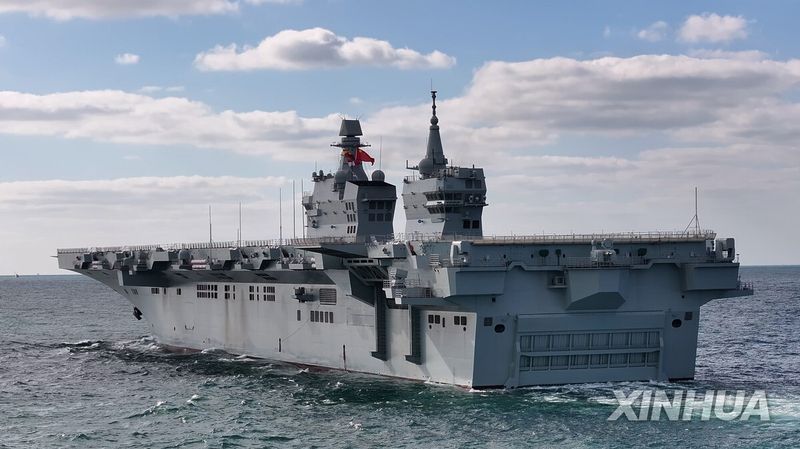
[Financial News] An analysis says China’s naval fleet, including submarines, has surpassed 400 vessels, posing a threat to U.S. maritime dominance.
The Wall Street Journal (WSJ), citing U.S. military data on the 1st (local time), noted that China’s naval fleet, including submarines, has surpassed 400 vessels—about 35% more than the U.S. Navy by number of vessels.
China is challenging U.S. maritime dominance by rapidly expanding its warship fleet and extending its blue-water operations, drawing on its powerful shipbuilding industry.
The newspaper noted that China’s strong capacity to build large numbers of commercial vessels is supporting the expansion of its navy. According to data from S&P Global Market Intelligence cited by WSJ, China accounted for 52.6% of global cargo vessel construction last year by gross tonnage. South Korea accounted for 27.6%, and the United States 0.01%. China is also using this production capacity to build warships quickly.
Cargo vessel construction last year: China accounted for 52.6% of global gross tonnage; the United States, 0.01%
According to WSJ, China has added 71 major warships and submarines since 2020, including 19 last year.
China is also acquiring larger, more capable vessels in succession. Its fleet of Type 055 vessels, each in the 13,000-ton class, has grown to 10 since the first entered service in 2020. China classifies them as destroyers, while the United States classifies them as guided-missile cruisers because of their size and firepower. The Zunyi, a vessel of this class, sailed around Australia early last year and held live-fire drills, prompting civilian flights to be rerouted.
The United States, by contrast, is struggling to expand its fleet because its shipbuilding industrial base has weakened. A recent report by the U.S. Department of the Navy noted that although the budget for shipbuilding has doubled over the past 20 years, the number of vessels has not risen above the 2003 level. Programs such as frigate construction and extending the service lives of aging cruisers have also run into difficulties.
China is also expanding its carrier force. It currently has three aircraft carriers and is building a fourth. Western experts believe the fourth will be nuclear-powered. Its third carrier, the Fujian, is equipped with an electromagnetic catapult that accelerates carrier-based aircraft for takeoff.
A U.S. Department of Defense report from last year cited by WSJ assessed that China aims to increase its carrier fleet to nine by 2035. The United States has 11 aircraft carriers, and WSJ reported that the U.S. carrier count is expected to remain unchanged over that period.
China’s carriers are also operating over a wider area. In June last year, China sent two carriers simultaneously into the open waters of the western Pacific for the first time, where they held an exercise playing opposing sides. Last year, it also sent a carrier beyond the Pacific islands linking key U.S. military hubs such as Guam for the first time.
WSJ analyzed that China’s core military objectives are to control the Yellow Sea, East China Sea and South China Sea, absorb Taiwan, and prevent U.S. military intervention. The area around the “First Island Chain,” stretching from Japan through Taiwan to the Philippines, is a key theater in this U.S.-China rivalry.
As many as 100 Chinese naval vessels operate along major trade and shipping routes in Asia. Also active alongside the navy are the coast guard, fishing boats that could serve as a maritime militia in an emergency, and research vessels. WSJ reported that these operations, involving a variety of vessels, are increasing the burden on the United States and its allies, who must track and respond to them.
WSJ noted that the United States still leads in the total tonnage of its naval fleet and retains an advantage in operating aircraft carriers.
Xi Jinping’s “Maritime Power” ... Combining Commercial Maritime Interests with Military Objectives
China’s maritime expansion is intertwined with President Xi Jinping’s national strategy. Soon after taking office as president in 2013, Xi stressed to Communist Party leaders that China should become a “maritime power.” WSJ analyzed that Xi has combined commercial maritime interests with military objectives.
China has funded port construction around the world, including in Sri Lanka and Peru. WSJ noted that these ports support Chinese trade while also offering potential footholds for use by the navy.
China has also expanded its direct military footholds. Starting around 2014, it began turning reefs in the South China Sea into artificial islands and military bases, and later opened its first overseas military base in Djibouti, East Africa. It is also expanding docks, ship repair facilities and weapons storage facilities at naval bases along its own coast.
The U.S. State Department criticized China for using its maritime capabilities to display military power, press broad territorial claims and threaten neighboring countries. The United States also said it was committed to upholding freedom of navigation and standing with its allies and partners.
China funds ports around the world, including in Sri Lanka and Peru ... potential military footholds
Ryan Martinson, an associate professor at the U.S. Naval War College, explained that China is regularizing its operations beyond the First Island Chain and training to keep U.S. forces from approaching the Chinese mainland if war breaks out. The analysis is that China is seeking to push as far east as possible the area in which it prepares for a maritime confrontation with the United States.
The White House told WSJ that the Trump administration is working to restore U.S. shipbuilding capacity and pursuing workforce development and regulatory reform. White House spokesperson Anna Kelly emphasized that President Trump has made restoring U.S. maritime dominance a priority.
WSJ highlighted two shipyards on Changxing Island near Shanghai. They are building advanced warships while also producing gas carriers and large container ships ordered by overseas customers. An analysis of satellite images from May this year presented by WSJ showed two landing ships, two cruisers, three destroyers and two frigates being built or undergoing maintenance at the same time.
[email protected] Lee Seok-woo, International Affairs Specialist Reporter