“The wound has healed, so why does it still hurt?” ... Protein that exacerbates chronic pain identified [Health LAB]
- Input
- 2026-11-03 05:00:00
- Updated
- 2026-11-03 05:00:00
[Financial News] Why can even light touch cause severe pain after nerve damage? Researchers in South Korea have identified the role of a specific protein that amplifies pain after nerve injury. In experiments with mice, suppressing the protein’s activity eased pain hypersensitivity, and in some experiments the effect lasted for up to six weeks. The findings are expected to offer a clue to developing new treatments for neuropathic pain that is difficult to control with existing painkillers.
According to the Gwangju Institute of Science and Technology (GIST) on the 3rd, a research team led by Professor Jeong Ui-heon of GIST’s Department of Biomedical Science and Engineering found that IGFBPL1, a protein that increases in sensory neurons after peripheral nerve injury, is a key regulator involved in the onset and persistence of neuropathic pain.
IGFBPL1 (insulin-like growth factor-binding protein-like protein) is a protein related to IGF (insulin-like growth factor), which regulates cell growth and development, and is structurally similar to binding proteins that regulate IGF activity. It has been known to be involved in nerve growth and immune regulation in the central nervous system, including the brain and retina, but this is the first time its role in regulating pain in peripheral sensory nerves has been identified.
Damage to peripheral nerves caused by diabetes, cancer treatment, trauma or surgery can lead to “neuropathic pain,” which can involve pain from even light touch as well as burning or tingling sensations. It is estimated to affect 7%–10% of adults worldwide. Because existing drug treatments, such as antidepressants and anticonvulsants, often do not adequately control the pain, new therapeutic targets need to be identified.
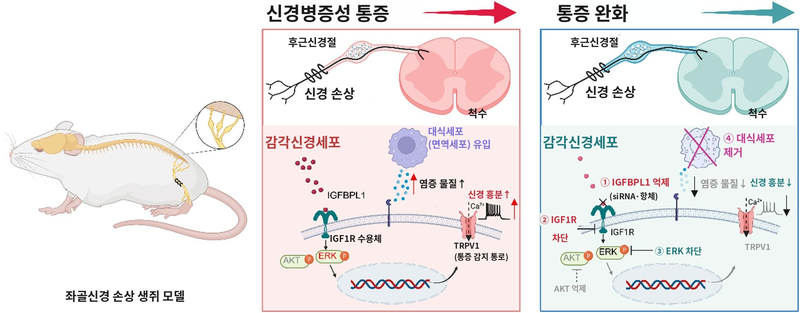
The research team induced neuropathic pain in mice using a chronic constriction injury (CCI) model, in which the sciatic nerve is loosely tied to compress it, and analyzed changes in IGFBPL1 in the dorsal root ganglion (DRG), a relay station beside the spinal cord that transmits sensory signals. The analysis showed that IGFBPL1 expression increased after nerve injury, peaked on day 7 and remained high through day 21.
A substantial proportion of the sensory neurons expressing IGFBPL1 were found to be nociceptive neurons, which detect pain. IGFBPL1 expression also increased in a sciatic nerve crush (SNC) model, in which the sciatic nerve is crushed and injured.
The team then directly injected into the dorsal root ganglia (DRG)—clusters of neurons beside the spinal cord that transmit sensory information—short interfering RNA (siRNA) fragments that selectively suppress IGFBPL1 gene expression. siRNA is a short genetic material that inhibits the activity of a specific gene.
As a result, pain hypersensitivity in response to pressure on the paw or heat was markedly reduced. The effect also lasted for up to six weeks after injury in a partial peripheral nerve injury (SNI) model, in which some branches of the sciatic nerve are cut while the others are left intact. Injecting a neutralizing antibody that blocks IGFBPL1 activity also temporarily reduced pain hypersensitivity.
By contrast, additional injections of IGFBPL1 worsened pain hypersensitivity in mice with nerve injuries. In healthy mice without nerve injuries, however, injecting IGFBPL1 did not change their pain responses. This showed that IGFBPL1 amplifies pain hypersensitivity after nerve injury rather than causing pain under normal conditions.
In tracing how it works, the research team found that IGFBPL1 activates ERK, an intracellular signaling protein, through IGF1R, a receptor on the surface of neurons.
IGF1R expression also increased in the dorsal root ganglia after nerve injury, and reducing its expression or blocking its function greatly reduced pain hypersensitivity. In particular, when IGF1R was blocked, injecting IGFBPL1 produced almost no pain hypersensitivity. Blocking the ERK signaling pathway also greatly reduced the response.
The team also found that IGFBPL1 increases the responsiveness of TRPV1, a pain-sensing channel that responds to high temperatures and capsaicin.
Professor Jeong Ui-heon said, “This study’s new treatment strategy of locally targeting the dorsal root ganglion, which relays pain signals, could offer a clue to developing treatments for neuropathic pain that do not rely on opioid painkillers,” adding, “Since this study focused primarily on male mice, we plan to continue follow-up validation in female animals, various models of pain conditions—including neuropathy induced by diabetes and anticancer drugs—and human tissues.”
The study was published online on October 8 in the international neuroscience journal Journal of Neuroinflammation.
[email protected] Yeon Ji-an Reporter