Gwangju Special Metropolitan City Office of Education to Build Nationwide Education Alliance Ahead of Student Independence Movement Centennial
- Input
- 2026-11-02 15:51:59
- Updated
- 2026-11-02 15:51:59
【Financial News, Jeonnam-Gwangju—Reporter Hwang Tae-jong】The Jeonnam-Gwangju Unified Special Metropolitan City Office of Education (Gwangju Special Metropolitan City Office of Education) will build a nationwide education alliance to raise the historical profile of the Student Independence Movement ahead of its centennial in 2029.
The plan is to strengthen communication with historians and textbook authors to ensure that the historical significance of the Student Independence Movement is fully reflected in elementary, middle and high school history textbooks, and to build a cooperative ecosystem with education offices nationwide, centered on the National Council of Superintendents of Education of Cities and Provinces.
The Student Independence Movement was a large-scale anti-Japanese protest that began in Gwangju on November 3, sparked by an incident at Naju Station on October 30, 1929, during Japanese colonial rule, in which Japanese middle school students harassed Korean female students. The movement spread nationwide and unfolded over five months as a large-scale anti-Japanese movement involving approximately 54,000 people. November 3 has been designated Student Independence Movement Memorial Day in its commemoration.
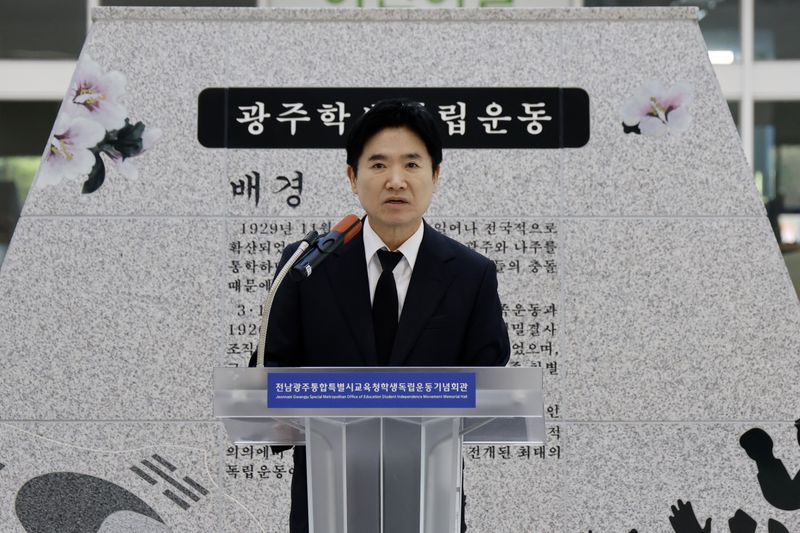
On the 2nd, Gwangju Special Metropolitan City Superintendent of Education Kim Dae-jung held the K-Democracy Education Vision Proclamation Ceremony at the Student Independence Movement Memorial Hall and announced four initiatives to raise the historical profile of the Student Independence Movement.
The four initiatives comprise plans for education and commemorative projects, including: establishing a nationwide education solidarity network for the 2029 centennial of the Student Independence Movement; creating a 'Righteous History Experience Belt' linking schools in the movement's birthplace with historical sites; building a network of 320 schools and applying for national honors for meritorious individuals yet to be identified; and building a 'K-Democracy Hall' and seeking inscription on UNESCO's Memory of the World Register.
Superintendent Kim Dae-jung emphasized, "The Student Independence Movement is one of Korea's three major independence movements, alongside the March First Movement and the June Tenth Movement, but it has not been sufficiently recognized in light of its historical significance. We will go beyond one-off commemorative events and pursue ongoing efforts to honor the movement and provide education about it."
First, in 2029, the centennial year of the Student Independence Movement, the Gwangju Special Metropolitan City Office of Education will jointly proclaim a 'Declaration for the 100th Anniversary of the Student Independence Movement,' with young people from across the country taking part, and hold a 'National Youth Peace and Independence Culture Festival' as a cultural and artistic response. It will also support the expansion of the Student Independence Movement 100th Anniversary Commemorative Projects Preparatory Committee, which includes participants from the public, private and academic sectors, into a national steering committee at the pan-government level.
In addition, a Democracy History Learning Center will open this December so students can experience the history of the Student Independence Movement, the April 19 Revolution and the May 18 Democratization Movement through immersive content such as artificial intelligence (AI) and augmented reality (AR), and develop their capacity as democratic citizens through discussions and student self-governance activities. The office will then create the Jeonnam-Gwangju Righteous History Experience Belt, linking three hubs, including Hwajeong Cave, a historic site of Japanese military facilities, and the Student Independence Movement Memorial Hall.
It will also establish a Righteous History Trail linking sites and schools associated with the anti-Japanese movement in the Jeonnam-Gwangju region, including the former Naju Station, the site of the former Gwangju Station, Gwangju Jeil High School, Jeonnam Girls' High School, Gwangju Natural Science High School, Moksang High School and Yeosu Seo Elementary School. Field trips and project-based classes will be run in connection with the curriculum.
In particular, in partnership with 320 schools in Korea and abroad that took part in the Student Independence Movement, the office will distribute school-specific history learning materials about the movement and expand the posthumous awarding of 'honorary diplomas for righteous predecessors of the Student Independence Movement.' It will also install plaques reading '1929 Anti-Japanese Learning Site' at these schools to pass on learning in the classroom.
Superintendent Kim said, "Following our application to the Ministry of Patriots and Veterans Affairs on August 15 for state honors for 100 student independence activists who have not yet received them, we plan to continue submitting applications as we uncover additional historical records."
The Gwangju Special Metropolitan City Office of Education will also build a K-Democracy Hall to preserve records related to the Student Independence Movement and use them for education. It also plans to create a Digital History Education Archive containing the names of 4,723 people confirmed to have participated in the movement to date and approximately 24,000 records of media coverage, among other materials. The office will uncover and collect further historical records and make them available for use as educational materials in schools nationwide.
In addition, the office will work with relevant organizations, including the Korea Heritage Service, to seek inscription of records of the Gwangju Student Independence Movement on UNESCO's Memory of the World Register, and will explore a joint inter-Korean inscription over the longer term.
[email protected] Hwang Tae-jong Reporter