“Selling like hot cakes even at six times the local price”... K-strawberries in Southeast Asia surge in exports
- Input
- 2026-11-04 09:04:45
- Updated
- 2026-11-04 09:04:45
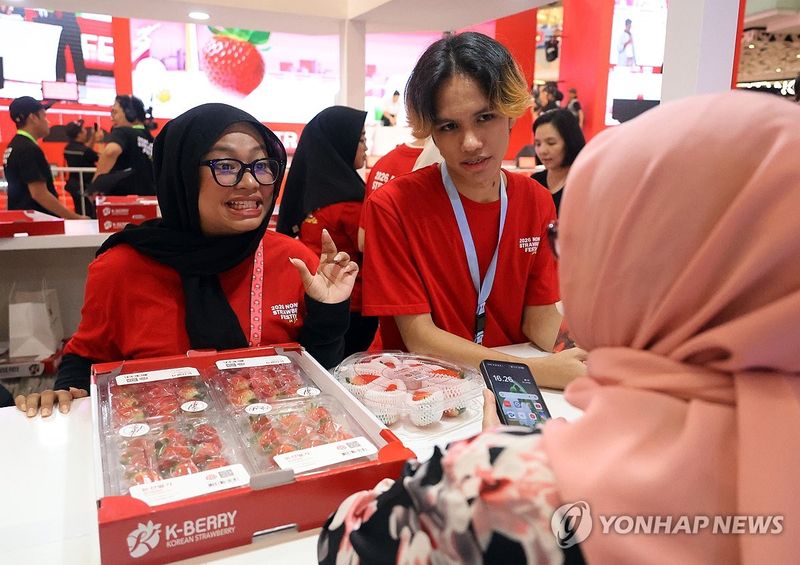
[Financial News] South Korean strawberries, a quintessential winter fruit, are establishing themselves as premium produce in overseas markets and sustaining export growth. Despite costing five to six times as much as locally grown strawberries in Southeast Asia, their high sweetness and large size are generating buzz on global social media and driving up demand.
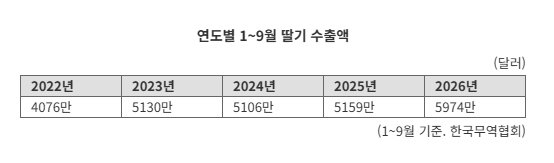
The Korea International Trade Association said on the 4th that cumulative strawberry exports from January to September this year reached $59.74 million, up 15.8% from $51.59 million in the same period last year. For the January-to-September period, strawberry exports have steadily expanded, from $40.76 million in 2022 to $51.30 million in 2023, $51.06 million in 2024 and $51.59 million last year. This year’s figure is nearing the $60 million mark. Major export markets include Thailand, Singapore, Hong Kong and Vietnam, among other destinations in Southeast Asia.
In Southeast Asian markets, South Korean strawberries sell for around 16,000 to 21,000 won per 300 grams. Compared with locally grown strawberries, which cost around 4,000 to 7,000 won per 500 grams, they are a high-priced fruit—three to five times more expensive by weight—but so popular that sellers struggle to keep them in stock.
The secret to the explosive popularity of South Korean strawberries despite their high price is their exceptional taste and quality. Their average sugar content is 11 to 14 degrees Brix, up to roughly twice that of locally grown strawberries in Southeast Asia, at 7 to 8 degrees Brix. Strawberries grown in Southeast Asia’s hot, humid climate year-round lack sweetness and are highly acidic, so they are consumed mainly for processing into products such as jam and smoothies. South Korean strawberries, by contrast, have juicy flesh thanks to large day-to-night temperature swings, while ongoing cultivar development—including Maehyang, Seolhyang, the golden thread that joins our hearts and King's Berry—has further enhanced their sweetness and aroma.
A mukbang video featuring Korean strawberries, posted by a well-known Vietnamese TikToker, has surpassed 15.7 million views, spurring local consumers’ interest in buying them.
The expansion of smart farms is also considered a factor behind rising exports, as it has significantly increased winter production of high-quality strawberries. By precisely controlling growing conditions through smart farms, producers can manage strawberries—which are sensitive to temperature and humidity and soften easily—and reliably harvest top-grade fruit of uniform size and shape. Quality-control efforts by the government and local authorities have also helped, including cold-chain systems that maintain low-temperature distribution and the designation of dedicated export complexes.
Industry officials expect export performance to improve further this winter, when full-scale shipments of winter strawberries begin, given that exports had already posted strong growth through September, which includes the off-season.
Lee Eun-hee, a professor in the Department of Consumer Studies at Inha University, said, “In overseas markets such as Southeast Asia, trying premium Korean fruit and posting about it amid the K-content and social media mukbang craze has itself become a consumer trend. The distinctive sweetness of Korean strawberries, combined with a stable production base enabled by smart farms, will further boost overseas demand for K-strawberries this winter, their peak season.”
[email protected] Park Kyung-ho Reporter