“All-Out Response to Pine Wilt Disease” ... Korea Forest Service Holds Meeting of National Control Response Team
- Input
- 2026-11-02 15:09:15
- Updated
- 2026-11-02 15:09:15
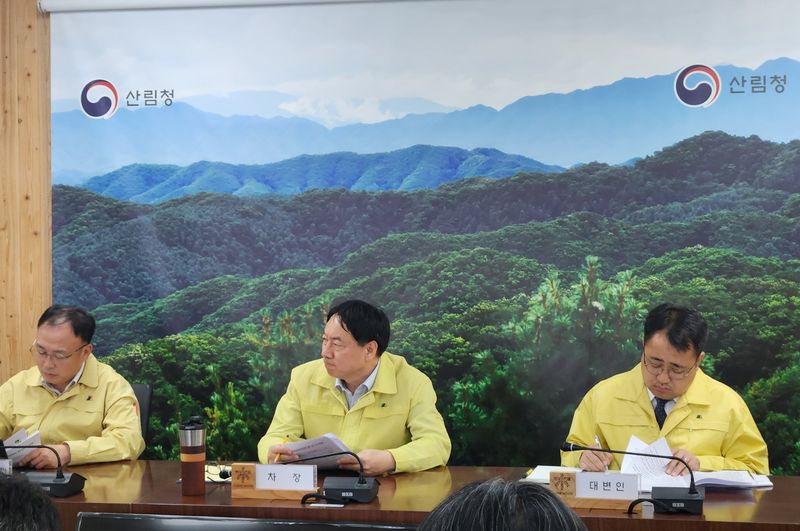
The Korea Forest Service said it held a National Control Situation Management Meeting of the National Pine Wilt Disease Control Response Team at Government Complex Daejeon on the 2nd, where it comprehensively reviewed regional control strategies and on-site response efforts. The meeting was organized to share the team’s operational performance over the past two weeks and its plans going forward, as well as to review local governments’ progress in implementing their control plans and the difficulties they face on the ground, with regional coordinators leading the discussions.
That day, the Korea Forest Service shared the latest pine wilt disease control policies, nationwide outbreak figures, and effective surveillance and control techniques with regional support teams. It plans to further strengthen its field-focused support system and continue uniform, efficient control management at the national level.
Pine wilt disease is a devastating forest pest and disease spread by the vector insects solsuyeom-suyeom-haneulso and bukbang-suyeom-haneulso. When trees are infected, the channels that carry water become blocked, causing pine trees to die in 100% of cases. In particular, rising temperatures and drought linked to recent climate change have lengthened the vectors’ period of activity, while affected areas are expanding into higher elevations and areas where the trees grow in dense natural stands. As a result, the importance of proactive surveillance and initial control measures has grown more than ever.
Lim Ha-su, deputy administrator of the Korea Forest Service, said, “The National Control Response Team must closely monitor local governments’ progress in controlling the disease and quickly identify problems on the ground so that its work leads to tangible control results.” He added, “We will do everything we can to stop the spread of the damage through thorough surveillance, strategic control measures, and close cooperation among relevant agencies.”
[email protected] Kim Won-jun Reporter