“Sales are strong, but...” Naver and Kakao diverge; AI monetization starts now
- Input
- 2026-11-02 16:28:09
- Updated
- 2026-11-02 16:28:09

[Financial News] Naver and Kakao are expected to post contrasting profitability results for the third quarter. Naver’s operating profit is expected to decline despite higher revenue, as it faces cost pressures from AI infrastructure investment and business expansion. Kakao, by contrast, is expected to improve profitability on the back of growth in its advertising and commerce businesses and greater cost efficiency. While both companies see AI as a future growth driver, they differ in their investment burdens and monetization strategies: Naver is focusing on enhancing search and shopping and expanding infrastructure, while Kakao is prioritizing the expansion of services built around KakaoTalk.
According to industry sources on the 2nd, Kakao will announce its third-quarter results on the 5th, while Naver will do so on the 12th of this month.
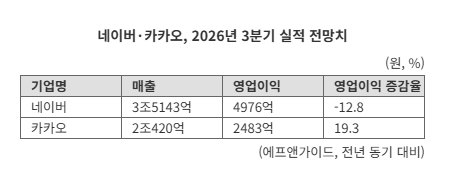
FnGuide, a financial information provider, estimates Kakao’s consolidated operating profit for the third quarter at 248.3 billion won, up 19.3% from the same period last year. Advertising and commerce businesses built around KakaoTalk are expected to support improved results. Talk Biz businesses, including business messaging and display ads, provide a stable revenue base, while commerce services such as KakaoTalk Gift and Talk Deal are also contributing to results.
Kakao has laid the groundwork to develop AI agents into a new growth driver while maintaining a stable revenue base in existing businesses such as KakaoTalk advertising and commerce. One of Kakao’s strengths is that it can leverage KakaoTalk’s existing user base and service touchpoints rather than building a separate platform and attracting users from scratch. If AI agents move beyond conversation and information searches to facilitate real transactions, such as reservations, payments and product purchases, they could also create synergies with Kakao’s existing advertising and commerce businesses. However, concrete service enhancements and monetization plans are seen as key to sustaining growth over the medium to long term.
Naver, by contrast, is expected to see profitability weaken despite top-line growth. Its third-quarter revenue is forecast at 3.5143 trillion won, up 12% from the same period last year, and is expected to extend its record of posting its highest quarterly revenue for six consecutive quarters since the second quarter of last year. Operating profit, however, is forecast to fall 12.8% to 497.6 billion won.
Naver’s declining profitability is attributed to the combined cost pressures of AI infrastructure investment and expansion of its existing businesses. The company is acquiring more graphics processing units (GPUs) needed to run its own AI services and data centers, increasing related depreciation expenses. The rollout of Npay Connect terminals to expand its offline payments business, along with commerce promotions and marketing costs, is also seen as driving up operating expenses. The reduction in operating days for advertising and commerce during the Chuseok holiday in September, as well as one-off costs such as sports broadcasting rights fees, is also believed to have weighed on results.
Naver is integrating AI into search and commerce to strengthen the competitiveness of its existing services, while securing infrastructure such as GPUs and data centers to expand into the corporate and public-sector markets. The company believes that large-scale infrastructure investment could become a new pillar of growth if it leads to actual customer acquisition, higher utilization rates and revenue growth.
Ultimately, the companies’ medium- to long-term competitiveness depends on how quickly they can turn their different AI business strategies into revenue. Naver’s key challenge is achieving business results that can recoup its increased infrastructure investment, while Kakao’s is generating tangible revenue from AI services by leveraging its existing user base.
An industry source said, “The difference in the two companies’ results stems more from differences in how they secure future growth drivers and in their investment strategies than from a simple ranking of their business competitiveness.” The source added, “Whether each can turn its distinct investment strategy into actual revenue will be a factor determining their medium- to long-term competitiveness.”
[email protected] Jang Min-kwon Reporter