Loans deemed “unrecoverable” by four major financial groups top 3 trillion won for first time, stoking asset-quality concerns
- Input
- 2026-11-02 16:17:34
- Updated
- 2026-11-02 16:17:34
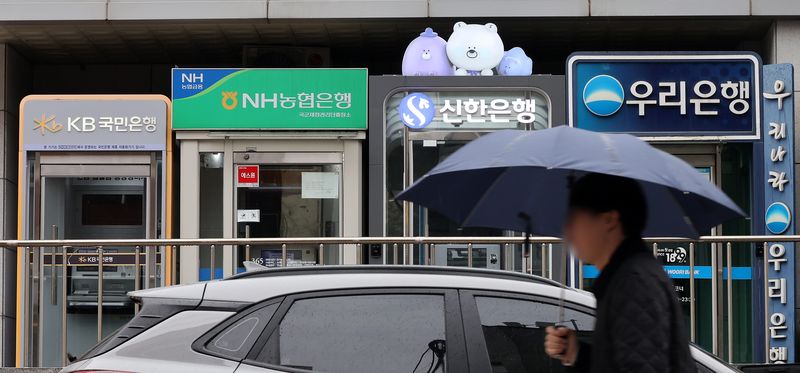
[Financial News] The amount of loan claims that the four major financial groups consider effectively unrecoverable topped 3 trillion won for the first time ever. Total nonperforming loans have grown by more than 2 trillion won since the start of this year, while the ratio of provisions set aside against bad loans has fallen at all four groups. Analysts say that, despite major financial institutions continuing to post record results, mounting delinquency burdens—particularly among small and midsize businesses and the self-employed—have raised warning signs over asset-quality management.
Estimated losses top 3 trillion won for the first time; NPLs also exceed 14 trillion won
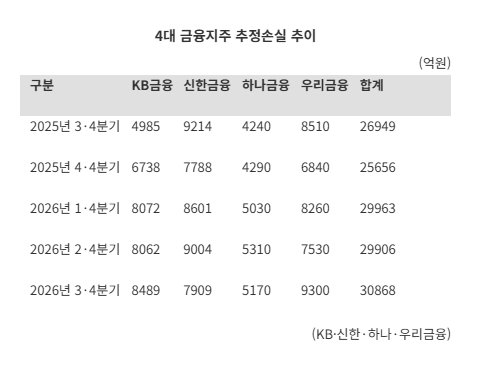
According to the financial industry on the 2nd, estimated losses at the four major financial holding companies—KB, Shinhan Financial Group, Hana and Woori Financial Group—totaled 3 trillion 86.8 billion won at the end of the third quarter this year. That was up 391.9 billion won (14.5%) from the same period last year (2 trillion 694.9 billion won). The figure also rose by 95.7 billion won (3.2%) from the previous quarter (2 trillion 991.1 billion won), reaching a record high.
Estimated loss is the lowest asset-quality tier in the five-stage classification financial companies use for their credit exposures: normal, precautionary, substandard, doubtful and estimated loss. These are claims deemed effectively unrecoverable and account for part of nonperforming loans (NPLs), which are classified as substandard or below.
Among the financial holding companies, Woori Financial Group had the largest estimated losses, at 930 billion won, up 177 billion won (23.5%) from the previous quarter (753 billion won). KB Financial Group also saw the figure rise during the same period, from 806.2 billion won to 848.9 billion won, an increase of 42.7 billion won (5.3%). By contrast, estimated losses fell at Shinhan Financial Group, from 900.4 billion won to 790.9 billion won, and at Hana Financial Group, from 531 billion won to 517 billion won.
The total volume of nonperforming loans also expanded. The four financial holding companies had about 14.32 trillion won in NPLs at the end of the third quarter, up about 2.39 trillion won from the end of last year.
The increase in nonperforming loans was particularly pronounced at Hana Financial Group. Its NPL balance rose 35.0% from the end of last year to 4.2535 trillion won, the largest among the four financial holding companies. This far outpaced the 3.8% growth in total lending over the same period. Its NPL ratio also climbed 0.20 percentage points, from 0.73% in the third quarter last year to 0.93% this year. The ratios at Shinhan Financial Group and Woori Financial Group each rose 0.02 percentage points, while KB Financial Group’s fell 0.05 percentage points.
NPL coverage ratios fall across the board
As nonperforming loans increased, the NPL coverage ratios—which indicate the financial holding companies’ capacity to absorb losses—fell across the board. The NPL coverage ratio measures provisions for loan losses against the balance of substandard-and-below loans. A lower ratio means that provisions set aside against nonperforming loans have become smaller relative to the loans’ balance.
Woori Financial Group’s NPL coverage ratio posted the largest decline, falling 17.35 percentage points from 130.04% in the third quarter last year to 112.69% in the same quarter this year. Hana Financial Group’s ratio dropped 14.84 percentage points, from 105.03% to 90.19%, making it the only one of the four financial holding companies to fall below 100%. Hana Financial Group recorded a ratio of 100% or less in every quarter this year. In the third quarter this year, the ratios at Shinhan Financial Group (115.48%) and KB Financial Group (129.26%) were down 8.61 and 4.14 percentage points, respectively, from a year earlier.
This reflects the fact that provisions have not kept pace with the growth in nonperforming loans. For example, from the end of last year through the third quarter this year, Hana Financial Group increased provisions for loan losses related to loan receivables by 10.9%, while its NPL balance grew 35.0% over the same period.
There are concerns in the financial industry that deteriorating corporate loans and rising delinquency rates among small and midsize businesses and the self-employed could weigh on future asset-quality management. At the end of the third quarter this year, the simple average delinquency rate on SME loans at the four major banks was 0.57%, its highest level in nine years and six months, since the first quarter of 2017 (0.59%).
“Amid high interest rates, small and midsize businesses appear to be struggling with weak domestic demand,” a financial industry official said. “With the NPL sales market having contracted, it is difficult to speed up the resolution of nonperforming loans. And with further base-rate hikes also expected, it is true that pressure on asset quality has increased.”
[email protected] Seo Ji-yun Reporter