Enter an industry to get recommended factory sites... Preliminary permit diagnosis now available on smartphones, too
- Input
- 2026-11-03 06:00:00
- Updated
- 2026-11-03 06:00:00
[Financial News] Even businesses unsure where to build a factory can now get recommendations down to the address of a candidate site by entering just their industry and desired criteria.
According to the Ministry of Land, Infrastructure and Transport (MOLIT) and the Ministry of Trade and Industry on the 3rd, the latest revamp will make it easier for businesses and the public to find land for factories and to check relevant regulations and permitting requirements in advance.
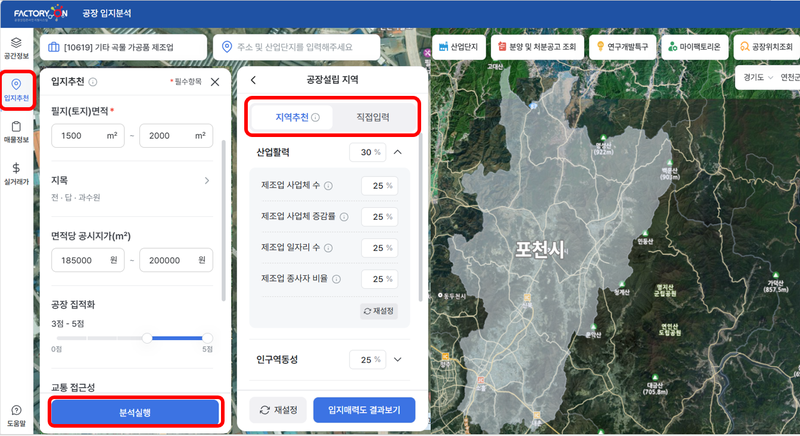
The biggest change is that the service now makes recommendations as well as assessments. Even without specialized knowledge of factory construction, users can have the system analyze site attractiveness in each region and automatically select the best location. Site attractiveness is calculated by weighting indicators including industrial vitality, such as the number of manufacturing businesses and jobs; population dynamics, such as population growth rate and the share of young people; regional capacity, such as the level and volatility of officially assessed land prices, average income and fiscal self-reliance; and living infrastructure, such as schools, medical facilities and childcare centers. By setting criteria such as location, area, land category and officially assessed land price to suit the type of factory they plan to build, users can receive recommendations down to the specific address in one step.
Users can now check sites on the spot, too. Until now, preliminary assessments were available only on office PCs, but users can now check regulations and receive assessments on a smartphone while visiting candidate sites. The lookup, assessment and recommendation functions are available on the Factory-On mobile website. However, detailed analyses and simulations using three-dimensional spatial data are available only on PCs because of hardware requirements.
The service identifies and analyzes the laws and regulations that apply to candidate factory sites and assesses whether construction is possible. Users can also simulate building placement, earthwork volumes, slope and the area eligible for permits based on the building coverage and floor area ratios, using three-dimensional spatial data that reproduces the actual terrain, to gauge the optimal location in advance. The service was created by linking MOLIT’s Digital Twin National Land platform (V-World, K-GeoP) with the Ministry of Trade and Industry’s Online Factory Establishment Support System (Factory-On). It has been available to the public and local government officials since March 10, 2025.
The service was introduced against a backdrop of lengthy and complex factory permitting procedures. Factory establishment permits typically take anywhere from six months to more than a year, and businesses have cited a lack of information and complicated administrative procedures as challenges. When the service was launched, local governments projected that using preliminary assessments could cut the permitting period by three months or more.
Lee Dae-seop, Director General for National Land Information Policy at MOLIT, said, “The Factory Permitting Pre-Diagnosis Service is a leading example of innovation that has brought digital twins and spatial information into everyday life, taking the benefits and convenience of public administrative services to the next level.” He added, “We plan to expand the service to other areas involving building and land permits.”
Lee Jae-seok, Director General for Regional Economic Policy at the Ministry of Trade and Industry, said, “Service enhancements and other improvements have made it easier and more convenient for the public and businesses to use the service, from finding factory sites to checking permitting requirements.” He added, “We will continue working with MOLIT and local governments to develop the system so that anyone, anywhere in the country, can receive one-stop support from site selection through permitting.”
[email protected] Jeong Gyeong-su Reporter