AI to balance traffic at baseball stadiums... Samsung Electronics and KT conduct field trials
- Input
- 2026-11-02 14:23:21
- Updated
- 2026-11-02 14:23:21
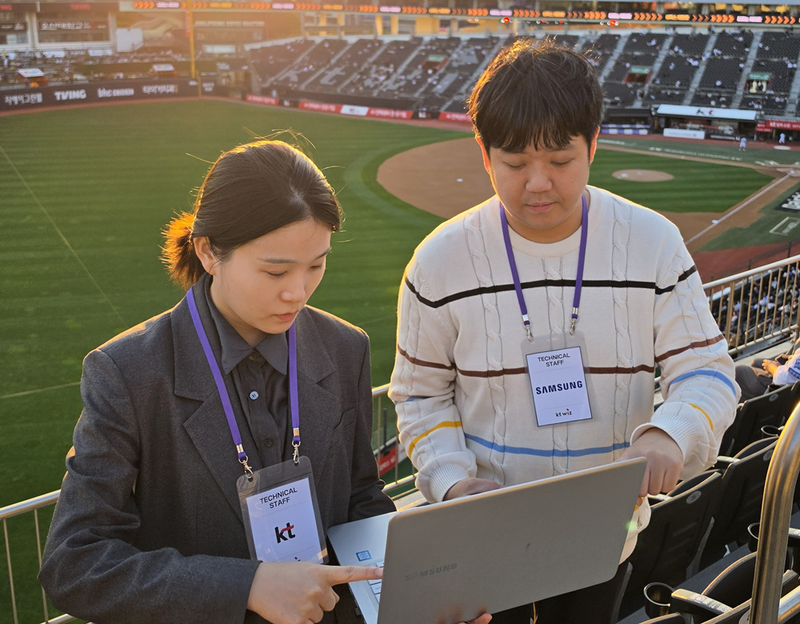
[Financial News] Samsung Electronics and KT have validated on a commercial network technology that uses artificial intelligence (AI) and digital twins to automatically adjust base station settings and reduce traffic concentration. When applied at a crowded baseball stadium, the technology reduced the difference in communications load between base stations by up to 34%.
Samsung Electronics said on the 2nd that it had conducted a field trial of autonomous network operation technology with KT for about three months starting in July at the KT wiz Park baseball stadium in Suwon-si, Gyeonggi Province. The technology enables a network to recognize changes in usage conditions and find and apply an appropriate operating plan without people having to adjust settings manually.
Previously, specialists analyzed on-site data, adjusted base station settings, applied them to the live network, and then checked the results. This made it difficult to respond to conditions in which users’ locations and data usage changed frequently.
The technology developed by the two companies combines AI analysis with advance verification by a digital twin. AI learns from commercial network data to identify interactions between base stations and generate candidate settings that adjust factors such as antenna beam direction and width. The digital twin then verifies each candidate’s performance in a virtual environment. Based on the results, AI selects the best option and applies it to the live network.
To do this, Samsung Electronics created a three-dimensional virtual space that reflects actual terrain and building structures, modeling user distribution and movement, radio conditions, and traffic characteristics. It also factored in the operating characteristics of base stations and devices. The approach compares the effects of different settings before changing the live network and selects an operating plan.
The baseball stadium used for the field trial is a place where crowds move all at once before and after games, while data usage fluctuates sharply during games as people watch videos and share content on social media. AI monitored these changes and developed operating plans for 5G base stations suited to the conditions.
The field trial showed improved network resource efficiency as traffic previously concentrated on some base stations was redistributed to neighboring ones. The difference in communications load between base stations fell by up to 34%, while the load concentrated on a particular base station fell by up to 16%. The companies said the digital twin’s predictions also closely matched actual performance observed on the commercial network.
Jin-guk Jeong, vice president and head of the Next-Generation Communications Research Center at Samsung Research, Samsung Electronics, emphasized, “The two companies have developed technology that uses a digital twin to verify in advance optimization measures identified by AI, so they can be applied to actual commercial networks,” adding, “We will continue to lead network innovation with future communications technologies that improve both network operating efficiency and users’ perceived quality.”
Jongsik Lee, executive vice president and head of the Future Network Lab in KT’s Network Division, said, “This field trial confirmed that AI Cell Twin-based autonomous operation technology can be applied to commercial networks.” He added, “KT will continue to advance its AI Cell Twin technology to respond proactively to changing network conditions and, through this, build an autonomously operated network that provides customers with better communications quality.”
Samsung Electronics plans to work with telecommunications operators and partners in South Korea and abroad to expand digital twin-based advance verification technology to a variety of network operating environments and pursue the development of autonomous networks for the 6G era.
[email protected] Park Ji-yeon Reporter