₩4.5 Trillion in Guarantee-Backed Loans for SMEs; FSC Ramps Up Liquidity Support as Delinquencies Rise
- Input
- 2026-11-02 14:00:00
- Updated
- 2026-11-02 14:00:00
Recourse rights on trade receivables-backed loans will be abolished. During Homeplus’s rehabilitation proceedings, 220 suppliers were left to shoulder ₩31 billion in loans that the company failed to repay. The change is intended to prevent such losses from happening again.
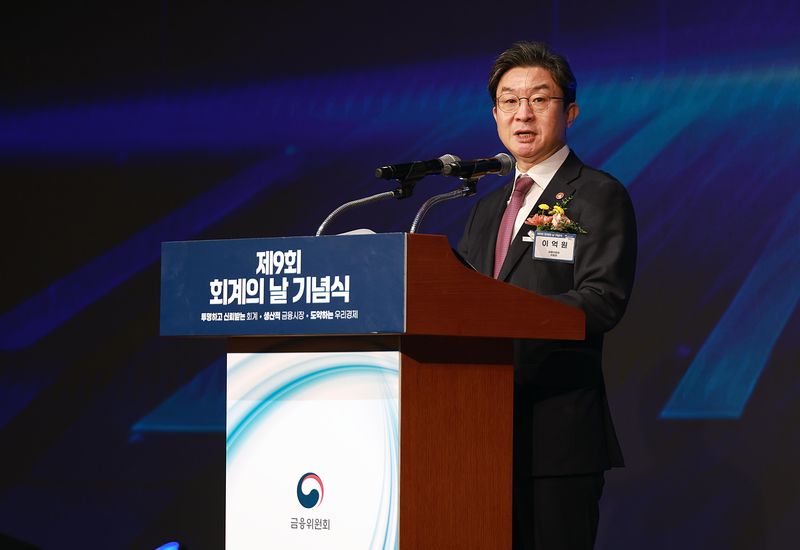
On the 2nd, the Financial Services Commission held its sixth Productive Finance Transformation Meeting, chaired by FSC Chairman Lee Eog-weon, to discuss these measures. Eighteen institutions, including 16 banks, the Korea Credit Guarantee Fund (KODIT) and the Korea Technology Finance Corporation (KOTEC), also signed an MOU.
Under the agreement to support small and medium-sized enterprises, banks will make special contributions totaling ₩300 billion over the next three years. It has not yet been decided which banks will contribute or how much each will provide. KODIT and KOTEC will use the funds to provide guarantees totaling ₩4.5 trillion. This will enable guarantee-backed loans at relatively low interest rates to be offered to key SMEs and mid-sized companies in regional areas. Interest rates will fall further if local governments provide a secondary interest subsidy. Each local government plans to recommend key companies based on factors such as growth potential and contribution to the economy, and to participate in interest subsidy programs.
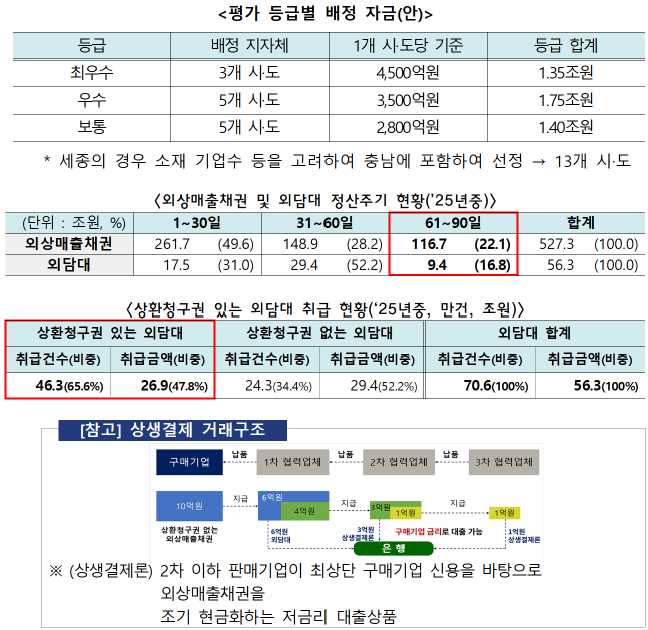
The FSC has set different support amounts for local governments. ₩450 billion will be allocated to three top-rated local governments, ₩350 billion to five high-performing cities and provinces, and ₩280 billion to five average-rated local governments. Fourteen cities and provinces outside the capital region are eligible for the open call, with Sejong included in South Chungcheong Province. A separate evaluation committee will assess local governments’ project capacity, regional financial coordination and policy alignment, among other factors. Banks’ records of participation in the program will be reflected in future regional reinvestment evaluations.
Improvements to the trade receivables and trade receivables-backed loan systems are also being pursued. To help SMEs receive payment for deliveries more quickly and safely, the maturity of trade receivables and the related loans will be cut from a maximum of 90 days to 60 days. As a result, about ₩117 trillion in trade receivables is expected to be converted into cash earlier. SMEs that take out these loans to obtain working capital while waiting for payment are expected to save about ₩36.3 billion in interest costs annually.
As a rule, recourse rights on trade receivables-backed loans will be abolished. This is expected to reduce guaranteed debt by about ₩26.9 trillion annually. Recourse is the right of a bank to seek repayment from a seller (subcontractor) if the buyer goes bankrupt without repaying its loan.
When Homeplus filed for rehabilitation in March last year, banks exercised their recourse rights. The 220 suppliers that had delivered products to Homeplus had to repay about ₩31 billion. Concerns also arose over whether partner companies would have to repay ₩45.1 billion in outstanding trade receivables-backed loans during Taeyoung Engineering & Construction’s workout in 2023. Recourse rights on existing loans of this type will also be abolished when they mature or are renewed after January 2027.
The improvements to the trade receivables-backed loan system were a project that a task force formed late last year had aimed to complete in the first half of this year. However, coordination among the various stakeholders took longer than expected, so the changes will take effect starting next February. Shin Jang-su, a division director at the FSC, said, “With recourse rights on these loans abolished, banks will apply more stringent credit assessments to buyers. In theory, this could lead to a reduction in lending, but I urged the banking sector not to cut lending in connection with this change.”
Sellers will be the designated recipients of interest refunds when trade receivables-backed loans are repaid early. As a result, sellers are expected to receive about ₩8.3 billion in interest refunds annually. The range of buyers eligible to offer win-win payment loans will also be expanded in stages, and incentives for companies using the win-win payment system will be strengthened.
Chairman Lee said, “Over the past year, we have pursued a major shift toward productive finance so that finance can support the growth of businesses and industries, and the financial sector had provided a total of ₩264.3 trillion as of the end of July. However, with delinquency rates among SMEs recently rising, we need to proactively clear bottlenecks in the flow of funds and strengthen the foundations of productive finance so that companies can minimize the impact of interest rate hikes and fluctuations, and sufficient funding can reach where it is needed.”
[email protected] Park Mun-su Reporter