“Taking the lead globally in Physical AI and quantum technology” ... 2026 Global ICT Standards Conference opens
- Input
- 2026-11-02 11:26:47
- Updated
- 2026-11-02 11:26:47
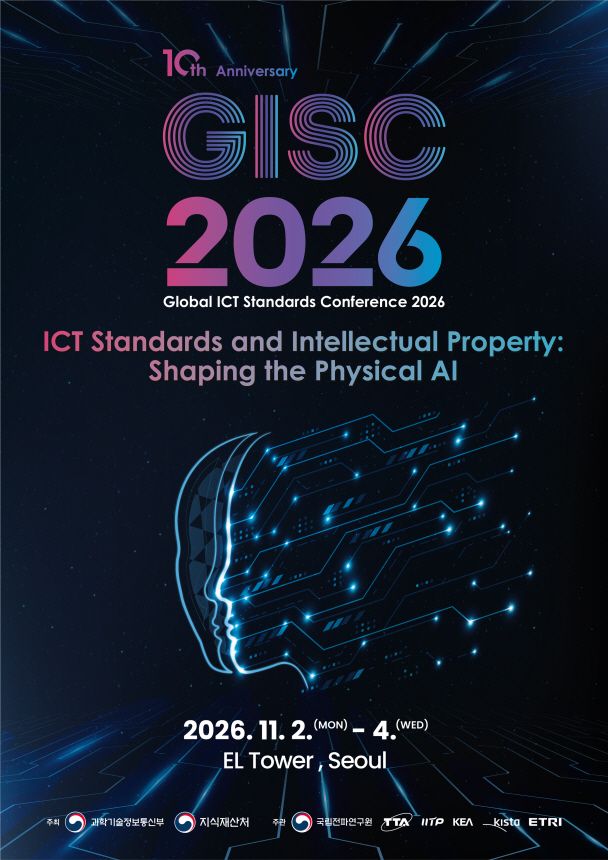
The Ministry of Intellectual Property and MSIT announced that they will jointly hold the 2026 Global ICT Standards Conference (GISC 2026) at El Tower in Seocho District, Seoul, for three days, from the 2nd to the 4th.
Marking its 10th anniversary this year, the event brings together around 1,000 ICT experts from Korea and abroad to focus on technical standardization and strategies for linking intellectual property in the era of AI transformation (AX). Given the exceptionally rapid pace of change in AI, many participants include not only established formal standards bodies such as the International Telecommunication Union (ITU) and the International Organization for Standardization (ISO), but also private-sector-led de facto standards bodies such as MLCommons and IEEE, regional standards organizations such as the European Telecommunications Standards Institute (ETSI), and government agencies from abroad. The direction of the AI Partnership Project (AIPP), being jointly pursued with Korea (Telecommunications Technology Association (TTA)) and Europe (ETSI) at the center, alongside the United States (ATIS) and Japan (TTC), will also be shared.
At the opening ceremony on the first day, Professor Young Jae Jang of the Korea Advanced Institute of Science and Technology (KAIST) delivered a keynote address on “Autonomous Manufacturing Using Physical AI for Manufacturing, Its Applications in Industrial Settings, and the Role of Standards.” Commendations and certificates were presented to 27 contributors to ICT standards and patents. During the event, specialized seminars will be held in two tracks: a global track (AI, quantum technology, satellite communications, etc.) and a domestic track (including a public hearing on the Physical AI convergence standards framework).
In the global industrial sector, Physical AI—which goes beyond software-only AI by combining AI with physical devices such as robots, autonomous vehicles, and smart factories—is attracting attention as a game changer that could transform the future of manufacturing and logistics. However, if communication standards between different types of devices, data interoperability, and safety standards are not unified, adoption in industrial settings could be delayed. National efforts to establish standards from the early stages of technology development and secure key related patents are therefore considered essential.
Lee Do-gyu, head of MSIT’s Information and Communications Policy Office, said, “To lead the global technological competition accelerating in the AI era, we will expand investment to gain an early lead in international standards and patents, and support the creation of an open ecosystem.”
Kim Il-gyu, director general of the Ministry of Intellectual Property’s Intellectual Property Policy Bureau, also said, “Major countries such as the United States and Japan view standards as part of their strategy for global dominance,” adding, “We will further strengthen related policies so that high-value standard patents can be developed from the R&D stage in key areas such as next-generation communications and Physical AI.”
[email protected] Kim Won-jun Reporter