Ruling camp drifts apart as opposition watches warily ... Political unity faces a minefield
- Input
- 2026-11-02 13:58:53
- Updated
- 2026-11-02 13:58:53
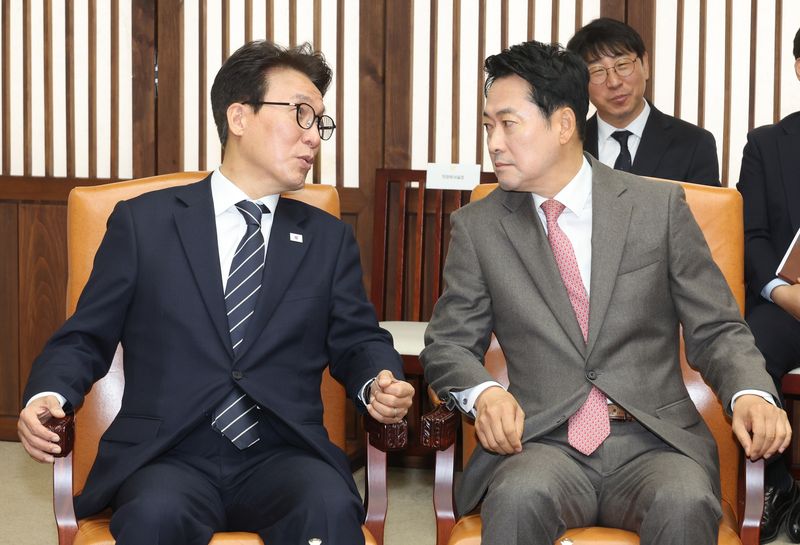
[Financial News] The banners of “unity” are wavering in both the Democratic Party of Korea (DPK) and the People Power Party. DPK leader Kim Min-seok pledged to raise his party’s approval rating by 10 percentage points within 100 days of taking office, but is struggling to do so. Meanwhile, the opposition camp appears to be reorganizing around Seoul Mayor Oh Se-hoon, but cooperation between Jang Dong-hyeok and independent lawmaker Han Dong-hoon is effectively impossible. Both parties aim to mend internal divisions ahead of the 2028 general election, but countless obstacles lie in their path.
Approval ratings, merger, Shincheonji ... Ruling party at a crossroads over division
According to political sources on the 2nd, tensions between the pro-Lee Jae Myung and pro-Jung Chung-rae factions in the ruling camp have risen again. In particular, Jung, the former party leader, appeared on Park Si-young TV on the 31st of last month and voiced concern about Kim’s leadership. “By around 100 days into Kim’s term, the outcome will be clear,” Jung said. “I’m thinking through, one by one, what my role will be after that, what flag I’ll carry, and what words I’ll write on it—and I’m putting it all down in writing.” He was signaling that he would have a role if Kim failed to meet his goal of raising the party’s approval rating by 10 percentage points.Criticism has emerged that former party leader Jung is undermining Kim Min-seok’s leadership and stirring up internal discord. Speaking on SBS Radio’s Kim Tae-hyun’s Political Show that day, lawmaker Park Jie-won said, “What flag would a former party leader be carrying?” He added, “We should think about working together, pooling our wisdom, and finding a way to break through together.”
Whether and when to merge with the Rebuilding Korea Party is also a point of contention. President Lee reportedly responded positively to a merger during a dinner with senior DPK lawmakers who have served five or more terms, and Jung also floated the idea of a “January merger” on YouTube. However, Rebuilding Korea Party leader Shin Jang-sik drew a firm line, saying, “I categorically reject being used as a tool to turn the tide for the Kim Min-seok leadership.”
There is still no shortage of flashpoints for discord. As early as the 3rd, the DPK plans to report the findings of its own investigation into allegations that Shincheonji members joined the party en masse. Depending on the findings and whether the party takes follow-up action, factional tensions could well flare up again. If meaningful evidence emerges concerning allegations of Shincheonji’s involvement, the questions Kim raised during the Aug. 17 party convention are likely to gain legitimacy. If not, the pro-Jung faction is expected to hit back forcefully.
Attention is also focused on the DPK’s National Committee elections, which run through the 3rd. Some view the contest for women’s committee chair between pro-Jung Moon Jeong-bog and pro-Lee lawmaker Kim Nam-hee as a proxy battle between factions. Chairs will also be elected for committees on senior citizens, youth, university students, people with disabilities, labor, farmers and fishers, protecting people’s livelihoods, the social solidarity economy, and small businesses. Some party members are also seen trying to funnel support to candidates from particular factions.
Oh Se-hoon, Jang Dong-hyeok, Han Dong-hoon and Lee Jun-seok: complicated political calculations
Across the broader opposition camp, a realignment of forces is expected around Seoul Mayor Oh Se-hoon, whose political profile has grown after his acquittal at the second trial in a case involving allegations of proxy payment for opinion-polling fees associated with Myeong Tae-gyun. Oh has called for a “conservative alliance” that includes party leader Jang Dong-hyeok, lawmaker Han Dong-hoon and Reform Party lawmaker Lee Jun-seok, but has been passive when it comes to Han’s return to the People Power Party. The prevailing view is that Han cannot rejoin the party under Jang’s leadership. With Lee also continuing to take aim at Han, the political calculations are highly complex.Oh is envisioning conservative unity that excludes no one, including Jang, with whom he clashed during the June 3 local elections. Oh has already entered the race for the 2030 presidency, giving him time on his side. Rather than wage a battle with Jang over political direction, he appears to be seeking to demonstrate the inclusiveness expected of a presidential hopeful.
However, Oh is taking a cautious stance on Han’s return to the party, saying it “needs to be handled like glassware.” The pro-Han faction has consequently criticized this as a “halfway unity” proposal. Critics also argue that keeping his distance from Han while Jang continues to align himself with Yoon Again and groups advocating election-fraud claims does not fit the identity of “reform conservatism.” With Lee continuing his sharp attacks on Han day after day, some are cautiously suggesting that Han could be isolated in a broader conservative alliance.
However, both Oh’s and Han’s camps reportedly agree that an alliance is necessary. They appear to be continuing to weigh its timing and intensity. The two figures are set to attend discussion forums at the National Assembly on the 3rd, 30 minutes apart; whether they will meet and shake hands is also something to watch.
[email protected] Lee Hae-ram Reporter