“Fix a frozen computer with one click” ... Daejeon city official develops AI auto-recovery program ‘OnSet’
- Input
- 2026-11-02 10:48:59
- Updated
- 2026-11-02 10:48:59
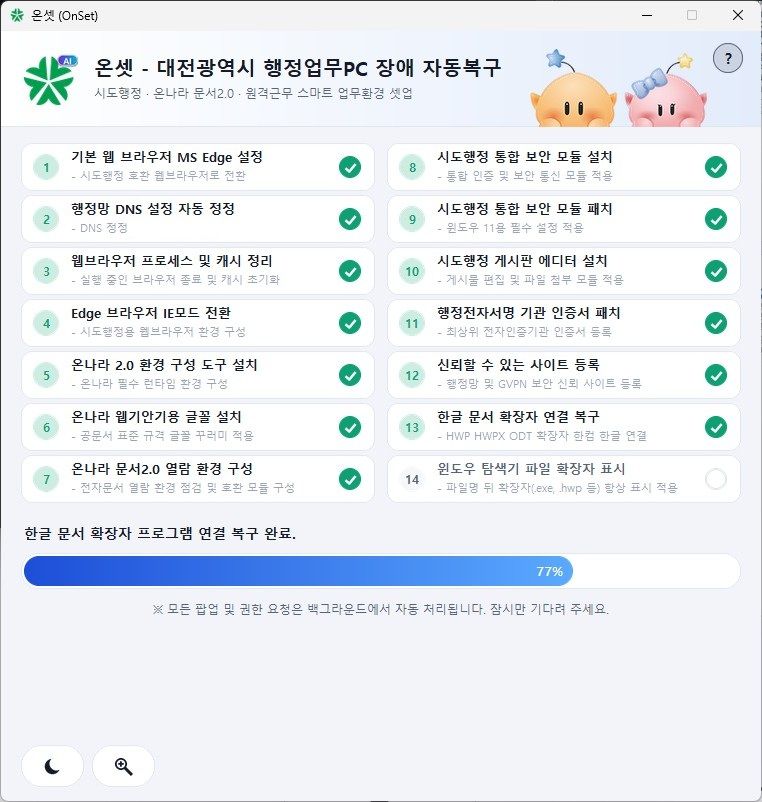
Daejeon City said on the 2nd that it had developed an auto-recovery program, ‘OnSet,’ that uses generative AI to automatically fix work computer configuration errors in just one minute, and will begin full-scale service for all employees in November.
In local government offices, disruptions preventing access to administrative portals or electronic approval systems have frequently occurred due to security updates and conflicts involving Windows, browsers, and document programs. As a result, employees have faced delays in urgent approvals and administrative work while waiting for remote support or having to reset their PCs.
‘On-Set,’ developed in-house by Daejeon City Hall, refers to settings (set) that encompass everything (on). The program lets anyone resolve problems with a single click, without extensive PC knowledge. It immediately and automatically addresses 14 types of problems: seven involving administrative portals, four involving electronic approval, and three involving PC settings. In particular, it automatically detects and adjusts internet security settings to match office and work-from-home environments, helping ensure continuity of work even when employees are working from home and remote support is difficult to obtain.
The project has received high praise because Park Byeong-su, an administrative officer with Daejeon City's Information Technology Office, carried out the entire process himself, from design to production, using generative AI tools and without any outsourcing fees. It is an example of leading innovation in public services by actively adopting so-called “vibe (conversational) coding,” a technique in which a public official codes while conversing with AI.
It has long been pointed out that public institutions face difficulties in promptly addressing problems encountered on the ground when building IT systems or developing software, due to complex contracting procedures, high outsourcing costs, and lengthy development periods. This case is cited as an administrative model showing that, instead of undertaking a large-scale systems integration (SI) project with a substantial budget, frontline staff can use general-purpose AI tools to quickly build small, customized “Before Service” programs.
Lee Gil-ju, Daejeon City's AI Innovation Officer, said, “It is meaningful that a public official who knows the inconveniences of frontline work best used AI to create a solution directly, without additional budget.” He added, “We will continue to actively incorporate AI technology into internal administrative work and do our utmost to improve staff efficiency and provide services to citizens promptly.”
[email protected] Kim Won-jun Reporter