Hyundai Engineering and Construction to Provide Five Years of Technical Advisory for U.S. SMR 'EAGL-1'; Signs Framework Agreement with FANCO
- Input
- 2026-11-02 10:30:59
- Updated
- 2026-11-02 10:30:59
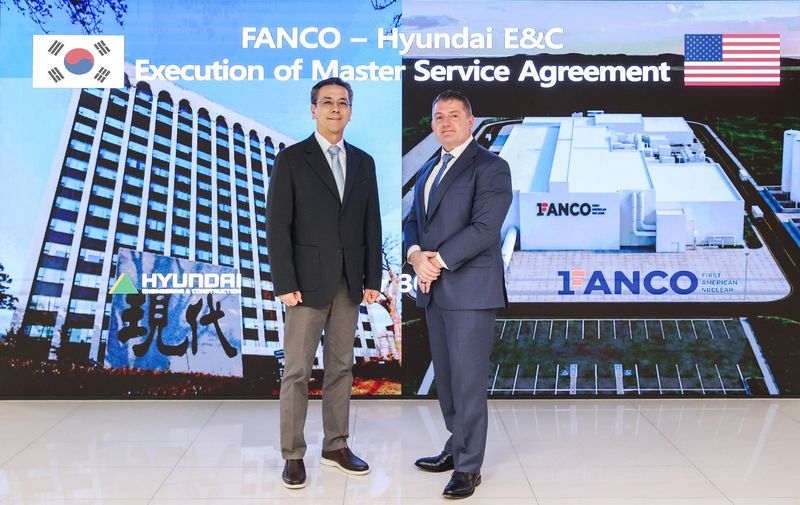
[Financial News] Hyundai Engineering and Construction will provide five years of technical advisory services for the development of a next-generation U.S. small modular reactor (SMR) that uses a lead-bismuth alloy as its coolant.
Hyundai Engineering and Construction said on the 2nd that it signed an MSA (Master Service Agreement) after meeting with FANCO executives at its headquarters in Gye-dong, Jongno District, on the 30th of last month. Lee Han-woo, CEO of Hyundai Engineering and Construction, and George Malone, head of FANCO's nuclear program, along with other senior executives from both companies, attended the meeting and discussed in detail plans for cooperation on the EAGL-1 project.
An MSA is a master agreement that sets out in advance the terms and scope of responsibilities that apply when companies work together over the long term. As specific work arises, its scope, duration and contract amount are then finalized through individual work orders. This agreement takes the framework agreement signed in July to the stage of a substantive contract, establishing a framework for long-term cooperation. The agreement runs for five years and can be extended by mutual consent.
EAGL-1 is a liquid metal fast reactor (LMFR) design that uses a liquid lead (Pb)-bismuth (Bi) alloy as its coolant. Each reactor unit generates about 240 MWe. Its modular design allows multiple units to be grouped into clusters, with generating capacity expanded as power demand grows. The project also offers a 'bridge power' solution: initially meeting demand with existing power sources before transitioning to nuclear power in stages. FANCO says this can improve project speed and flexibility in places that need rapid power supply, such as large data centers and industrial complexes. The company is preparing for commercialization, including by submitting a regulatory engagement plan to the United States Nuclear Regulatory Commission (NRC).
Cooperation between the two companies began in earnest this summer. On July 13, in New York, U.S., Choi Young, executive vice president of Hyundai Engineering and Construction's New Energy Business Division, and FANCO CEO Mike Rainbos signed a framework agreement. Hyundai Engineering and Construction agreed at the time to take part in designing power plant auxiliary facilities, developing a bridge power solution, reviewing constructability and devising a modularization strategy. FANCO says EAGL-1 can reduce radioactive waste by at least 95% by recycling spent nuclear fuel.
With this agreement, Hyundai Engineering and Construction has further expanded its U.S. SMR partnership network. With Holtec International, it is pursuing a project to build two 300-MW-class SMR-300 units at the Palisades nuclear plant site in Michigan. In August, it also signed a framework agreement with TerraPower, developer of the sodium-cooled fast reactor Natrium, and secured priority as EPC partner for up to eight follow-on nuclear plants planned after the first unit in Kemmerer, Wyoming. The company is broadening its portfolio from light-water SMRs to Generation IV reactors.
A Hyundai Engineering and Construction representative said, "Hyundai Engineering and Construction is expanding its global achievements not only in large-scale nuclear power but also in the next-generation energy construction market," adding, "Through this agreement with FANCO, we will lead the commercialization of the EAGL-1 project and further strengthen our leading position in the U.S. SMR market."
[email protected] Jeong Gyeong-su Reporter