Using Two Sensors to Estimate Gas Levels at 14 Locations: KICT Develops AI Hazard-Prediction Technology for Underground Spaces
- Input
- 2026-11-02 10:22:48
- Updated
- 2026-11-02 10:22:48
[Financial News] An AI technology has emerged that can estimate hazardous gas concentrations at 14 locations inside a tunnel using measurements from just two sensors.
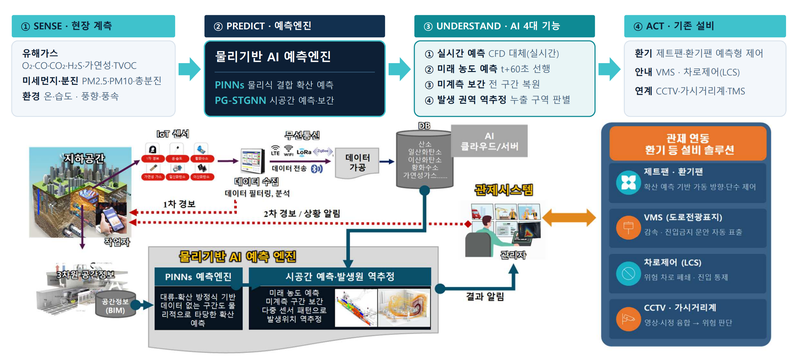
According to the Korea Institute of Civil Engineering and Building Technology (KICT) on the 2nd, a research team led by Kim Young-seok, a senior research fellow in its Geotechnical Research Division, developed a system that measures hazardous gas and oxygen concentrations at underground construction sites in real time and uses AI to predict changes in risk. The system brings together real-time data collection and analysis, risk prediction, estimates of gas release locations, and alerts.
The system receives real-time data from on-site sensors on hazardous gas concentrations, temperature and humidity, and airflow, then analyzes it using AI. Its measurements cover six types of gases—carbon monoxide, carbon dioxide, oxygen, hydrogen sulfide, explosive gases, and total volatile organic compounds (TVOC)—as well as fine dust and particulate matter, wind direction, and wind speed. Based on its analysis, it predicts the paths gases will take and changes in their concentrations, upgrading the conventional “measurement and alarm” approach, which sounded an alarm only after levels exceeded thresholds, to “prediction and response.” It can also estimate concentrations in areas without sensors and work backward to identify the direction in which gas is spreading and where it first originated.
The system’s performance was verified in experiments and at worksites. Alongside indoor experiments that recreated a range of conditions, the research team tested the system in actual large-diameter conduits and culvert-type tunnels (underground passage tunnels). The system estimated gas concentration patterns at 14 locations using readings from two sensors, and pinpointed the area where gas originated using only about 30 seconds’ worth of data collected after its appearance. It was designed to use data from different types of sensors together, also opening the way to integration with monitoring equipment already installed at worksites.
Underground construction sites are workplaces with many hazards. Carbon monoxide, hydrogen sulfide, volatile organic compounds, and particulate matter can be generated during excavation and blasting, the operation of diesel equipment, welding, and waterproofing and painting work. Because ventilation is difficult underground, hazardous gases can spread quickly and oxygen levels can easily fall, making it essential to monitor working conditions continuously and respond to risks early. Suffocation accidents in confined spaces can readily result in loss of life. According to the Ministry of Employment and Labor, there were 174 suffocation accidents in confined spaces, including underground areas, over the 10 years from 2014 to 2023. Of the 338 people affected, 136 died. The fatality rate reached 40%, 41 times higher than for other accident-related injuries.
KICT head Park Sun-kyu said, “This technology is significant because it identifies hazards in underground working environments that are invisible and gives workers time to respond,” adding, “Starting with tunnels, we will apply it to a range of underground spaces and contribute to preventing serious accidents at construction sites.”
[email protected] Jeong Gyeong-su Reporter