Two people who brought Hangul to the fingertips... Rosetta Hall, Park Du-seong and 100 years of Hunmaengjeongeum [Hong Chae-wan’s Global Profile]
- Input
- 2026-11-07 05:00:00
- Updated
- 2026-11-07 05:00:00
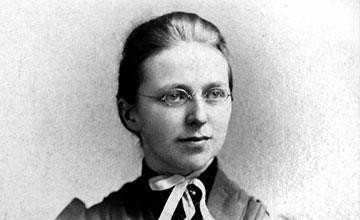
This is the story of Rosetta Sherwood Hall and Park Du-seong. The 4th marked 100 years since Park Du-seong promulgated Hunmaengjeongeum, Hangul Braille. Before that milestone came Hall’s “Pyeongyang Braille”; after Hunmaengjeongeum was created came years of making books so people could learn and use it.
A doctor meets a girl with visual impairments and learns Braille
Born in New York State in 1865, Hall graduated from the Woman’s Medical College of Pennsylvania and came to Joseon as a medical missionary in 1890. She treated patients at Bogunyeogwan, a women’s hospital, and later continued her medical work in Pyeongyang. At a time when women found it difficult to be examined and treated by male doctors, the presence of women physicians helped make medical care more accessible.Hall’s interest in education for people with visual impairments broadened after she met a girl named Oh Bong-rae in Pyeongyang. Bong-rae could not see, but she was determined to learn. Hall realized that she would first need to learn how to educate people with visual impairments if she was to teach the girl.
When her husband, William Hall, died of an infectious disease in 1894, Hall returned to the United States. While staying in her homeland after his death, she studied Braille education as she prepared to return to Joseon. She sought out William Wait, who developed New York Point, to learn how Braille was structured and explore ways to adapt it to Korean.
The result was a four-dot Hangul Braille system she devised in 1897. Hall transcribed part of the contents of Chohak Eonmun, a Hangul textbook for beginners, into Braille. She made teaching materials by pricking holes with a needle in thick, oil-treated hanji. It was a process of adapting text read with the eyes so it could be read with the fingertips. The materials were used to teach students at the Pyongyang Women’s School for the Blind, including Oh Bong-rae.
According to historical records from Ewha Medical Center, Hall began teaching Bong-rae Braille in earnest in Pyeongyang in 1898. Progress was slow at first, but about a year later Bong-rae was able to read the materials Hall had prepared. As people who saw Bong-rae reading and writing introduced other girls with visual impairments, the program expanded. An effort to teach one child grew into a place of learning for many more.
Classrooms where students studied with Japanese Braille... “We need Braille for our language”
While Hall was teaching girls with visual impairments in Pyeongyang, another teacher in Seoul began working with Braille. He was Park Du-seong, who came from Ganghwa. A teacher at an ordinary school, he transferred to the Department for the Blind at Jesaengwon in 1913.He did not begin with some grand mission. Park was in difficult financial circumstances, and the offer of official housing was one of the reasons he applied for the position. The students he met at the school he joined that way changed the course of his life.
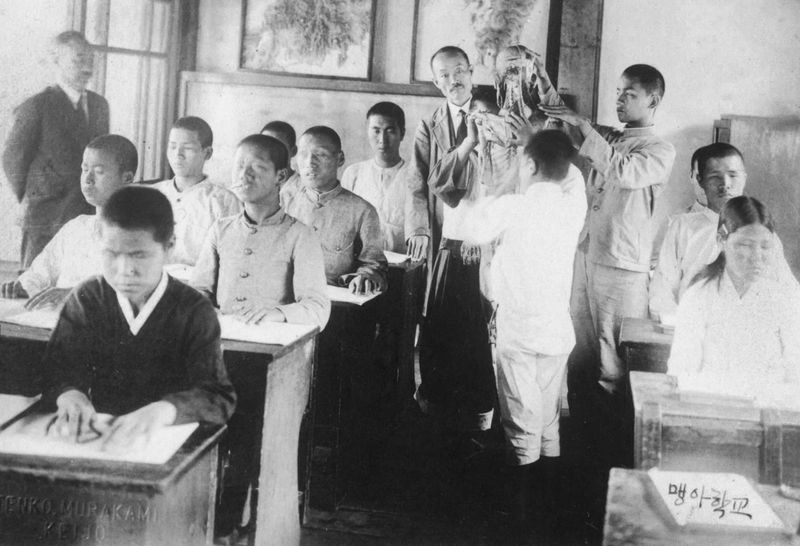
At the time, students at Jesaengwon were taught using Japanese Braille. As Park set about producing Japanese Braille textbooks, he also recognized that students needed a Braille system for reading and writing their own language. Hall’s Hangul Braille was in use in Pyeongyang, but it was difficult to read because, among other things, it did not distinguish initial from final consonants.
Park began researching Hangul Braille in 1920. In 1923, he and his students secretly formed the Joseon Korean Braille Research Committee and continued their work. During their research, they also devised “3-2-point Braille,” using three dots for consonants and two for vowels, but it had the drawback of making initial and final consonants difficult to distinguish. As a result, students with visual impairments did not simply wait for a teacher to create a script; they joined in researching a script they themselves would use.
The principles Park established were clear: the system had to be easy to learn, use as few dots as possible, and avoid confusion between characters. Text scanned at a glance with the eyes and text read by tracing each character with the fingertips involved different ways of reading. Even the same consonant had to be easy to identify as either an initial or a final consonant.
Created through trial and error, Hunmaengjeongeum used six dots to distinguish initial consonants, vowels, and final consonants. It represented not only consonants and vowels but also numbers and punctuation, and used contractions for frequently occurring characters. Park presented it to the world on November 4, 1926. Its name, “Proper Sounds for Teaching the Blind,” embodied an aspiration to carry on the meaning of Hunminjeongeum.
A doctor who learned Braille to teach one girl, and a teacher who researched a new Braille system so his students could read Korean. What they began was not completed with a single chart of characters. Their work continued in making books to read and sending them to people who wanted to learn. Thanks to the needle that pierced hanji and the thick Braille books sent across the country, the circle of people able to read Hangul grew.
[email protected] Hong Chae-wan Reporter