North Korea steps up real-world threats amid ‘loudspeaker rhetoric,’ flaunts cluster munitions’ power to neutralize South Korea-U.S. airfields and artillery positions
- Input
- 2026-11-02 14:38:03
- Updated
- 2026-11-02 14:38:03
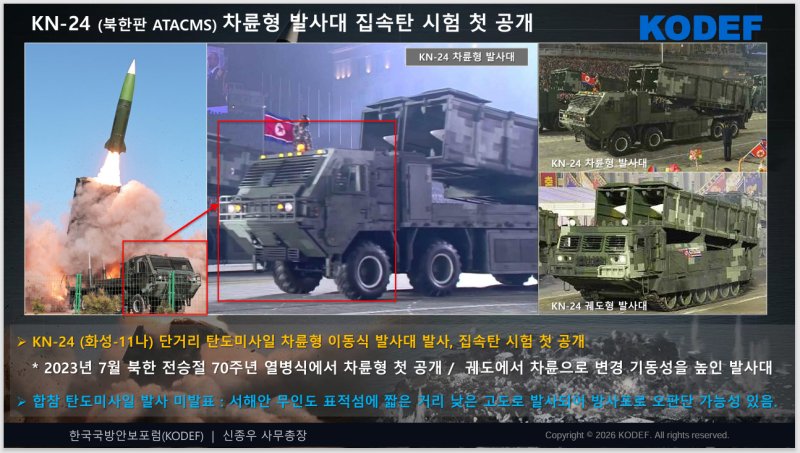
According to KODEF’s analysis, North Korea first unveiled a wheeled TEL at a Victory Day military parade in July 2023, and has since completely shifted its design from a tracked to a wheeled platform to improve mobility. Experts pointed to the possibility that the Joint Chiefs of Staff (ROK JCS) failed to immediately announce the launch in this test because the missiles were fired toward a target island off the west coast at short range and extremely low altitude, and may have been mistaken for multiple rocket launchers.
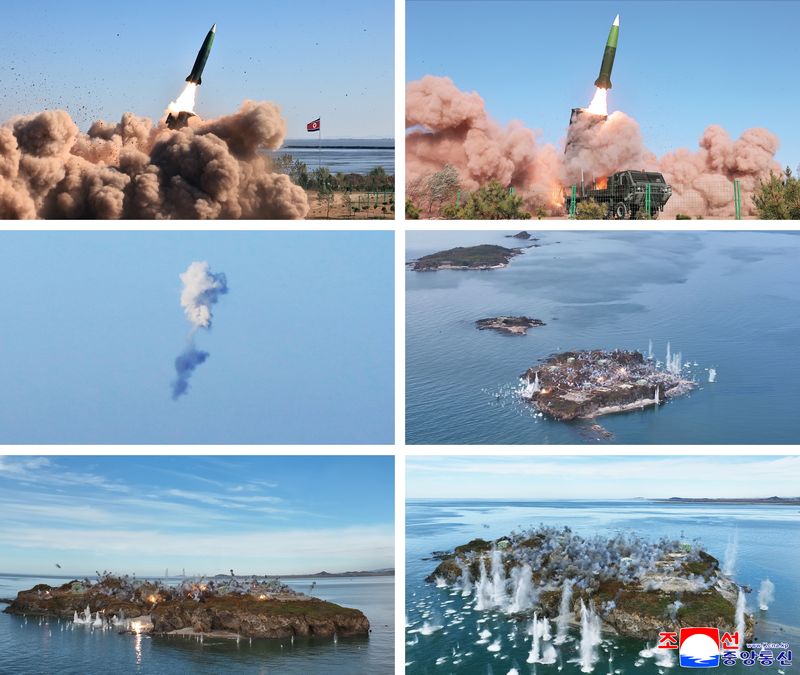
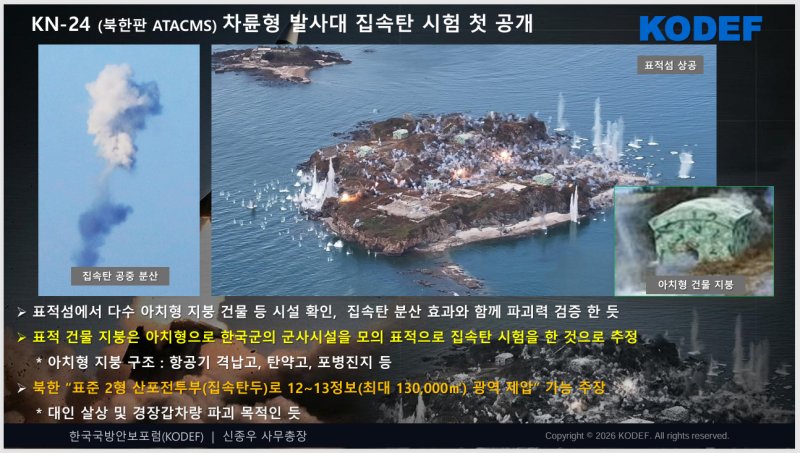
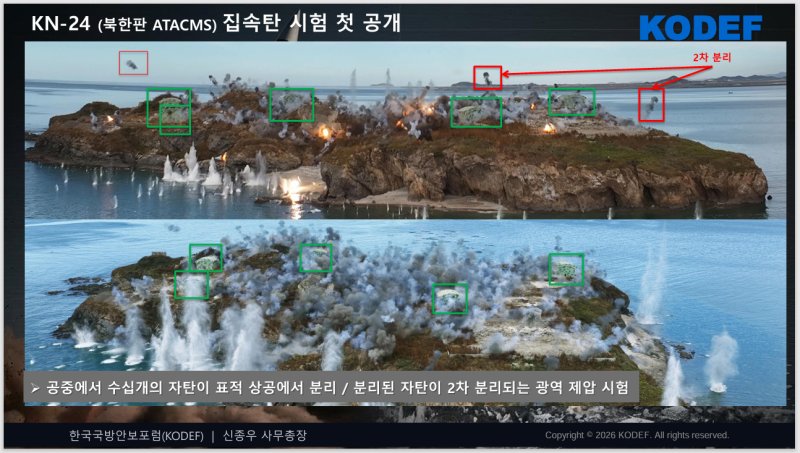
The most dangerous aspect is what was targeted. Footage released by North Korea demonstrated wide-area suppression over a target island in the West Sea, with dozens of submunitions dispersing in the air before separating again in a second stage. The numerous arched-roof buildings installed on the island were assessed to be targets closely simulating key military facilities, including ROK Armed Forces aircraft hangars, ammunition depots and artillery positions. Using its self-developed ‘Standard Type 2 cluster warhead,’ North Korea tested its ability to kill personnel and destroy lightly armored vehicles, and to devastate at once a vast area of up to 12–13 jeongbo (about 130,000 m2), openly flaunting the effectiveness of its strike capability against South Korea.■ Flexibility to offset conventional inferiority: ‘Failure to intercept would increase the burden of protecting military facilities’Yoo Ji-hoon, a committee member at the Korea Institute for Defense Analyses (KIDA), assessed North Korea’s show of force as more than simply displaying a new weapon. He said it was part of a calculated strategy to maximize the use of its existing short-range ballistic missile forces and diversify warhead types according to operational objectives. Conventional high-explosive munitions focus on precisely destroying a specific single target, whereas cluster munitions are specialized in simultaneously paralyzing air-defense and logistics infrastructure spread across a wide area.
Yoo said, ‘If North Korea combines the rapid tactical strike capability of short-range ballistic missiles with the wide-area reach of cluster munitions, it can inflict significant cumulative damage on our side even with a surprise attack using a limited number of missiles.’ He analyzed that ‘this is an attempt to offset the relative inferiority of its conventional weapons compared with combined South Korea-U.S. forces through asymmetric technology.’
From a strategic perspective, he added that ‘securing these various types of munitions expands operational flexibility depending on battlefield conditions while sending an external pressure message that structurally increases the ROK Armed Forces’ defensive burden.’ He also recommended that ‘a sober and further military assessment should follow regarding actual strike accuracy, the reliability of the submunitions and the level of mass-production capability for deployment in combat.’■ Kim Yo Jong’s promised anti-South loudspeakers remain ‘silent’; winter suspension of border work is a variableWhile North Korea is advancing the fielding of ballistic missiles and cluster munitions in the rear, direct clashes along the border, such as loudspeaker provocations at the front line, are instead in a lull—a contrasting pattern.
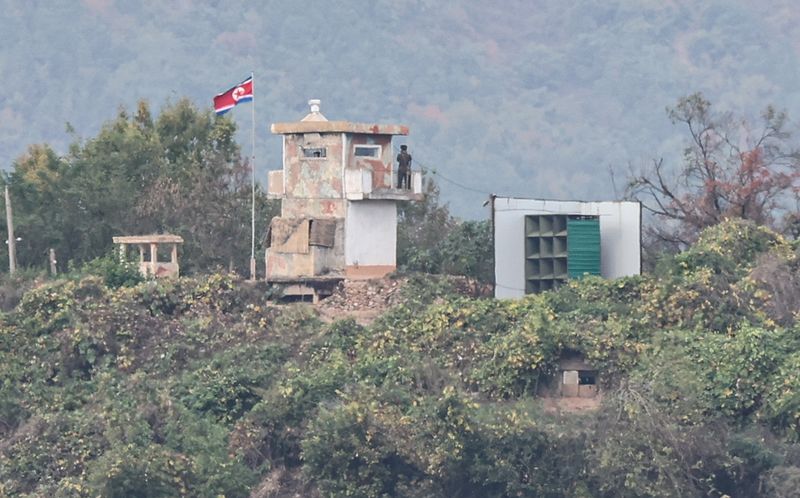
According to military authorities, Kim Yo Jong, director of North Korea’s General Affairs Department, raised the threat level on the 19th of last month by citing such grounds as ROK Armed Forces counterfire in areas near the Military Demarcation Line (MDL) and floating a ‘review of resuming anti-South loudspeaker operations during October.’ But even though the deadline she indicated has passed, no signs of full-scale loudspeaker operation or a restart have been detected. A ROK JCS official said, ‘So far, we have not confirmed any operation of North Korean loudspeakers targeting the South along the front line.’ The National Intelligence Service also made clear in a report to the National Assembly that the loudspeakers had not been activated.
The military burden of the ‘proportional response’ warned of by the South Korean government and military authorities—resuming retaliatory broadcasts toward North Korea and proposing a link to the military communication lines—is seen as a factor preventing North Korea from deploying its loudspeaker card first. In her statement, Kim Yo Jong also appeared to step back, using language that suggested a ‘conditional resumption.’
The approaching winter, when the ground freezes, is another variable in the physical standoff. The North Korean military has typically halted outdoor ‘borderization’ work—such as installing barriers and laying mines around the front-line MDL—from late November to early December, resuming it the following spring. Experts said that if front-line construction is halted due to winter constraints, the factors that could lead to physical friction with the South Korean military would themselves diminish, greatly reducing North Korea’s tactical justification and practical incentive to activate anti-South loudspeakers first.■ ROK JCS explains lack of public notice of North Korean ballistic missile launch: ‘A cautious measure taken with operational security in mind’The South Korean military is expected to closely monitor the pause in anti-South loudspeaker provocations at the front line while building a readiness posture capable of overmatching North Korea’s growing conventional asymmetric capabilities—including surprise missile provocations and the ability to inflict devastating, wide-area damage on key military bases if an interception fails. Yoo stressed, ‘It is urgent to establish an integrated defense posture that continues the integrated operation of South Korea-U.S. intelligence, surveillance and reconnaissance (ISR) assets and the development of the Korean Air and Missile Defense (KAMD), while comprehensively strengthening from the ground up the dispersal of key military forces, protection of key hangars, damage recovery and operational sustainability.’
Military authorities said that day, in response to questions about why they had not notified the media despite identifying North Korea’s ballistic missile launch on the 31st of last month, ‘Whether to issue a notice is determined after considering the protection of our military’s surveillance and reconnaissance assets and capabilities, operational security and other factors.’ Col. Jang Do-young, public affairs director of the Republic of Korea Joint Chiefs of Staff, said, ‘It is true that we have announced ballistic missile launches because they violate UN Security Council sanctions.’ He added, ‘In this case, South Korea and the United States were closely coordinating on the missile’s characteristics and specifications, while a highly precise analysis was underway.’ He continued, ‘Our military does not issue notices on every North Korean projectile. We ask for your understanding that we exercised caution in notifying the media.’
The previous day, North Korea’s Korean Central News Agency (KCNA), a major outlet for its external communications, reported that the country’s Missile General Bureau had conducted a ‘test to assess the combat applicability and power of a tactical ballistic missile cluster warhead’ on the 31st of last month. The missile was reportedly launched at low altitude and over a short range.
North Korean ballistic missile launches violate UN Security Council resolutions imposing sanctions on North Korea. The South Korean military has immediately notified the media when North Korea launches ballistic missiles, with the exception of cruise missiles, which do not violate Security Council resolutions.
[email protected] Lee Jong-yoon Reporter