Janggeum Maritime Vice Chairman Jung Ga-hyeon, ‘born in 1976,’ regains 100% control of Sinokor Petrochemical [fn Market Watch]
- Input
- 2026-11-02 10:32:51
- Updated
- 2026-11-02 10:32:51
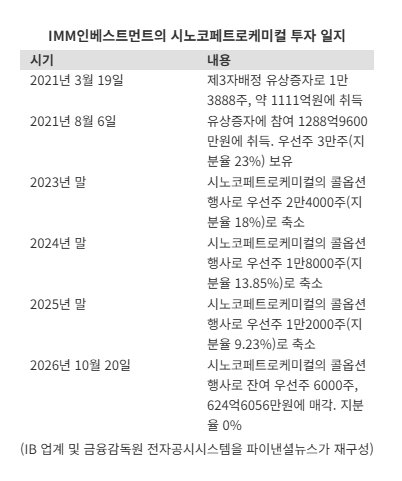
[Financial News] Jung Ga-hyeon (born in 1976), vice chairman and eldest son of Janggeum Maritime Chairman Jung Tae-soon, has drawn attention by regaining 100% control of Sinokor Petrochemical, an affiliate of Janggeum Maritime Group that is also classified as a privately held personal company. In 2021, Sinokor Petrochemical received an investment of about KRW 240 billion from private equity firm IMM Investment, giving up a 23% stake. Jung is regarded as a figure who shook up the global shipping market by securing around 150 very large crude carriers (VLCCs) between 2025 and 2026.
According to investment banking industry sources and the Financial Supervisory Service’s electronic disclosure system on the 2nd, Sinokor Petrochemical acquired 6,000 preferred shares—20% of the 30,000 preferred shares issued—from Jema, a special-purpose company of IMM Investment, on the 20th of last month for KRW 62,460,561,000, or KRW 10.41 million per share. As a result, Jung now holds 100% of Sinokor Petrochemical’s common shares, while the company holds 100% of its preferred shares as treasury shares.
Sinokor Petrochemical exercised its call option (right of first refusal) five times, reducing IMM Investment’s stake held in the form of preferred shares from 23% to 0%. The company began exercising the options in stages in 2023; since it could have exercised them until March 2028, the buyback represents an early redemption. It appears to have used the abundant cash generated by its near-monopoly on crude oil shipments through the Strait of Hormuz to secure control.
Sinokor Petrochemical is an affiliate of Janggeum Maritime, which mainly operates MR tankers (petrochemical product carriers). It is a shipping company with long-term transportation contracts with global oil companies such as ExxonMobil and Royal Dutch Shell. Thanks to stable cash flow from long-term charter contracts, a young fleet and long-standing partnerships with global oil majors, it continues to generate market demand for vessel sales and refinancing.
Despite its competitiveness, the company had no choice but to seek an outside capital injection in 2021 because of a liquidity shortfall. That year, Sinokor Petrochemical received about KRW 111.1 billion in preferred-share investment from IMM Investment’s Infrastructure 8 Fund (IMM Infrastructure No. 8 Private Equity Partnership). Including project funds and other investments, the total amounted to about KRW 240 billion.
After receiving the investment, Sinokor Petrochemical also took on several hundred billion won in debt from Janggeum Maritime, Janggeum Maritime and financial firms including Korea Investment & Securities and Acuon Capital. The borrowing was to secure a large number of vessels. Sinokor Petrochemical also took out a loan from one financial institution at an annual interest rate of around 8–9%; most of it is reportedly now repaid using the company’s substantial cash reserves.
According to major foreign media reports, shortly before the war broke out, Janggeum Maritime invested about $7 billion (approximately KRW 9.3 trillion) to build a tanker fleet of around 160 vessels, the largest in the world. That is close to 10% of the world’s entire VLCC fleet.
Janggeum Maritime Group earned a record charter rate of $500,000 a day (approximately KRW 670 million) by leasing out vessels as ‘floating storage facilities’ for crude oil left with nowhere to go because of the Strait of Hormuz blockade. VLCCs deployed in the Persian Gulf are rented out to store crude oil.
Janggeum Maritime’s vessels have effectively handled crude oil shipments from major Middle Eastern producers such as Saudi Arabia, the United Arab Emirates, Iraq and Qatar using what is known as ‘shuttle shipping (Ship-to-Ship Transfer)’: loading crude at ports inside the Persian Gulf, passing through the Strait of Hormuz, then transferring the oil to other vessels in the safe waters of the Gulf of Oman. According to Lloyd’s List, a UK shipping publication, Janggeum Maritime is reported to have accounted for 47% of the VLCCs that passed through the Strait of Hormuz last September, and more than 50% in early October.
Meanwhile, the launch of an independent business platform jointly managed with a global shipping company is just around the corner for Janggeum Maritime, a company founded in 2008 and wholly owned personally by Vice Chairman Jung Ga-hyeon. Mediterranean Shipping Company (MSC), the world’s largest container shipping line, is seeking to acquire a 50% stake in Janggeum Maritime. Greece’s competition authority has approved the merger, while the Korea Fair Trade Commission is reviewing it. At the end of 2024, on a consolidated basis, Janggeum Maritime had total assets of KRW 7.5484 trillion, while Janggeum Maritime had KRW 3.3794 trillion.
[email protected] Kang Gu-gwi Reporter