“Relay races are dangerous, you know” ... Relay race canceled at school sports day after one parent’s complaint [What do you think?]
- Input
- 2026-11-02 04:40:00
- Updated
- 2026-11-02 04:40:00
[Financial News] “Apparently, a parent complained today that the relay race was dangerous, so it got canceled.” The story that the relay race, often called the highlight of an elementary school sports day, was abruptly canceled after a parent raised safety concerns has sparked outrage online. After police have frequently been dispatched to schools in response to residents’ noise complaints and children have often distributed apology letters to apartment complexes, critics say excessive parental interference is now making even traditional sports-day activities disappear.
On the 1st, a post titled “The relay race got canceled after someone complained, ‘Relay races are dangerous, you know’” spread rapidly across various online communities and social media platforms (SNS). The post included a messaging exchange between an elementary school student and a parent. The child, who had been practicing after even an anchor runner was selected, expressed disappointment upon hearing that the event itself had been scrapped because of a parent’s complaint. Netizens who saw the post could not hide their bitterness, commenting, “Are they not even allowed to run because they might fall?” and “The school is so helplessly caving to malicious complaints.”
Scenes like this are no longer unusual in schools. According to statistics from the Seoul and Busan metropolitan offices of education released last May, one in eight elementary schools in the Seoul area (12.4%) and at least one in three in Busan (34.7%) were found to be imposing their own restrictions on physical activities in schoolyards, citing noise complaints and other reasons.
In particular, the number of 112 calls citing “noise pollution” has reached a serious level. Calls to 112 about noise from sports days rose fivefold in seven years, from 70 in 2018 to 350 in 2025. Patrol cars were actually dispatched to schools for 345 of those calls, or 98.5%. A principal at an elementary school in Seoul said, “Often, rather than many people protesting, it’s one particular resident who repeatedly calls 112,” adding, “When the police keep coming to the school, it inevitably has a chilling effect on educational activities.”
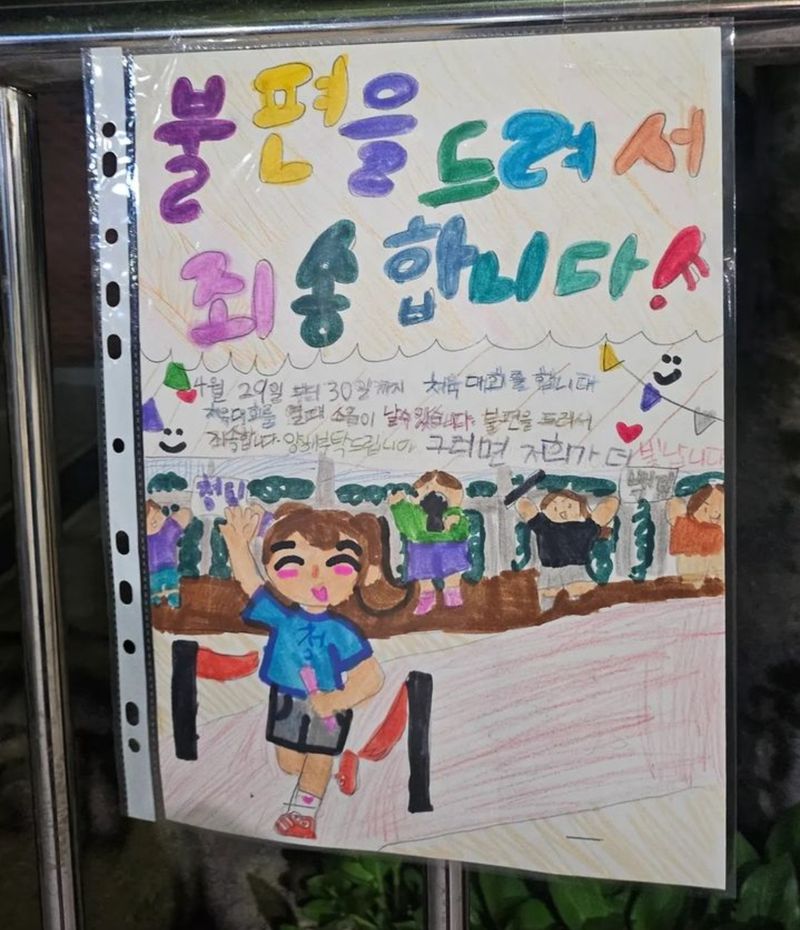
With the situation as it is, students preparing for sports days have even been putting up handwritten posters in nearby residential neighborhoods asking residents for understanding: “We’re sorry. Please let us play just a little.” In the name of discouraging competition, some schools have everyone cross the finish line as joint winners, while “mute sports days,” where applause and cheering are discouraged, have also emerged.
As restrictions on physical activity at schools approach a critical level, government authorities and politicians have begun working on measures. The National Police Agency issued a directive to police agencies across the country to “refrain as much as possible from responding to simple noise complaints related to school sports days.” The Ministry of Education also appealed for “adults’ generous understanding so that children can run and play in good health.”
Fundamental solutions through legislation are also being explored. Chun Ha-ram, floor leader of the Reform Party, said, “Because of the selfishness of a small number of people filing excessive complaints, children are being deprived of their right to run and play freely,” and is pushing to introduce the “Children’s Voices Are Not Noise Act.” The bill is intended to explicitly exclude children’s voices from the scope of regulation under the Noise and Vibration Control Act and to revise guidelines for receiving and handling 112 calls, thereby providing legal protection for legitimate educational activities at schools.
[email protected] Moon Young-jin Reporter