Jeonse prices climb further amid scarcity ... Seoul apartment jeonse-price gains outpace home-price gains
- Input
- 2026-11-01 15:30:43
- Updated
- 2026-11-01 15:30:43
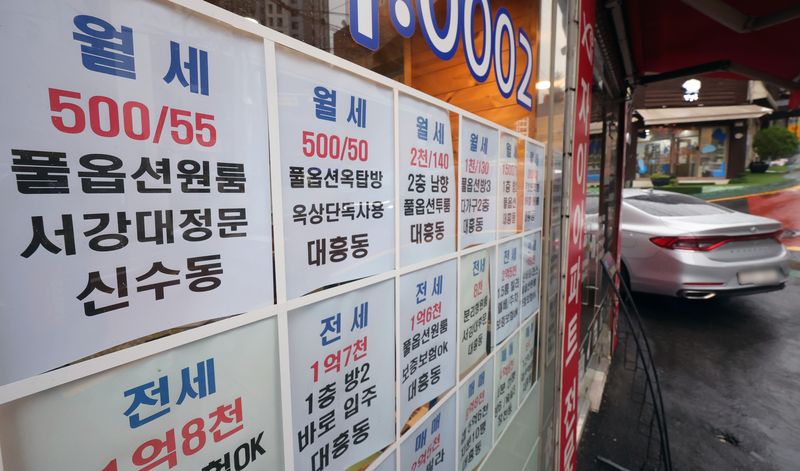
[Financial News] This year, the cumulative increase in Seoul apartment jeonse prices has exceeded the rise in sale prices. The main reason cited is a sharp drop in jeonse supply relative to demand, as lending restrictions, owner-occupancy requirements and measures to block gap investing have combined to constrain the market. Experts expect jeonse prices to remain strong for the time being.
An analysis by Financial News on the 1st of the Korea Real Estate Board’s (KREB) weekly apartment price index and actual transaction prices from the Ministry of Land, Infrastructure and Transport (MOLIT) found that the cumulative increase in Seoul’s apartment jeonse price index was 8.91% from the first week of January through the fourth week of October this year. That was 0.18 percentage points higher than the cumulative rise in the sale price index over the same period (8.73%). The cumulative increase in jeonse prices overtook that in sale prices in the first week of October, and the gap has widened for four consecutive weeks. As recently as early March, the sale-price increase was about 0.8 percentage points higher than the jeonse increase, but the rankings have reversed ahead of year-end.
The change is even clearer compared with last year. During the same period last year, cumulative increases in sale and jeonse prices were 6.88% and 2.31%, respectively, with the increase in sale prices nearly three times that in jeonse prices. This year, the jeonse price increase has surged to 3.9 times last year’s rate, overtaking the increase in sale prices. Recent trends have also diverged. The weekly increase in sale prices slowed from 0.29% in late August to 0.09% in the fourth week of October, while jeonse prices rose steadily by 0.16%–0.19% a week over the past six weeks.
The scarcity of jeonse listings is also evident in actual transactions. According to MOLIT’s actual transaction price disclosure system, 80,892 jeonse leases were recorded for Seoul apartments from January through September this year, down 26.9% from 110,664 during the same period last year. By contrast, monthly-rental transactions totaled 85,318, a decline of just 1.5%. As monthly rentals filled the gap left by jeonse, their share of combined jeonse and monthly-rental transactions rose from 43.9% to 51.3%, surpassing half. Monthly rentals accounted for 57.5% of newly signed contracts alone. The share of existing jeonse tenants who switched to monthly rent when renewing their contracts also increased from 6.3% to 7.5%.
Jeonse deposits have also risen sharply. For the same apartment complex and unit size, the median deposit for newly signed jeonse leases this year was up 8.6% from last year. Seongbuk District (15.4%), Gangdong District (14.3%), Nowon District (14.0%) and Songpa District (13.4%) all posted double-digit increases. According to the KREB index, jeonse prices in Songpa District surged 10.18% this year while sale prices rose 4.35%. In Gangnam District, sale prices fell 1.64%, while jeonse prices rose 2.34%, moving in opposite directions.
The sharp rise in jeonse prices is largely attributed to a decline in listings caused by regulations. Analysts say that restrictions on gap investing, lending rules and owner-occupancy requirements have made it harder to buy homes with jeonse tenants in place, reducing the number of jeonse properties coming onto the market. More landlords have also opted to rent out their properties monthly instead of on jeonse because of the burden of property holding and capital gains taxes. Shin Bo-yeon, a professor in the Department of Real Estate AI Convergence at Sejong University, explained, “With gap investing being prohibited, jeonse and monthly-rental listings aren’t coming onto the market, and the market is shifting toward owner-occupancy.”
A shortage of supply is another problem. According to MOLIT’s Housing Construction Performance Statistics, 22,768 Seoul apartments were completed from January through September this year, down 21.5% from 29,017 during the same period last year. Completions in the first half of the year totaled 12,251 units, only about half of the 23,685 recorded a year earlier. Jeonse listings on the market have also dwindled. MOLIT reported that Seoul apartment jeonse listings totaled 21,385 as of the 1st, down 3,616 (14.5%) from 25,001 on the same day last year.
The government is counting on a recovery in supply. According to MOLIT, permits for Seoul housing and construction starts rose 40.4% and 41.1%, respectively, from the same period last year during the first eight months of this year. MOLIT believes that if construction starts proceed as planned, completions could exceed the long-term average from 2028. However, it typically takes at least two to three years from the start of construction until residents can move in, making it difficult to increase jeonse supply in the short term.
Experts expect jeonse prices to keep rising for the time being. “If this is combined with demand from residents relocating for Seoul Metropolitan Government urban-renewal projects starting late next year, increases in jeonse and monthly rents will be even larger,” Shin said. “This is just a prelude. If around 180,000 households relocate by 2030, the upward trend will steepen further amid lending restrictions, high property holding taxes and other factors.”
[email protected] Jeong Gyeong-su Reporter