“Fear of a wave of bankruptcies is setting in” ... Delinquency rate at five major banks hits a 91⁄2-year high
- Input
- 2026-11-01 15:29:31
- Updated
- 2026-11-01 15:29:31
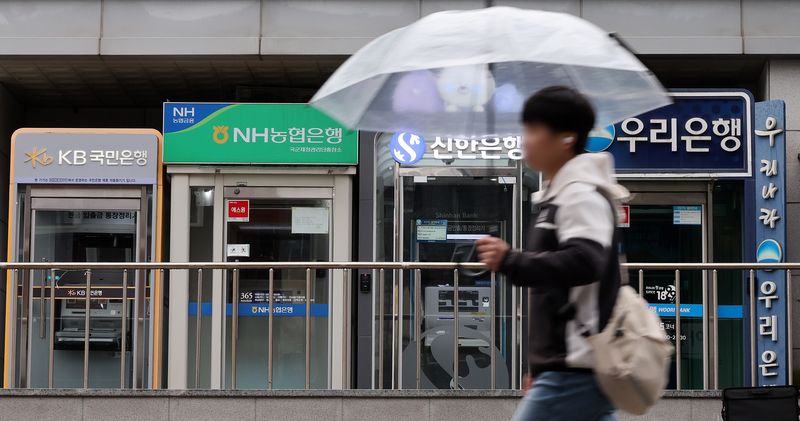
[Financial News] The delinquency rate on loans at South Korea’s five major banks has surged to its highest level in nine and a half years. The rate has continued to rise, particularly among small and midsize businesses, stoking concerns about corporate distress amid a sluggish economy and high interest rates.
According to financial industry sources on the 1st, the average delinquency rate on won-denominated loans at the five major banks (KB Kookmin, Shinhan, Hana, Woori and NongHyup Bank) stood at 0.42% at the end of the third quarter this year. This was the highest level since the first quarter of 2017 (0.45%), up 0.05 percentage points from the same period last year (0.37%) and 0.03 percentage points from the previous quarter (0.39%). The rate counts loans overdue by at least one month.
The delinquency rate on corporate loans stood at 0.49%, its highest level since the second quarter of 2017 (0.58%). It was up 0.07 percentage points from the same period a year earlier (0.42%) and 0.04 percentage points from the previous quarter (0.45%). In early 2017, the rate had also been high as restructuring in the shipbuilding and shipping industries coincided with an economic slowdown.
The rise in delinquencies was particularly pronounced among small and midsize businesses. At the end of the third quarter, their loan delinquency rate was 0.60%, the highest since the first quarter of 2017 (0.65%). The rate, which was 0.54% in the third quarter last year, fell to 0.49% in the fourth quarter, but rose again to 0.57% in the first quarter and 0.58% in the second quarter this year.
With sales and cash flows at companies unable to recover sufficiently amid a prolonged slump in domestic demand, the added burden of interest costs is believed to have weakened vulnerable companies’ ability to repay their debts.
The delinquency rate on loans to large companies also rose to 0.18%, its highest level since the second quarter of 2021 (0.19%). That was up 0.11 percentage points from the same period last year (0.07%) and 0.10 percentage points from the previous quarter (0.08%). However, banking industry sources believe this is likely a temporary development reflecting distress in some large loan exposures, including the workout and commencement of rehabilitation proceedings involving affiliates of the JoongAng Group.
By industry, wholesale and retail trade had the highest delinquency rate at 0.71%, followed by construction at 0.69%, accommodation and food services (0.55%), real estate (0.51%), scientific and technical services (0.49%), and manufacturing (0.36%).
Delinquency burdens were relatively high in wholesale and retail trade and accommodation and food services, where sales have been weak as the recovery in consumption has been delayed. The risk of loan distress also appears to be rising in sectors facing a prolonged downturn in the real estate market and a slowdown in construction.
By contrast, the household loan delinquency rate remained unchanged from the previous quarter at 0.33% at the end of the third quarter. Overall, however, it has been trending gradually upward, rising from 0.30% at the end of the third quarter last year to 0.32% in the first quarter this year.
“Except for a few booming sectors such as semiconductors, small and midsize businesses continue to struggle with weak domestic demand and declining sales,” a banking industry official said. “With no clear drivers of an economic recovery in the near term, and the possibility of further base-rate hikes, there are concerns that delinquency rates will continue to rise, particularly among vulnerable companies.”
[email protected] Seo Ji-yoon Reporter