U.S. stocks plunge for a second straight day as AI investment jitters cloud the economic outlook
- Input
- 2026-11-01 15:27:52
- Updated
- 2026-11-01 15:27:52

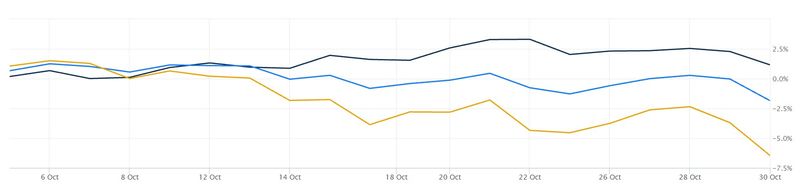
[Financial News] U.S. stocks plunged for a second straight day over the final two days of last month, dragging down shares of “Big Tech” companies focused on artificial intelligence (AI). Investors are now concerned not only about the outlook for AI, but also about the outlook for the U.S. economy, which has relied on AI.
On the 30th of last month (local time), the Dow Jones Industrial Average (DJIA), the Standard & Poor’s (S&P) 500 Index, and the NASDAQ Composite Index fell 1.09%, 1.82%, and 2.86%, respectively. The indexes had also fallen on the previous trading day, by 0.25%, 0.3%, and 1.38%, respectively, and failed to rebound. The NASDAQ-100 Index, which is made up of large-cap stocks listed on Nasdaq, fell 3.46% on the 30th.
Intel was the hardest-hit major stock. Its shares plunged 28.58%, marking the steepest drop in about 52 years, since 1974. Intel lost more than $140 billion (about 187 trillion won) in market capitalization that day. Other major AI-related semiconductor stocks also fell, including Nvidia (-4.22%), AMD (-10.88%), and SK hynix American depositary receipts (ADRs) (-7.95%). The PHLX Semiconductor Sector (SOX), which comprises 30 major semiconductor stocks listed in the United States, fell 7.2%, its largest one-day drop since June 23.
The latest plunge came as doubts about the profitability of AI-related Big Tech companies mounted in the market following third-quarter earnings reports from Alphabet on the 28th and Amazon and Intel on the 29th. Alphabet shares dropped 12.6% in a single day on the 29th after Google’s search revenue came in below market expectations. Amazon’s third-quarter revenue also fell short of forecasts, with advertising revenue particularly below expectations. Intel’s third-quarter results met market expectations, but a weaker fourth-quarter revenue outlook fueled market skepticism about the semiconductor sector.
Also on the 31st, U.S. credit rating agency S&P Global Ratings downgraded the credit outlook for Meta Platforms (hereafter Meta), which had announced on the 26th of the same month that it would raise $95 billion (about 126 trillion won) to build infrastructure such as AI data centers. Reflecting Meta’s financial position, including sharply rising capital expenditures and free cash flow turning negative, S&P changed the credit outlook from “stable” to “negative.” It kept the credit rating itself at “AA-.” Meta said it “disagrees” with S&P’s assessment, arguing that “significant product and business opportunities lie ahead, and these will support a very strong credit rating.”
Joe Tigay, a portfolio manager at U.S. asset manager Equity Armor Investments, told Canada’s CBC that “the market has moved beyond the vague ‘hopes and dreams’ stage of AI-related investment and has now entered a stage where concrete results must be demonstrated.”
Some experts said the economy as a whole is too dependent on AI-related technology stocks. Vincent Reinhart, chief economist at U.S. asset manager BNY Investments, told the U.K.’s Financial Times (FT) on the 31st that the U.S. economy “is heavily dependent on spending in the technology sector,” adding that “this is happening not only in the United States but across the world.” Robert Sorkin, chief U.S. economist at U.S. asset manager PGIM, discussed a scenario in which the AI investment boom leads the U.S. economy to overheat and then fall into recession. He said the probability of a U.S. recession was 10% early this year, rose to 20% in September, and could climb to 25% in the future. The FT reported that as investors’ doubts about the sustainability of AI investment grow, they are lowering their economic growth forecasts and increasing purchases of safe-haven government bonds. U.S. GDP grew 3.4% in the third quarter, above market expectations, but prices for U.S. 10-year Treasury Inflation-Protected Securities (TIPS) surged at the end of October to their highest level since early September.
[email protected] Park Jong-won Reporter