FATF steps up efforts to combat fraud... “North Korea and Iran retain high-risk status”
- Input
- 2026-11-01 12:19:44
- Updated
- 2026-11-01 12:19:44
According to financial authorities on the 1st, FATF will prepare an in-depth analysis report to address gaps in the implementation of international standards in the virtual asset sector. The report will focus on countries with a significant presence in the sector that have shortcomings in implementing international standards. Member countries that have not introduced laws and systems based on FATF Recommendation 15, which sets out anti-money laundering (AML) obligations such as implementing and supervising the Travel Rule, or that have not undergone an official assessment of their operational effectiveness, will also report on their implementation of the standards. The findings of the in-depth analysis are expected to be presented at the plenary meeting in June 2027. South Korea was not assessed on Recommendation 15 in FATF’s fourth round of mutual evaluations. This in-depth analysis will review the implementation of international standards in the virtual asset and virtual asset service provider sectors.
A new report aimed at blocking illicit financial flows linked to scam compounds was also adopted. Based on countries’ practical experience and case studies, the report analyzes how international criminal networks that support scam compounds raise and move funds. It also proposes ways to counter the business models and specialized criminal services used by criminal organizations. During the report’s preparation, South Korea shared emerging types of scam crimes, financial flows, and response cases. It introduced victim-prevention measures, including the rapid suspension of transactions, and a whole-of-government cooperation system using the AI-based Anti-phishing Sharing and Analysis Platform (ASAP).
In line with the ministerial declaration issued in April, FATF is considering ways for member countries to actively use a range of tools and capabilities to combat fraud. It plans to incorporate the findings and policy recommendations of the report on scam compounds into follow-up measures. In particular, member countries stressed the importance of information-sharing across borders and international cooperation, given the transnational nature of fraud and the movement of criminal funds. The need for stronger monitoring of financial and non-financial sectors—including financial institutions and virtual asset service providers—as well as cooperation in detecting suspicious transactions, tracing and freezing funds, and recovering criminal proceeds throughout the entire process was also noted.
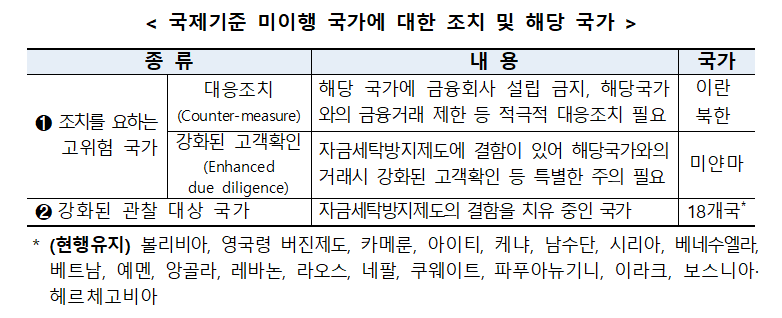
The plenary also discussed measures against countries that fail to implement international standards. Iran and North Korea retained their status as “high-risk jurisdictions subject to a call for action (countermeasures).” Myanmar also retained its status as a “high-risk jurisdiction subject to a call for action (enhanced customer due diligence).” The Democratic Republic of the Congo, Côte d’Ivoire, Bulgaria, and Monaco were removed from the list of jurisdictions under increased monitoring. Eighteen countries remained on the list: Bolivia, the British Virgin Islands, the Republic of Cameroon, Haiti, Kenya, the Republic of South Sudan, Syria, Venezuela, Vietnam, Yemen, Angola, Lebanon, Laos, Nepal, Kuwait, the Independent State of Papua New Guinea, Iraq, and Bosnia and Herzegovina.
Mutual evaluation reports assessing the effectiveness of measures to prevent money laundering, terrorist financing, and proliferation financing in the United States and Mexico, as well as their implementation of FATF recommendations, were also discussed and adopted. Member countries reaffirmed the importance of combating and preventing crime by imposing AML obligations on and supervising designated non-financial businesses and professions (DNFBPs), such as lawyers and accountants, and by collecting, managing, and using beneficial ownership information for legal entities, amid the evolution of money laundering methods.
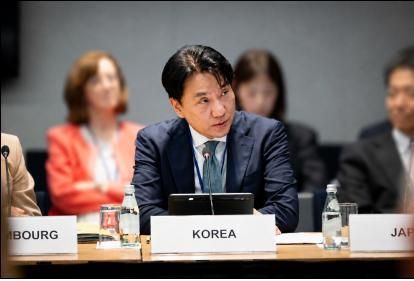
Lee Hyung-ju, head of the Financial Intelligence Unit, attended a FATF steering committee meeting held at the British Embassy in Paris, where participants discussed future responses for countries with shortcomings in implementing FATF standards in which major scam compounds had been identified, based on the findings of a research report FATF completed as part of its Phase 1 project on combating global fraud. Lee stressed, “Since most of those countries have limited capacity, technical assistance should come first, through capacity-building programs and other measures. International cooperation is important given the transnational nature of organized crime.” The next plenary meeting is scheduled to be held at OECD headquarters in Paris, France, in February 2027.
[email protected] Park Mun-su Reporter