Korean Firms Seek Opportunities at Japanese Data Centers, from Investment Returns to Equipment Contracts
- Input
- 2026-11-01 17:22:21
- Updated
- 2026-11-01 17:22:21
【TOKYO/SEOUL—Special Correspondent Seo Hye-jin and Reporter Park Ji-yeon】South Korean companies considering commitments to a joint South Korea-Japan data center fund are targeting both investment returns and opportunities to supply their own products and equipment. They are exploring projects that could involve everything from supplying semiconductors and cooling equipment to constructing and operating facilities. Experts say the companies could also expand their businesses by using data centers directly to secure the computing resources they need.■Samsung, SK and LG Link AI Investment to Core BusinessesAccording to business sources on the 1st, South Korean conglomerates are already linking investment in artificial intelligence (AI) infrastructure to the expansion of their core businesses. Six companies—Samsung Electronics, Samsung C&T, Samsung SDS, Samsung SDI, Samsung Life Insurance and Samsung Fire & Marine Insurance—agreed last September to invest a total of $1 billion (about 1.3358 trillion won) in U.S. AI infrastructure company Helix Digital Infrastructure. Helix develops data centers alongside power and telecommunications infrastructure.
Through this investment, Samsung plans to bring together its affiliates’ capabilities in semiconductors, cooling equipment, construction and operations, and batteries. The strategy is to invest in an AI infrastructure company while also securing opportunities to take part in building and operating facilities, beyond supplying components and equipment.
SK Group is pursuing an AI data center in Ulsan with Amazon Web Services (AWS), targeting its first operations next year. The project combines the construction and operating capabilities of SK Telecom and SK Broadband with the group’s energy and telecommunications infrastructure and AWS’s cloud capabilities. Lee Sang-heon, an analyst at iM Securities, said, “Given that SK is also pursuing the construction of a large-scale data center in South Korea, it could approach this as a way to expand its business overseas.”
LG is also supplying a package for a data center in Indonesia that combines LG Electronics’ cooling technology, LG Energy Solution’s batteries, and LG CNS’s design, construction and operations capabilities. LG Electronics is also addressing demand for cooling at AI data centers, investing a total of 150 billion won to build a new chiller plant in Virginia and expand production lines in Pyeongtaek and Changwon, South Korea.■Beyond Construction to Operations and Use...Locations Also in FocusCompanies can also find opportunities to participate in the joint fund established by Korea Investment Holdings and SBI, drawing on their respective capabilities. Lee said, “If South Korean companies take part in a joint South Korea-Japan data center project, they could do so through equity investment or as limited partners (LPs) in the fund. Samsung C&T could construct data centers, Samsung SDS could participate in related businesses, and Samsung Electronics could also consider using data centers in Japan in the future.”
Revenue can also be generated from operations and computing services once a facility is up and running. In a recent report on Samsung SDS, iM Securities classified data center investment approaches as direct asset ownership, equity investment, and design, construction and operations for clients. Direct ownership generates revenue by providing space for servers, power and cooling, or by leasing out GPU computing resources. Although this approach requires a substantial investment, it can increase returns depending on facility utilization rates and demand for services.
Securing computing resources can also be an important investment objective for companies that use data centers. Lee said, “Samsung Electronics also needs to use data centers for things like physical AI,” adding, “Investment in data centers in Japan can also be viewed as an extension of these businesses.”
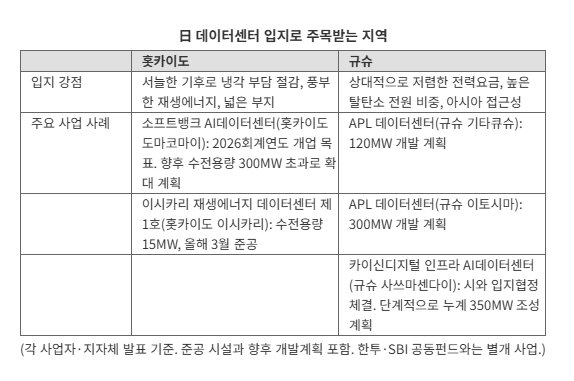
Where to build data center facilities is also drawing attention. A key consideration in choosing a site for large-scale AI computing facilities is whether they can secure the enormous amounts of power they need.
Kyushu, one of the candidate sites for the project, has infrastructure for nuclear power and renewable energy generation. Production bases for semiconductor companies, including JASM, a TSMC subsidiary in Kumamoto, as well as Sony and Mitsubishi Electric, are also located there. The concentration of advanced industries is growing, with TSMC’s entry spurring further investment by related companies and the development of supply chains.
In a report in February, Mitsubishi UFJ Trust and Banking said, “Facilities for AI training face relatively few constraints from communication latency, so they can also be located in regional areas where it is easier to secure power.”
[email protected] Seo Hye-jin, Park Ji-yeon Reporter