North Korea fired a cluster-warhead missile the previous day; South Korean military detected it but could not announce it immediately
- Input
- 2026-11-01 10:19:11
- Updated
- 2026-11-01 10:19:11
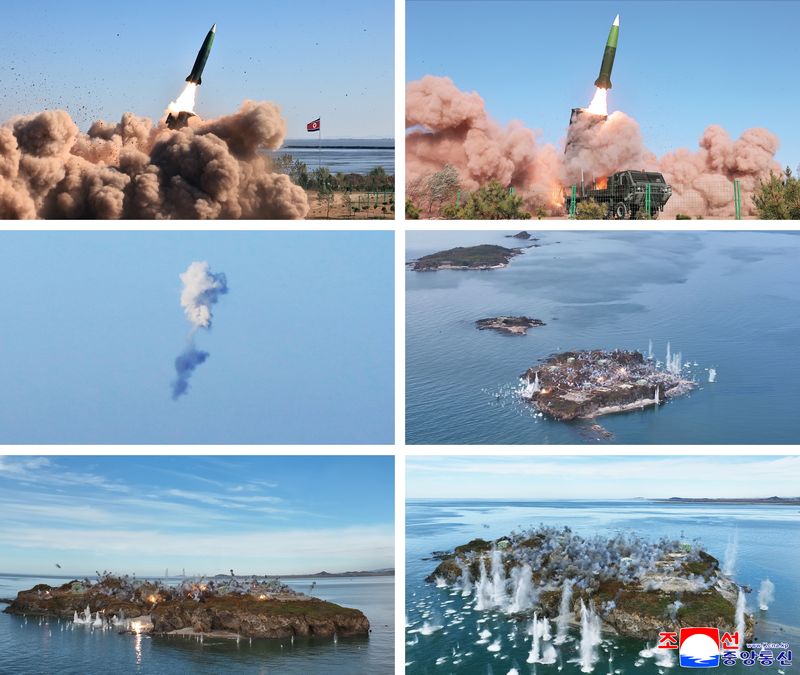
North Korea claimed that the cluster-warhead missile launched this time, equipped with a standard Type 2 dispersal warhead, could devastate a target area of approximately 11.9–12.9 hectares at an extremely high density.
A dispersal warhead refers to a cluster warhead (cluster munition or cluster bomb) containing multiple submunitions (bomblets) inside a single warhead. It is a weapon that maximizes lethality by exploding in midair and scattering the submunitions in all directions. In April, North Korea also test-fired a Hwasong-11D-type missile equipped with a cluster warhead, with State Affairs Commission Chairman Kim Jong Un and his daughter Ju Ae observing.
Photos released by the news agency that day showed the missile launch, the warhead exploding in midair and its submunitions scattering into the air, and submunitions exploding across a wide area of the target zone.
Images also showed arched-roof structures, believed to be modeled on aircraft hangars, ammunition depots, artillery positions and other facilities of the Republic of Korea Armed Forces, being destroyed by cluster munitions on the target island.
North Korea also said it would make four types of cluster warheads available for operational use by military units before the end of the year.
The South Korean military detected North Korea’s launch of a cluster-warhead ballistic missile the previous day but did not announce it immediately. Until now, it has tracked and announced each North Korean ballistic missile launch in real time. Concerns arose that the military’s detection and analysis may have been delayed because North Korea launched missiles at shorter ranges and lower altitudes.
The Republic of Korea Joint Chiefs of Staff (ROK JCS) said in this regard, “Yesterday, we detected a missile that North Korea launched from the area around Jeongju County in North Pyongan Province toward the Yellow Sea,” and added, “South Korea and the United States had been tracking related activity from before North Korea’s missile launch while closely sharing intelligence, and had maintained a state of readiness.” Like the South Korean military, Japan’s Ministry of Defense also made no announcement on the matter.
[email protected] Kim Gyeong-su Reporter