As Micro LED Stalls, OLED Expansion in Laptops Gains Momentum
- Input
- 2026-11-02 06:59:00
- Updated
- 2026-11-02 06:59:00
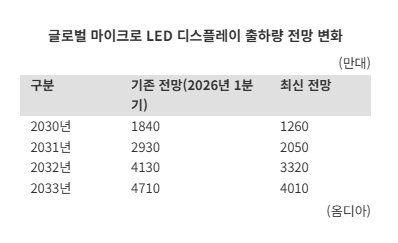
[Financial News] Micro light-emitting diode (LED), once touted as a next-generation display, is struggling to reach commercialization because of high manufacturing costs and the challenges of mass production, while organic light-emitting diode (OLED) is expanding its foothold in the laptop market. The expansion of the laptop OLED market is gaining momentum, particularly after Apple Inc. recently unveiled its first OLED MacBook. This is expected to further bolster the expansion of the IT panel businesses at Samsung Display Co., Ltd. and LG Display Co., Ltd., which have OLED technology and production capacity.■ Micro LED Growth Forecast DowngradedAccording to the latest report from market research firm Omdia on the 2nd, global shipments of Micro LED displays are expected to reach 20.5 million units in 2031. That is about 30% below the 29.3 million units Omdia forecast in the first quarter of this year. The forecast for 2030 shipments was also lowered by 31.5%, from 18.4 million to 12.6 million units.
Micro LED is a self-emissive display that arranges tiny inorganic LEDs, each measuring several tens of micrometers (μm), in pixels. Like OLED, it emits its own light without a separate backlight, while offering high brightness, a long lifespan and resistance to burn-in, leading to expectations that it would become a next-generation display technology. However, the transfer process for placing the countless LED chips onto a substrate, as well as the inspection and repair of defective pixels, entails enormous costs. Securing adequate production yields is also difficult, making it hard to achieve price competitiveness.
Limits are also becoming apparent in the finished-product market. Expectations for the market to take off rose as Samsung Electronics began showcasing Micro LED TVs in 2020, but by last year the global Micro LED TV market had yet to reach even 1,000 units a year. Garmin, a global smartwatch maker, also launched a Micro LED product last year, but adopted only OLED for this year’s follow-up model. In the automotive market, plans to use Micro LED for exterior vehicle displays fell through after Sony Honda Mobility canceled its electric vehicle project, AFEELA.■ Laptop OLED Market Expands, Highlighting South Korea’s Competitive EdgeWhile competing technologies struggle to reach commercialization, the OLED market is growing. The shift to high-performance displays is accelerating, particularly in the laptop market.
According to market research firm Counterpoint Research, total laptop display shipments are expected to decline 3% this year from the previous year, partly because of rising memory prices. By contrast, shipments of high-performance displays, including OLED and Mini LED, are expected to increase 11%.
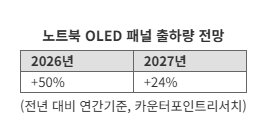
Shipments of OLED panels for laptops are forecast to rise 50% this year and 24% next year. The analysis is that Apple’s adoption of OLED and demand for premium AI PCs will drive market growth.
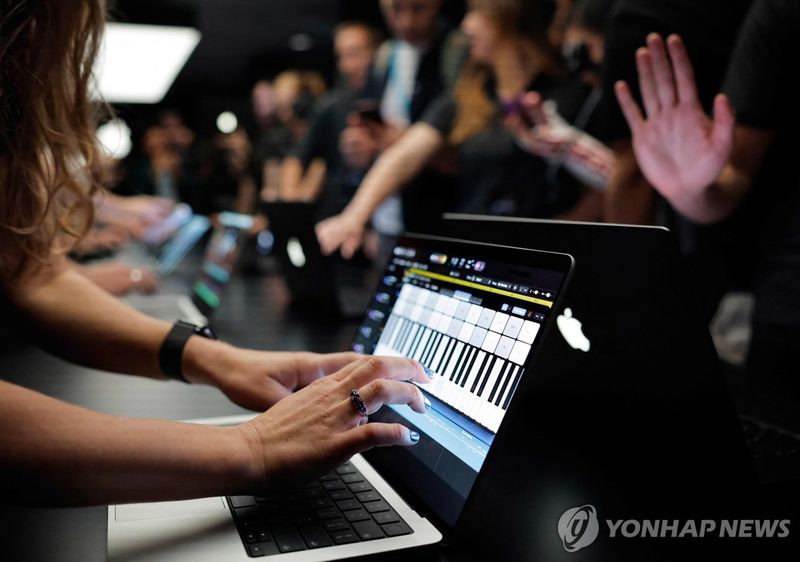
Apple recently unveiled 14- and 16-inch MacBook Pro models with OLED displays featuring touch functionality. This is the first time OLED and touchscreen functionality have been introduced to the MacBook lineup. With Apple joining major laptop makers, the shift to OLED in the premium laptop market is expected to gain momentum.
Samsung Display Co., Ltd. is reportedly supplying the entire initial batch of OLED panels for the new MacBook Pro. According to Omdia, Samsung Display has an 87.7% share of the laptop OLED market in the third quarter of this year. Building on its 8.6-generation IT OLED production line at its Asan campus in South Chungcheong Province, Samsung Display is expanding its supply of panels for laptops and tablets and strengthening its market leadership. LG Display Co., Ltd. is also stepping up its push into the laptop panel market, leveraging tandem OLED technology that improves brightness, lifespan and power efficiency.
An industry official said, “Technologies billed as next-generation displays are emerging, but ultimately OLED is likely to be the technology that survives in the market, as customers choose it for its superior performance, price and yield.”
[email protected] Lim Su-bin, Park Ji-yeon Reporter