Quad to Build Recycling Supply Chain to Counter China's Critical Mineral Controls
- Input
- 2026-11-01 09:28:54
- Updated
- 2026-11-01 09:28:54
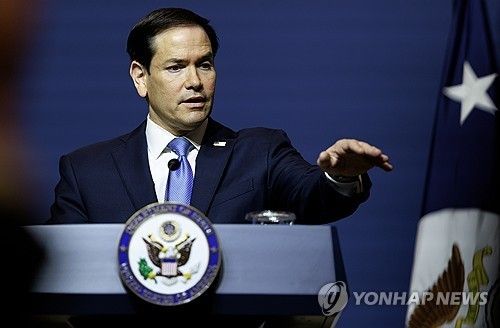
The Quadrilateral Security Dialogue (Quad), a security grouping of the United States, Japan, Australia and India, held a foreign ministers' meeting in Atlanta, United States, on the 31st (local time) and adopted a joint statement outlining economic security cooperation. Attending the meeting, held on the sidelines of the Group of Twenty (G20) foreign ministers' meeting, were U.S. Secretary of State Marco Rubio, Japanese Foreign Minister Motegi Toshimitsu, Australian Foreign Minister Penny Wong and Indian Foreign Minister Subrahmanyam Jaishankar.
In their statement, the four countries said that arbitrary export restrictions and non-market policies that cause overproduction threaten supply chains in major industries. Although they did not name any country, the comments were interpreted as effectively targeting China, which has been tightening its controls on critical mineral exports.
At a news conference, Secretary Rubio was asked whether the remarks were aimed at China. He said, “One country keeps repeating such activities and behavior. That is obvious to everyone.” However, he stressed that the Quad “is not an anti-China alliance or a coalition targeting any particular country. It is a cooperative arrangement that shares common interests and a common opposition to a particular administration,” adding that the group was not an organization intended to exclude any country.
Cooperation on critical minerals is focused on building recycling supply chains that extract minerals from waste and put them back to use. The Quad agreed to recover critical minerals from electronic waste and scrap metal, among other sources, and strengthen a private-sector-led recycling system spanning waste collection, processing and refining.
This cooperation is a follow-up to the “Quad Critical Minerals Initiative Framework” announced in May. The United States pledged $10 million to expand facilities that make use of waste resources, as well as related infrastructure, in India and ASEAN member states. The countries are also considering simplifying import and export procedures and strengthening enforcement of existing related regulations so that recycled materials can be traded smoothly across borders.
Coordination on energy supply chains is also expanding. Last September, the Quad held its first Fuel Security Forum to discuss ways to stabilize energy supplies in the Indo-Pacific. At the time, strengthening each country's strategic petroleum reserves and fuel inventories was a key area for cooperation. The Quad is broadening the scope of its economic security cooperation from critical minerals to energy resources.
The countries also agreed to work together to ensure the safety of maritime logistics networks. The four countries reaffirmed that freedom of navigation under international law must be guaranteed in the Strait of Hormuz, the Red Sea and the Bab-el-Mandeb Strait. They also opposed actions that hinder the safe movement of ships and crews or impose transit fees.
In advanced technology, cooperation on the U.S.-led “Pax Silica” initiative and superintelligence (SI) was presented as a key agenda item. The Quad plans to expand technical and financial support, using initiatives such as the “Quad SI Accelerator,” to help Indo-Pacific countries access trusted AI technologies. The joint statement uses the term “superintelligence” and separately explains that Australia, India and Japan use it to mean the same thing as AI.
The Nihon Keizai Shimbun analyzed that the agreement was also related to efforts to counter the spread of China's low-cost AI technology. With a number of Global South countries seeking to adopt Chinese AI models such as DeepSeek, the Quad had emphasized the deployment of U.S.-led AI technology as part of its economic security efforts, the paper said.
The countries also agreed to coordinate their response to cybercrime. The four countries said they would disrupt online scams and the activities of cybercrime organizations that threaten international security, and hold criminal groups and their leaders accountable. Japanese media, including Kyodo News, reported that Foreign Minister Motegi had emphasized the need for cooperation against malicious cyber activities, particularly North Korean hacking.
Semiconductor supply chains were also added as a new area of cooperation. The Quad agreed to begin identifying vulnerabilities in the supply chains for advanced semiconductors and SI-related hardware where bottlenecks could arise. It also plans to select priority countries for cooperation and identify projects in 5G, 6G, Open Radio Access Network (Open RAN) and SI-based radio access networks.
The countries will also strengthen exchanges among businesses to turn economic cooperation into concrete projects. The Quad agreed to hold its first “Quad Business Leaders Forum” to promote commercial transactions in key industries and public-private cooperation. The export credit agencies of the four countries are scheduled to meet in Tokyo, Japan, on the 18th to discuss specific cooperation projects.
In maritime security, the countries agreed to hold the first exercise under an Indo-Pacific maritime surveillance cooperation initiative in 2027 through “Sea Dragon.” Earlier, from September 25 to October 7, officials from all four countries also took part in a joint shipboard observation activity, sailing aboard an Indian Coast Guard vessel from Chennai, India, to Perth, Australia.
[email protected] Seung-hyun Ahn Reporter