China’s industrial equipment exports surge 2.5-fold ... South Korea loses ground in emerging markets
- Input
- 2026-11-01 11:00:00
- Updated
- 2026-11-01 11:00:00
[Financial News] China is rapidly encroaching on the global industrial equipment market with its competitive pricing, narrowing the foothold of South Korean companies. China’s industrial equipment exports have surged 2.5-fold over the past 10 years, and its share of emerging manufacturing markets has approached 30%. Analysts say South Korea should strengthen supply reliability in developed markets while seeking breakthroughs in emerging markets, particularly with automation and high-precision equipment.
■ China’s industrial equipment exports rise 2.5-fold in a decade
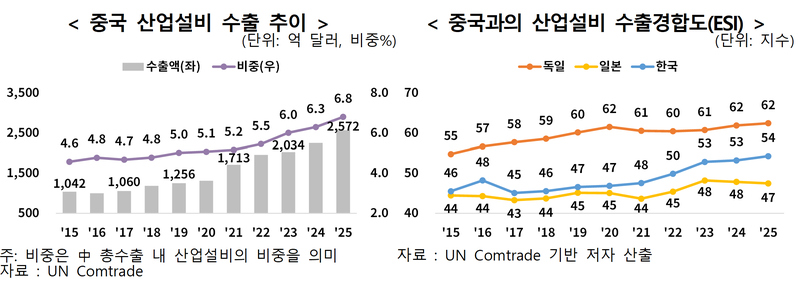
The Korea International Trade Association’s IIT said on November 1, in a report titled “The Rise of China’s Industrial Equipment Exports and Changes in the Global Supply Structure,” that China’s industrial equipment exports increased about 2.5-fold, from $104.2 billion in 2015 to $257.2 billion last year. Its average annual growth rate was 8.2%, far outpacing those of consumer goods (1.8%) and intermediate goods (6.0%) over the same period.The analysis indicates that China is expanding its influence beyond supplying consumer and intermediate goods to become a supplier of industrial equipment that helps build manufacturing production bases in other countries.
As China expands its exports, competition among major manufacturing powers is also intensifying. The export competition index (ESI) for industrial equipment between South Korea and China rose from 46 in 2015 to 54 last year. Over the same period, Germany’s score climbed from 55 to 62, while Japan’s rose from 44 to 47. A higher index means that the countries compete in the global market with more similar products.
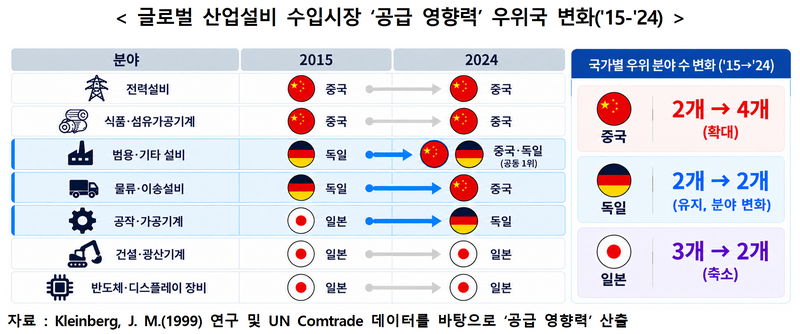
China is rapidly strengthening its competitiveness, particularly in general-purpose industrial equipment. It has overtaken Germany not only in power equipment and food and textile processing machinery, where it was already strong, but also in logistics and materials-handling equipment. In general-purpose and other equipment, it tied with Germany for first place globally in supply influence.
This growth is attributed to the combination of increased manufacturing investment in emerging countries such as ASEAN members and Chinese companies’ expansion of overseas production bases. China’s cumulative outward direct investment in manufacturing rose from $78.5 billion in 2015 to $338.9 billion in 2024. The expansion of overseas sales channels amid sluggish domestic demand, along with price competitiveness, also supported export growth.
■ South Korea loses ground in emerging markets ... targets high-value-added equipment
China’s growing influence was especially pronounced in emerging manufacturing markets. China’s share of industrial equipment imports in those markets rose by 8.5 percentage points, from 21.1% in 2015 to 29.6% in 2024. By contrast, in developed manufacturing markets such as the United States, its share increased only 1.2 percentage points, from 12.8% to 14.0% over the same period. This is seen as reflecting the constraints that U.S. trade sanctions placed on China’s market expansion.South Korea saw contrasting trends in developed and emerging markets. In developed manufacturing markets, its share edged up from 3.0% in 2015 to 3.3% in 2024. Over the same period, Germany’s share fell from 16.5% to 15.0%, and Japan’s from 7.5% to 6.4%.
In emerging manufacturing markets, however, South Korea’s share fell 2.2 percentage points, from 6.3% to 4.1%. The analysis attributes the weakening of South Korean companies’ market foothold to the rapid spread of Chinese-made general-purpose equipment.
The Korea International Trade Association recommended that companies strengthen their competitiveness in developed manufacturing markets by emphasizing supply reliability, including quality, delivery times and maintenance. It also stressed the need to actively pursue demand for new equipment in the U.S. market, where China’s share has declined.
The analysis said that in emerging manufacturing markets, companies should participate in supplying equipment from the outset of new production base construction or expansion to secure an early foothold, then broaden their business to meet demand for automation, greater precision and replacement of aging equipment.
Heo Seul-bi, a researcher at the Korea International Trade Association, stressed, “As China rapidly expands its supply of industrial equipment by leveraging its price competitiveness, our companies must differentiate themselves through reliable quality and delivery, as well as their capabilities in parts supply and maintenance,” adding, “The government should also support responses to local certification requirements and the identification of companies with demand, among other things, to reduce the burden on our companies as they expand overseas.”
[email protected] Kim Dong-ho Reporter