Ulsan and Incheon Sign Hydrogen and LNG Industry Mutually Beneficial Cooperation MOU ... Build a Mega-Regional Energy Nexus
- Input
- 2026-11-01 09:29:18
- Updated
- 2026-11-01 09:29:18
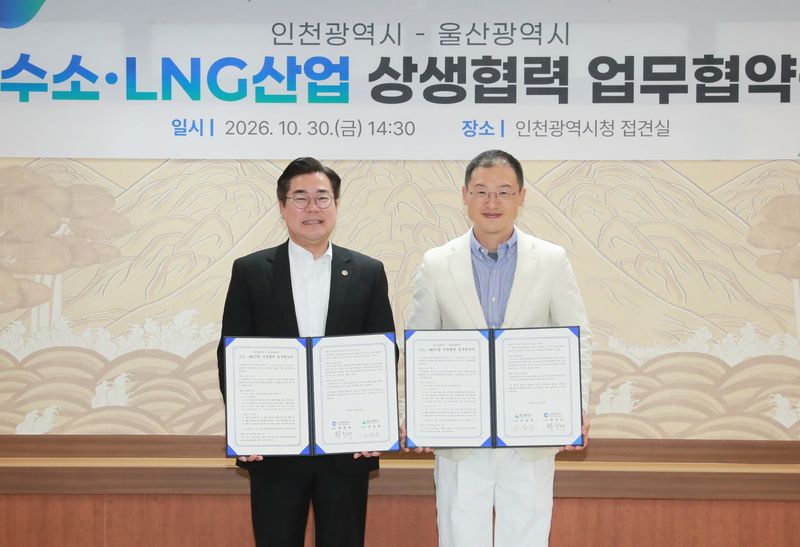
【Financial News, Ulsan = Choi Soo-sang】 Ulsan Metropolitan City and Incheon Metropolitan City have agreed to build a mega-regional energy hub by leveraging the two regions’ hydrogen and liquefied natural gas (LNG) industries.
According to Ulsan Metropolitan City on the 1st, Ulsan Mayor Kim Sang-wook and Incheon Mayor Park Chan-dae signed a “Hydrogen and LNG Industry Mutually Beneficial Cooperation Agreement” at Incheon City Hall on October 30.
The agreement was designed to maximize synergies by combining Incheon’s large-scale liquid hydrogen production and logistics infrastructure with Ulsan’s hydrogen production, mobility and shipbuilding industries, and its demonstration capabilities.
The two cities agreed to share information on conditions for hydrogen production and supply and work together to expand the adoption of hydrogen passenger and commercial vehicles and hydrogen refueling infrastructure. In particular, they will jointly explore the possibility of introducing new mobility models such as hydrogen taxis and identify new sources of demand in transportation, logistics and manufacturing.
They will also work together to identify new industries that use LNG’s otherwise-unutilized cryogenic energy and link it with advanced local industries such as AI data centers (AIDCs), semiconductors, biotechnology and cold-chain logistics.
The partnership is expected to provide strong support in addressing challenges faced by industry. The two cities plan to jointly identify ways to expand government support and improve regulations, and to coordinate their efforts in applying for competitive programs, including national R&D demonstration projects, significantly broadening business opportunities for local companies.
Ulsan Mayor Kim Sang-wook emphasized, “To prepare for the era of clean hydrogen, we must protect and expand current hydrogen demand and refueling infrastructure,” adding, “Together with Incheon, we will expand the market for hydrogen use and cooperate on utilizing LNG cold energy to build out a mega-regional nexus (a connecting hub) linking industries and regions.”
Incheon is currently positioning itself as the “Hydrogen Mobility Capital,” with SK E&S’s world’s largest liquid hydrogen plant at its center, and is leading the transition of public transportation to hydrogen. Ulsan, meanwhile, is drawing on the country’s largest by-product hydrogen supply network and the mobility infrastructure at Hyundai Motor Ulsan Plant to upgrade its hydrogen pipeline network and build a comprehensive hydrogen ecosystem spanning ships and power generation.
[email protected] Choi Soo-sang Reporter