Rubio: Trump’s foreign policy will remain unchanged even if Democrats take control of Congress
- Input
- 2026-11-01 09:03:30
- Updated
- 2026-11-01 09:03:30
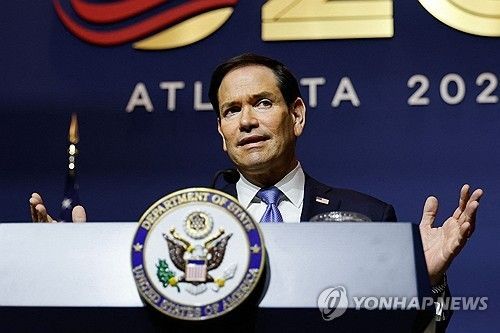
According to the U.S. Department of State on the 31st (local time), Secretary Rubio was asked at a news conference at the G20 Foreign Ministers’ Meeting in Atlanta, Georgia, whether his work as secretary of state would become more difficult if Democrats took control of Congress next January.
Secretary Rubio stressed, “That (control of Congress) will not affect or change the president’s directives (on foreign policy),” adding, “The president was elected to carry out U.S. foreign policy. That is a function of the executive branch.”
This means that even if Republicans lose their majority in Congress, the basic direction of the foreign policy pursued by President Trump will not change.
Secretary Rubio cited his own experience in Congress. “Congress has a role in foreign policy. I served in that role for a long time as a senator. So I understand well what Congress can and cannot do,” he explained.
“We’ve experienced being in both the majority and the minority, and we’ve also experienced Democrats taking the White House and Republicans controlling it,” he said. “In the end, I realized that our foreign policy is largely driven by the executive branch.”
Secretary Rubio served as a U.S. senator from Florida for 14 years, from 2011 to 2025. He became secretary of state in January last year, when the second Trump administration took office. He added, “What frustrated me most when I was a senator was that, although there are things we can do, ultimately foreign policy decisions are made by the executive branch.”
The remarks came three days before the U.S. midterm elections. The election, to be held on November 3, will fill all 435 seats in the House of Representatives and about one-third of the Senate seats. The new Congress resulting from the election will convene on January 3, 2027.
Public opinion ahead of the election favors the Democrats. In an NPR-PBS-Marist poll released on October 27, 52% of likely voters supported Democratic candidates, compared with 44% who supported Republican candidates. The Democrats led by 8 percentage points. As of October 31, election forecaster Decision Desk HQ (DDHQ) put the likelihood of Democrats winning a House majority at 83%. This is a projection, not the actual election result.
If Democrats gain control of Congress, they could constrain the Trump administration’s efforts to advance its foreign policy. In particular, Congress can influence policy implementation through its budget approval and oversight powers. If Democrats also take the Senate majority, conflicts could arise in the confirmation process for key foreign affairs and national security officials.
At the news conference, Secretary Rubio also separately mentioned Congress’s budget allocation and oversight functions, explaining that these are customary checks in the U.S. political system. His remarks are seen not as denying Congress’s influence, but as expressing the president’s determination to maintain the lead on foreign policy regardless of the balance of power in Congress.
[email protected] Seung-hyun Ahn Reporter