New York stocks lose $1 trillion in market value amid AI sell-off ... “A time when winners and losers are being separated”
- Input
- 2026-11-01 03:54:45
- Updated
- 2026-11-01 03:54:45
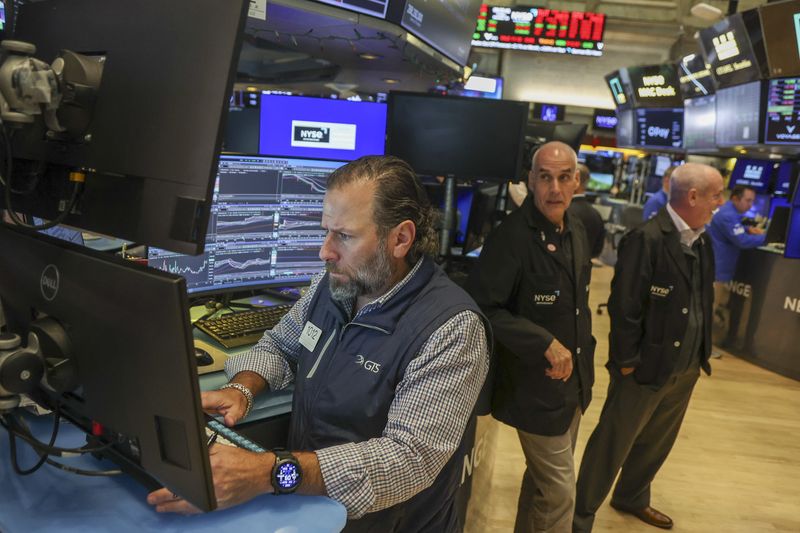
The market capitalization of New York stocks was estimated to have fallen by $1 trillion (about 1.336 quadrillion won) in a single day on the 30th of last month (local time).
Technology stocks came under selling pressure after recent earnings reports confirmed that massive investments in artificial intelligence (AI) infrastructure were not translating into returns for big tech companies.
Investors’ anxiety about AI grew further amid Blackstone Inc.’s forecast that Anthropic, an AI startup slated for what is expected to be the largest-ever initial public offering (IPO) this month, would remain at “junk bond” credit-rating levels for some time even after going public. Blackstone is the world’s largest private-equity firm.
But prominent tech stock analyst Dan Ives, a partner at Yorkville Ives, said it was not yet time to dump all AI-related stocks. He said it was time to distinguish between “disruptors (winners)” and “those being disrupted (losers)” and sell the losers.
$1 trillion in market value wiped out
The three major New York stock indexes tumbled on the 30th of last month. The Dow Jones Industrial Average (DJIA), which has relatively little exposure to AI, fell more than 1%, while the Standard & Poor’s (S&P) 500 and the Nasdaq Composite plunged 1.8% and 2.9%, respectively.
The Nasdaq 100, made up of 100 large technology stocks, plunged 3.5%. Semiconductor stocks were hit especially hard, with Intel plunging 29%.
According to NBC News, more than $1 trillion in market capitalization was wiped out in the U.S. stock market that day.
Questions over AI monetization
The fundamental cause of investors’ fear is uncertainty about whether AI can be monetized. During this third-quarter earnings season, big tech companies have poured hundreds of billions of dollars into data centers and AI infrastructure and said they would continue investing. But it became clear that the pace at which they are recouping those costs through returns falls far short of market expectations.
In particular, the free cash flow (FCF) of so-called hyperscaler big tech companies, which provide cloud services through massive data centers, is flashing red.
Meta Platforms, Alphabet Inc. and Amazon all reported negative FCF. Microsoft (MS) remained in positive territory, but its FCF declined.
This means that amid massive AI investments, these big tech hyperscalers are grappling with rapidly rising cash outflows.
Anthropic’s funding burden
As questions mounted over big tech’s ability to generate cash, concerns about Anthropic’s funding pressures added to the strain.
According to the Financial Times (FT), Blackstone Inc., which is coordinating Anthropic’s large-scale fundraising plan, warned investors that the company’s credit rating would remain at junk-bond levels even after its IPO.
Anthropic plans to raise massive sums through its so-called “North Star Plan (Project Northstar)” and invest more than $800 billion in AI infrastructure by 2045. This means that even if Anthropic, which has $112 billion in cash, raises $100 billion through an IPO, it would still need to secure substantial external funding, including through bond issuance.
But if it cannot escape a junk-bond credit rating, its access to funding will narrow because many insurers and pension funds face investment restrictions. It will also have to pay higher interest than expected.
These fundraising burdens put downward pressure on the AI theme as a whole.
Buckle up and hold on
No one knows how much longer the decline in technology stocks will last.
However, based on past experience, further declines cannot be ruled out.
According to Yahoo Finance on the 31st of last month, since 2023 there have been six occasions, including the 30th, when the S&P 500’s technology sector plunged by 10% or more. In four of those cases, the decline ranged from 14% to 27%.
Truist Chief Investment Officer (CIO) Keith Lerner said, “The market is no longer simply asking whether AI demand is increasing. Wall Street is demanding tangible evidence that massive investments are translating into solid net income and cash flow.”
Ives sees the current turmoil not as the end of the theme but as a process of sorting out winners and losers. Looking at results from Meta, SpaceX and others, he said this quarter’s earnings reports mark the beginning of a clear separation in the AI ecosystem between “disruptors (winners)” that will lead the market and “those being disrupted (losers)” that will lose their place.
Experts classify as winners big tech companies that hold sway over AI infrastructure and cloud services, as well as, in the software sector, large platform and cybersecurity companies that have integrated AI agents into their own platforms, such as Microsoft and Palantir Technologies.
By contrast, companies that fail to keep pace with the changes brought by AI, or whose transition costs rise without their proving actual revenue growth, are becoming losers and targets for selling.
[email protected] Song Kyung-jae Reporter