“Are AI employees earning their keep?” SKT sets out to assess agent performance
- Input
- 2026-11-01 14:23:25
- Updated
- 2026-11-01 14:23:25
[Financial News] SKT is introducing a system to evaluate the performance and costs of its in-house artificial intelligence (AI) agents, and is accelerating AI-driven workplace innovation. The company plans to shift its focus away from simply increasing the number of agents employees build themselves and toward verifying their actual contribution to work and their cost-effectiveness. Its strategy is to remove barriers to AI use, including restrictions on data access and security, and turn individual use into productivity gains across the organization.
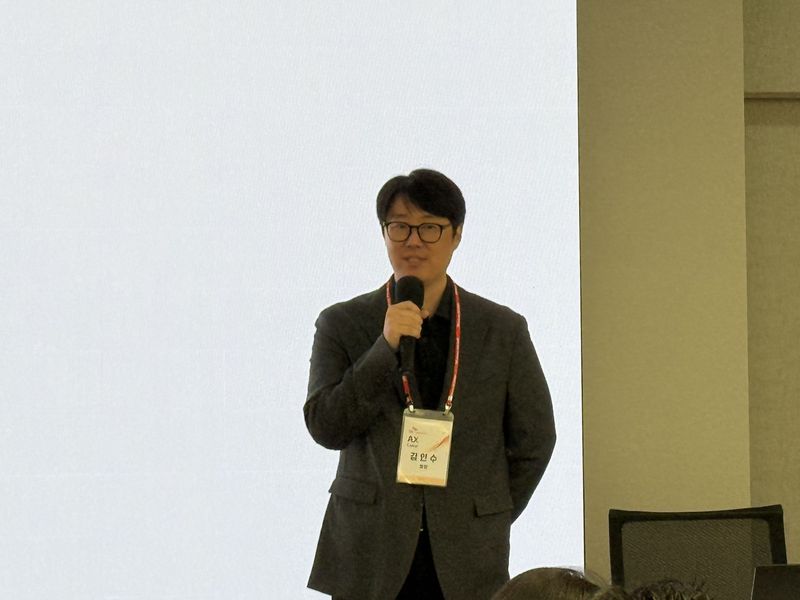
Kim In-su, AI Board team leader at SKT, said at an AI Transformation (AX) camp held on October 30 at SKT’s Human Resources Development Center in Icheon, Gyeonggi Province: “With AX 1.0, we started by having employees each try building and using their own agents. With AX 2.0, we want to generate results for the organization, going beyond the individual.”■ Assigning employee ID numbers to AI agents and expanding collaboration across the organizationThis year, SKT has been pursuing its “one AI agent per person” project, in which all employees build and use their own AI agents. More than 4,000 employees have created agents, and monthly users have reached at least 7,500.
As AI use spreads, SKT is prioritizing work outcomes and cost-effectiveness over simply expanding usage. “We are evaluating each agent one by one to see how effective it is and whether it makes sense for the company to pay for the tokens,” Kim said. “The aim is not so much to pare things down as to deliver results.”
To turn AI use into productivity gains across the organization, SKT operates three programs: the AX Enabler Task Force (TF), AX Sandbox, and AX Catalyst. The AX Enabler TF addresses company-wide issues that individuals have difficulty resolving, such as data access permissions, system integration, and security. SKT is also assigning employee ID numbers to AI agents and establishing a framework for collaboration across the organization.
AX Sandbox is an experiment in redesigning workflows around AI. In the first half of the year, SKT tested for about three months a model in which one employee in a service development organization handled planning, development, and verification with an AI agent. In the second half, it expanded the experiment across the company to test ways of working together.
AX Catalyst is a program that supports employees at the forefront of AI use in their day-to-day work. SKT selected 10 people for its first cohort in September and plans to expand the program starting next year. It provides support for AI model usage costs and data and system integration, while technical issues are addressed together with the AX Enabler TF.■ Patent application filed for security technology that enables AI use without exposing sensitive informationSKT is also developing its own technology to address data security and cost issues. It developed and filed a patent application for Z.E.Z (Zero Exposure Zone), a technology that provides only the necessary processing results without sending sensitive raw data to AI. The technology can also be used for tasks involving sensitive information, such as medical expense reimbursement.
SKT has also developed a system called Data Desk to help AI understand internal data. It automatically adds descriptions and business context to data fields represented by English abbreviations or numbers, helping users find the information they need. “The Network Center currently has more than 9,000 databases and about 300,000 data columns,” Kim said. “We estimate that adding descriptions to the data with an external large language model (LLM) would cost 100 million to 200 million won or more per year.”
SKT has responded by adopting an approach that uses its own neural processing unit (NPU) infrastructure and local AI models. The company says this has reduced costs while raising the accuracy of AI responses from around 40% to at least 80%.
SKT is also pursuing Workmap, which analyzes employees’ work materials and goals to map out workflows. The plan is to have AI draft workflows and refine them through conversations with employees, then use the results to establish standard procedures and identify tasks for AI agents to perform.
“SKT is moving through the trough of the AX J-curve, in which productivity falls at the beginning of AI adoption before rebounding,” Kim said. He emphasized that “we expect to see concrete results going forward, such as productivity gains across the organization and contributions to revenue.”
[email protected] Choi Hye-rim Reporter