France and Germany Reenter the Race for Vietnam’s High-Speed Rail Contract: “Korea Must Compete Through Local Partnerships”
- Input
- 2026-11-01 16:05:53
- Updated
- 2026-11-01 16:05:53

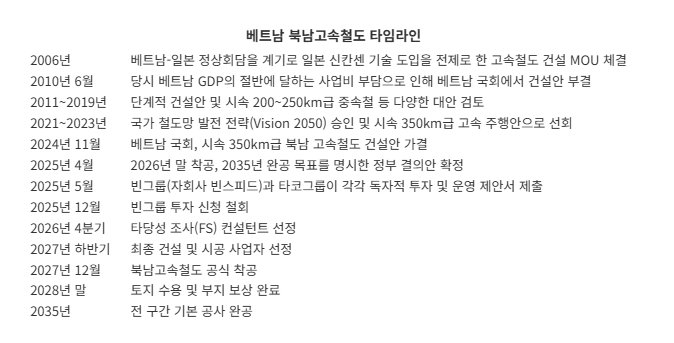
Germany’s Siemens is moving quickly to gain a foothold in the high-speed rail sector. Last month, Siemens signed a turnkey contract worth up to €1 billion (about 1.5 trillion won) with VinSpeed, Vingroup’s railway development subsidiary. Under the deal, Siemens aims to begin commercial operations in 2028 on two other high-speed rail routes in addition to the North–South Express Railway: the Hanoi–Ha Long (Quang Ninh) section, about 120 km long, and the Ben Thanh–Can Gio section in Ho Chi Minh City, about 54 km long. Siemens will supply its Velaro Novo high-speed train model along with advanced communications and electrification systems. The strategy appears to be to establish a favorable position in the North–South Express Railway bidding by taking the lead in setting Vietnam’s high-speed rail standards.■ “Korea Must Make a Decisive Move Through Technology Transfer and Local Partnerships”“Team Korea,” made up of South Korea’s railway industry, has also started moving again. In April, during President Lee Jae-myung’s state visit to Vietnam, Hyundai Rotem signed a contract with Vietnam’s THACO Group for the Line 2 (Ho Chi Minh City Metro) project, worth approximately 491 billion won. The partnership with THACO, a prominent local company, helped Hyundai Rotem establish itself in Vietnam’s railway market. Although South Korea trails its competitors somewhat in objective technical capabilities and track record, its solid operating experience built up through high-speed rail and its proactive offers of technology transfer are expected to be its greatest competitive strengths.
An industry official said, “What the Vietnamese government places the greatest emphasis on in infrastructure procurement is far-reaching technology transfer,” adding, “South Korean companies are much more willing to transfer technology than their competitors.” The official went on to recommend, “They should make a pragmatic, decisive move through diverse partnerships with local companies, including THACO, and a meticulous division of responsibilities.”
High-level talks between the two countries to secure the North–South Express Railway contract are also ongoing. On the 29th of last month, a National Assembly delegation comprising lawmakers Bok Ki-wang, Son Myeong-su and Kwon Young-jin, as well as former lawmaker Yang Jeong-suk and others, made an unscheduled visit to Vietnam and delivered a personal letter from National Assembly Speaker Cho Jeong-sik. In-depth discussions on the North–South Express Railway project reportedly took place at the meeting. South Korea began its efforts by dispatching President Lee Jae-myung’s special envoy team in July last year. In November of the same year, former National Assembly Speaker Woo Won-shik visited Vietnam, and last April, President Lee himself made a state visit to Vietnam, stepping up sales diplomacy. In July, Kim Yun-duk, then minister of Land, Infrastructure and Transport, visited Vietnam as a presidential special envoy.
An industry official said, “In Vietnam’s bureaucracy, where top-down decision-making is dominant, meetings and close communication among senior officials will be a key factor in determining whether bids for high-speed rail projects succeed or fail.” The official added, “Our government has continued to convey its strong commitment to winning high-speed rail contracts through the highest-level channels, and I understand that positive momentum is also building within the Vietnamese government.”
[email protected] Kim Jun-seok Reporter