Canada and EU launch ‘Future Alliance’ in face of Trump tariff threats, deepen ties on all fronts
- Input
- 2026-10-31 23:07:52
- Updated
- 2026-10-31 23:07:52
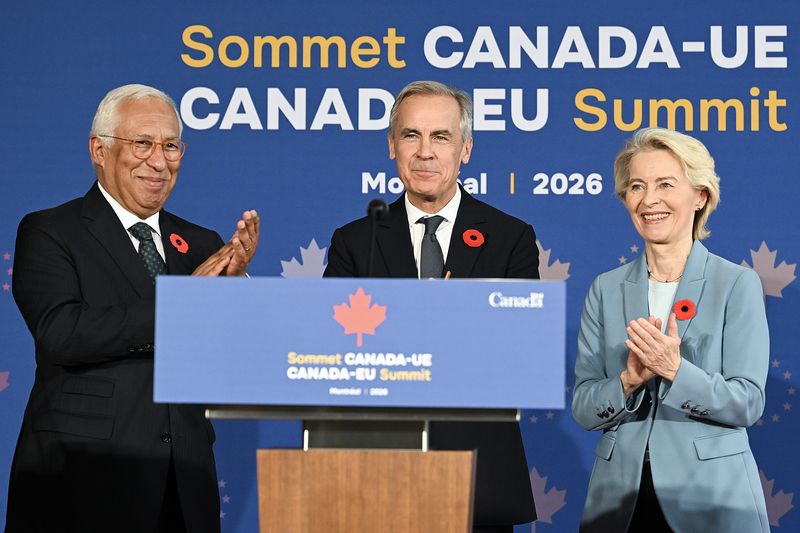
[The Financial News] Canada and the European Union (EU) have officially launched the “Alliance for the Future” (“Future Alliance”), strengthening economic and security ties in response to tariff pressure from the US administration of Donald Trump and its America First agenda. The move is seen as an effort to reduce reliance on the US and secure independent supply chains and strategic autonomy in future-oriented strategic industries such as critical minerals, artificial intelligence (AI) and defense.
■ Strategic alliance against Trump’s ‘weaponization of trade’ spans AI, supply chains and security
On the 30th (local time), foreign media including The Associated Press (AP) and The Guardian of the UK reported that Canadian Prime Minister Mark Carney, European Commission President Ursula von der Leyen and European Council President António Costa adopted a joint statement centered on launching the “Future Alliance” after the 21st Canada-EU summit, held over two days in Montreal, Canada.
Prime Minister Carney stressed, “The weaponization of trade is shaking our societies,” adding, “This alliance will help us withstand external economic pressure and make our own decisions rather than follow the dictates of great powers.” Commission President von der Leyen also underscored the need for supply-chain stability and a joint response, saying, “When trade becomes a tool of economic pressure, households ultimately pay the price.” Canada, which relied on the US for 71.7% of its merchandise exports last year, aims to double exports to markets outside the US within the next 10 years.
The two sides reached a range of agreements spanning technology, resources and security to substantially reduce reliance on the US. Canada will first join the European High Performance Computing Joint Undertaking (EuroHPC JU), allowing it to use Europe’s public supercomputers and quantum-computing resources for tasks such as training AI models. Carney cited plans for a merger between Canadian AI company Cohere—in which the Canadian government is investing up to 1.6 billion Canadian dollars (about 1.52952 trillion won) in equity—and Germany’s Aleph Alpha as a prime example of reducing reliance on US big tech.
In defense and security, the sides will strengthen cooperation on border security, cybersecurity and Arctic security, and work toward Canada’s participation in the EU’s Galileo satellite navigation system. The measure aims to reduce the risk of critical defense technologies being subject to decisions by US companies or politicians, as illustrated by the recent disruption to operations in the Ukraine war when access to US company SpaceX’s Starlink and Starshield communications networks was temporarily restricted.
In the economic sphere, the sides concluded negotiations on a digital trade agreement to lower barriers to online commerce and laid the groundwork for the European Investment Bank (EIB) to finance Canadian critical-mineral projects. They are also exploring the feasibility of exporting Canadian liquefied natural gas (LNG) to Europe and building a new undersea cable linking Canada, Europe and Asia. Canada also agreed to join the EU’s 90-billion-euro (about 134.1675 trillion won) loan program to support Ukraine, initially contributing 500 million euros (about 745.375 billion won).
■ Canada seeks to become EU’s first associate member...US pushes back with high tariffs
Building on the alliance, the two sides also moved to advance a plan to make Canada the EU’s first “associate member.” Carney said, “Today, we take another step toward associate membership,” and set a goal of concluding the relevant negotiations by June next year, when the next summit is scheduled to take place.
However, amid opposition from Germany and some other EU member states, which said the specific rights and obligations of associate membership were unclear and that there had been insufficient prior consultation, the final joint statement issued that day did not use the direct term “associate membership.” Instead, it said the sides would flesh out by next year a “closer cooperation relationship (gradual deepening of ties)” that falls short of full membership.
Meanwhile, the US is reacting sensitively to the growing closeness between the two traditional allies. Last month, President Trump said of the possibility of Canada becoming an EU associate member, “I don’t think that will happen,” but warned, “If they go through with it and I consider it a hostile act, I will impose very high tariffs or halt trade with Europe in several product categories.”
[email protected] Park Ji-hyun Reporter