“Do I have to quit next March?” ... The “1 p.m. nightmare” that has working mothers of 7-year-olds trembling [How Much Does It Cost?]
- Input
- 2026-11-01 11:06:03
- Updated
- 2026-11-01 11:06:03
[Financial News] November. When a chill sets in, lunchtime conversations among workers in their 30s and 40s with 7-year-old children tend to converge on one topic.
“Starting next March, my kid will get out of school at 1 p.m. How am I supposed to look after them until I get off work?”
In just a few weeks, elementary school enrollment notices will arrive at households across the country.
The joy of a child starting elementary school is fleeting before a huge disaster alarm starts ringing in dual-income parents’ heads. They must face the reality of public education: the kindergarten system that took children in at 9 a.m., fed them meals and snacks, and kept them safe until 5 or 6 p.m. ends, and at 1 p.m. children are sent out of school.
Until the parents finish work at 6 or 7 p.m. This huge five-hour gap every afternoon deals a devastating blow to the household budgets of dual-income families in their 30s and 40s as they try to fill it.
◇ The “1 p.m. cliff” ... A 1.5-million-won schedule to fill five hours

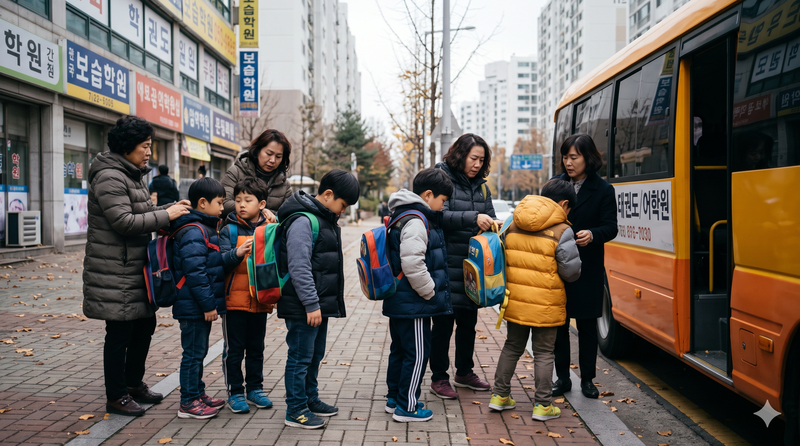
School after-care classrooms and the recently expanded Neulbom School are often cited as alternatives. But because of overcrowded classes, failing to get a place in the lottery, or concerns about comparing their child with others who leave school earlier, fewer parents than one might expect are comfortable leaving their children at school until the evening. In the end, the most reliable and safe way most ordinary dual-income parents choose to outsource childcare is the “academy shuttle circuit.”
A yellow shuttle bus pulls up outside the school in time for the 1 p.m. dismissal. Taekwondo at 1:30, piano at 2:30, art academy at 3:30, and then English academy at 4:30. Only after being sent around three or four academies like products on a conveyor belt can the child finally meet their parents after work.
This is not gifted education meant to help a child’s talents blossom. It is merely a “defensive schedule” cobbled together with money to keep the child safely indoors until the parents finish work. Each academy costs an average of 200,000 to 300,000 won, and the amount easily tops 400,000 won when core subjects such as English are included. Once private lessons are used to fill the four-to-five-hour gap without a break in the child’s itinerary, a monthly bill of 1 million to 1.5 million won per child becomes a fixed expense.
◇ Starting first grade scarier than childbirth ... Statistics confirm the “resignation rush”
“People quit their jobs most often when their child is in first grade.” This workplace rumor is not mere exaggeration but a cold fact borne out by Statistics Korea.
A closer look at Statistics Korea’s detailed data on “Employment Status of Married Women” and “Women with Career Interruptions” shows that the overwhelming leading cause of career interruption is childcare (at least 40%). By children’s age, the danger zone when employment rates take a sharp dip or resignation rates surge—at a level comparable to the newborn stage—is when children are 7 to 8 years old, the time they enter elementary school.
During early childhood, parents managed somehow with help from both sets of grandparents or by relying on full-day childcare at a daycare center. But once elementary school begins, the after-school care gap, managing academy schedules, and the child’s stress in adjusting to school all pile up, and eventually one parent—usually the mother—throws in the towel and leaves the workforce.
◇ The “childcare toll” paid to protect my career ... The bitter fiction of income
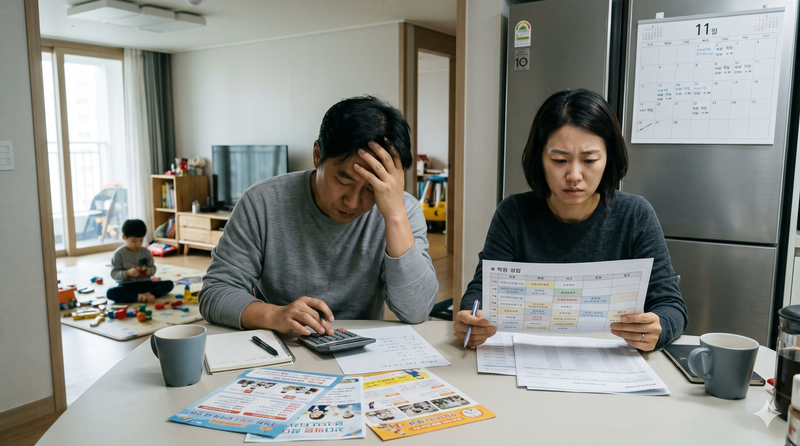
So why don’t they just quit their jobs now? Suppose one spouse earns 3 million won a month. To keep that salary, the couple spends half of it—1.5 million won—on academies to care for their child. They are left with only around 1.5 million won, yet they willingly continue this economically inefficient work.
That is because the fear that quitting once means never being able to return to a good-quality job at the same level weighs on people in their 30s and 40s, even if the numbers do not add up in the short term. In other words, the 1.5 million won paid to academies each month is not the cost of advance lessons to get a child into a prestigious university. It is a painful “childcare toll” paid to the private education market so parents can keep their careers and avoid being pushed out of the workforce.
November. As they ride the subway home in the cold and search for next March’s academy schedules, parents whose children are about to start first grade find a question circling in their minds. They seem to earn a lot, but once half their income goes to academy fees, their bank accounts are left looking bare. Are we working to protect our careers, or to earn money for academy fees? The burden of this “fake income” borne by South Korea’s dual-income families in their 30s and 40s weighs heavily on parents’ shoulders once again today.
[email protected] Jeon Sang-il Reporter