“Just took one dose of cold medicine and went to sleep”... On October’s last night, ‘this disease’ that choked the life out of breadwinners in their 40s and 50s [The Body Off the Record]
- Input
- 2026-11-01 18:00:00
- Updated
- 2026-11-01 18:00:00
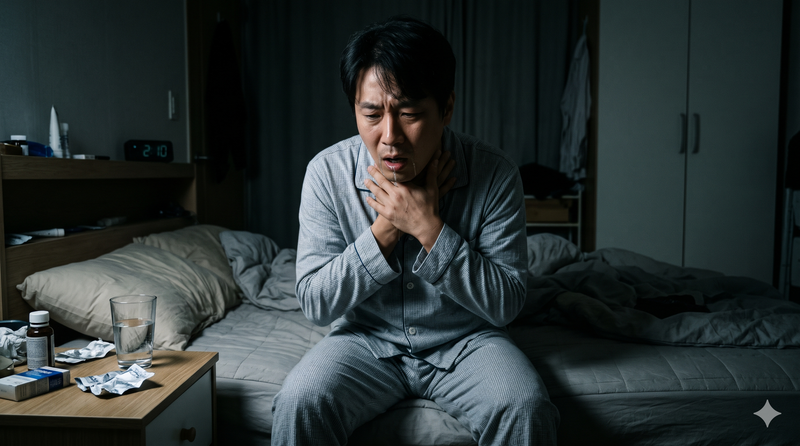
[Financial News] Saturday night, October 31, the last day of the month. As the calendar edged toward November, the night air turned bitterly cold, penetrating to the bone. A breadwinner in his 40s or 50s, having caught up on sleep over the weekend, begins to feel a scratchy throat toward evening and a sharp pain, like being scraped with a razor blade, every time he swallows.
“It suddenly got cold, so my tonsils have swollen badly again.”
Most middle-aged men take this familiar pain to be nothing more than a seasonal cold or tonsillitis. They ask their wives for a cup of warm honey water or tea, drink it, then head to bed with a common painkiller or throat lozenge from the first-aid kit in their mouths. They do so with the vague hope that after a good night’s sleep over the weekend, it will have eased by morning. But this foolish, complacent patience will, in just 2–3 hours, send him into a hell where oxygen is completely cut off.
2 a.m. He jolts awake to a bizarre, choking rasp. An intense pressure overwhelms him, as if a large golf ball were wedged tightly in his throat.
He tries to force air into his lungs, but no oxygen gets in. Unable even to swallow his saliva, he drools. Struggling for his life, he instinctively sits up, bends sharply forward, and gasps for air.
The condition behind this horrifying suffocation, which he tried to suppress with a simple cold medicine, is acute epiglottitis.
The epiglottis is a thin, leaf-shaped flap of cartilage deep in the throat, at the very top of the airway. When we swallow food or saliva, this flap closes to prevent foreign matter from entering the lungs (airway), serving as a vital safeguard. But when a bacterial infection, such as Haemophilus influenzae, causes acute inflammation of the epiglottis, the cartilage—once as thin as a sheet of paper—can rapidly swell into a bright red balloon.
The real terror begins when you lie flat on your back in bed. Gravity pushes the massively swollen epiglottis backward, completely sealing off the airway—the only passage through which oxygen can flow.
This is the pathological mechanism by which flesh in your own body clamps down on your windpipe. When patients instinctively lean forward, thrust their chins out, and drool as they adopt what is known as the ‘tripod position’ to breathe, it is the body’s most desperate distress signal that the airway is already becoming blocked.
Acute epiglottitis is an extreme emergency in which it takes only a few hours from the onset of symptoms for the airway to become completely blocked. If someone hesitates to go to the hospital in this state or tries to force down water or medication at home, the airway may be irritated and immediately close completely in a spasm.
Breadwinners in their 40s and 50s in South Korea often wear their characteristic insensitivity like a badge of honor, enduring all but the most serious pain with painkillers and regarding a trip to the hospital as a nuisance. But if they cannot swallow their saliva and drool, and their voice becomes muffled, as if they had a hot potato in their mouth, that is not a cold—it is a warning sign of impending death that calls for dialing 119.
If arrival at the emergency room is delayed until the airway is completely blocked, medical staff may have no choice but to perform the horrifying procedure known as a tracheotomy: with no time to administer anesthesia, they cut the skin at the front of the patient’s neck with a scalpel, open the trachea, and insert a breathing tube directly.
On the last night of October, before clutching your stinging throat and reaching for a painkiller, remember this: going to the hospital when you are sick is not making a fuss. It is a breadwinner’s most basic responsibility if they hope to see their family’s faces again the next morning.
[email protected] Jeon Sang-il Reporter