“Can even an elderly person earning 4.68 million won a month or owning a 1.7 billion won apartment receive the Basic Pension?” ... A closer look at the top 1% of recipients
- Input
- 2026-10-31 11:27:17
- Updated
- 2026-10-31 11:27:17
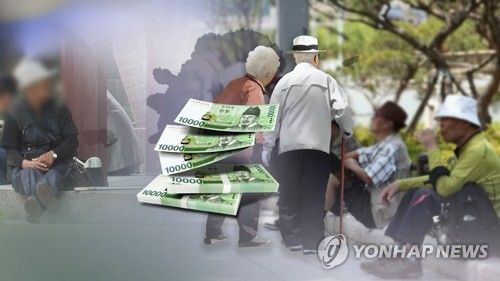
[Financial News] Among elderly people receiving the Basic Pension, those in the top 1% by recognized income have average ordinary assets of 340 million won and average monthly earned income of 2.2 million won, according to the data.
Average assets of 340 million won among the top 1% of Basic Pension recipients by recognized income
Data obtained from the Ministry of Health and Welfare on the 31st by the office of Rep. Nam In-soon, a member of the National Assembly’s Health and Welfare Committee, show that, as of the end of 2025, the average pre-deduction value of ordinary assets among Basic Pension recipients in the top 1% by recognized income was 340 million won. The effective average, calculated only for recipients who actually owned assets, was also 340 million won. Ordinary assets include homes, buildings, land, and deposits for jeonse and monthly rentals.
The average pre-deduction earned income of this top 1% was 2,198,000 won per month. The effective average, calculated only for elderly people who worked, was 2,578,000 won per month.
The statistics were released amid controversy that the Basic Pension’s broad range of deductions allows even high-income earners and people with substantial assets to receive benefits. The Ministry of Health and Welfare’s 2026 Basic Pension eligibility threshold is 2.47 million won per month for a single-person household, equivalent to 96.3% of the median income of 2.56 million won for a one-person household.
“Even an elderly person with 1.7 billion won in assets could receive the Basic Pension”: Hypothetical case sparked controversy, but differed from reality
However, the amount of actual income counted as recognized income differs considerably from the calculation used in other welfare programs. The Basic Livelihood Security Program deducts 30% of earned income, while the Basic Pension first excludes 1.16 million won per month and then deducts a further 30% from the remainder. For someone earning 3 million won a month, the Basic Livelihood Security Program counts 2.1 million won as income, while the Basic Pension recognizes only 1.28 million won. Under the Basic Pension formula, 1.16 million won is first deducted from 3 million won, and then 30% of the remaining 1.84 million won is deducted, leaving about 1.28 million won counted as income.
Under this formula, an elderly person with no other assets could qualify for the Basic Pension even with monthly earned income of 4.68 million won. A hypothetical case was also presented in which an elderly couple with no income could receive around 550,000 won a month in Basic Pension while owning an apartment with an actual transaction price of 1.7 billion won and an assessed price of around 1.2 billion won.
It also came under scrutiny that, after excluding recipients of occupational pensions such as those for civil servants, military personnel, and teachers from the total elderly population, the actual share receiving the Basic Pension exceeds the bottom 70%, reaching around 80%.
In response, the government drew up a reform plan that maintains the bottom-70% threshold while varying benefit amounts according to income.
The office of Rep. Nam In-soon said, “The actual circumstances of Basic Pension recipients in the top 1%, as confirmed by the Ministry of Health and Welfare’s official statistics, differed from extreme hypothetical cases raised by some, such as an elderly person owning a 1.7 billion won apartment,” and pointed out that “claims that wealthy elderly people receive the Basic Pension are somewhat exaggerated.”
[email protected] Ahn Ga-eul Reporter