The “How to Get to Tomorrow” Hidden in a Mirror ... Rohwa Jeong Exhibition at the National Museum of Modern and Contemporary Art, Korea (MMCA), in Cheongju
- Input
- 2026-10-31 08:30:00
- Updated
- 2026-10-31 08:30:00
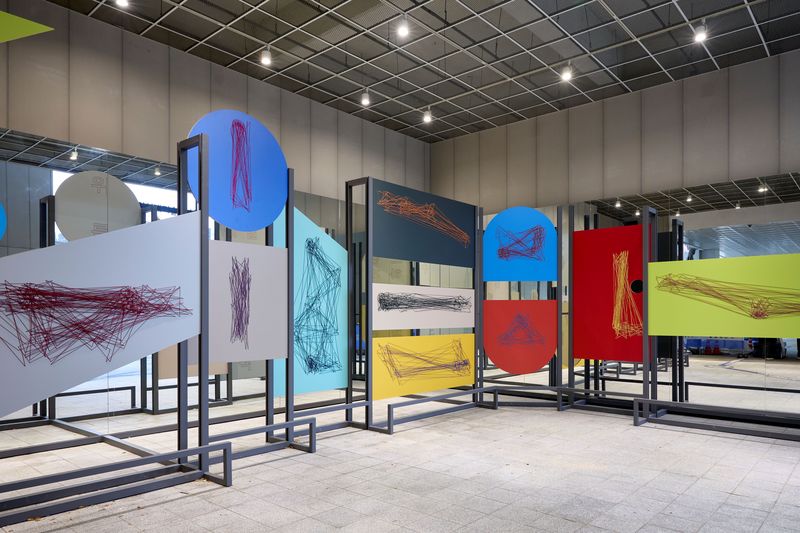
Passage, installed at the museum entrance, consists of panels embroidered with abstract images in various colored threads and arranged at different angles and heights. The work is made up of panels embroidered with cord through holes drilled in plywood, mirrors, and steel structures.
A structure standing like a folding screen blocks a mirror on the wall, so visitors walk around it, alternating between the images on the front and the back reflected in the mirror. On the backs of the panels reflected in the mirror, they can find the phrase “How to Get to Tomorrow.”
Scattered elements are connected into a single sentence through the mirror. The abstract images and words appear differently depending on where visitors stand and which way they look.
The title Passage refers both to a passageway and to a section of text. By bringing together the experience of walking along a path and reading a sentence, the work shows how new meanings can be found by stepping outside familiar visual conventions.
Rohwa Jeong is an artist duo comprising Noh Yunhui and Jeong Hyeonseok. They complete their work through dialogue and negotiation while maintaining their differences. The relationships between objects and environments, and between social conventions and perception, are central concerns for the duo. They have continued to revisit taken-for-granted conventions by placing everyday objects in unfamiliar settings or creating dissonance between language and images.
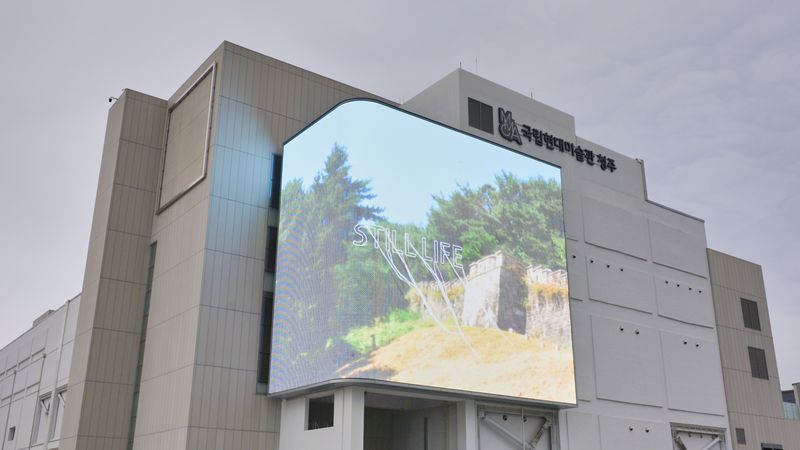
Rohwa Jeong have installed mosquito nets in various locations in Korea and abroad, embroidered the words “still life” on them in white thread, and documented them on video. In this work, too, the landscape moves subtly behind the letters, bringing stillness and movement together in a single frame.
“Still life,” meaning a depiction of inanimate objects, can also be read as “life that continues.” It prompts viewers to reflect on time and the movements of everyday life that continue even in scenes that seem still.
MMCA Cheongju is Korea’s first collection-storage museum, opened in 2018 after the former tobacco-manufacturing plant was rebuilt. It has also opened its collection storage areas to visitors as exhibition spaces, and on the 22nd of last month it renovated the open storage area on the first floor and newly displayed 32 works from its collection.
MMCA said, “We hope visitors will walk alongside Rohwa Jeong’s works, see familiar landscapes from a different perspective, and discover new meanings they may have missed in everyday life.” Admission is free.
[email protected] Jang In-seo Reporter