Researchers successfully improve efficiency of sawdust-based plastic feedstock production
- Input
- 2026-11-01 12:00:00
- Updated
- 2026-11-01 12:00:00
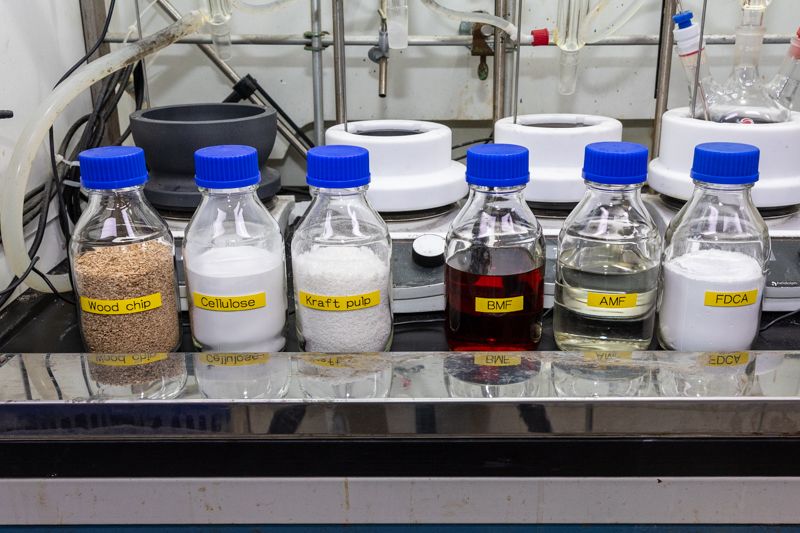
A team led by Dr. Hwang Dong-won of the Korea Research Institute of Chemical Technology and a team led by Professor Han Ji-hoon of Pohang University of Science and Technology (POSTECH) announced on the 1st that they had developed a “BMF-AMF-FDCA integrated process” for converting non-edible biomass into 2,5-furandicarboxylic acid (FDCA). FDCA can be used to make PET bottles in place of the petroleum-based feedstock terephthalic acid.
FDCA is currently made mainly from fructose, sugar, and other materials derived from corn. The first production in the Netherlands was achieved this September at a plant with an annual capacity of 5 tonnes. Meanwhile, research into using waste wood without competing with food is also gaining momentum. Earlier studies focused on making FDCA after converting cellulose in wood into an intermediate, or on boosting conversion efficiency with new catalysts. However, wood is difficult to break down because of its rigid structure, and intermediates produced during the reaction can easily degrade, reducing production efficiency.
The research team developed a three-step process to convert cellulose into BMF, AMF, and FDCA. The key was to reduce the high-pressure reaction in the first step and minimize the need to separately isolate and purify the intermediates or change solvents in subsequent steps. First, using sulfuric acid and bromide salts, they converted cellulose into BMF at atmospheric pressure, without a high-pressure process. The method uses two immiscible liquids, like water and oil. When an unstable intermediate forms, it quickly moves into the oil layer, reducing the formation of unnecessary byproducts. The principle is similar to quickly scooping up and storing an ingredient that spoils easily.
As a result, the yield of BMF from cellulose reached as high as 82%, and productivity was at least three times that of previously reported CMF/BMF processes. Yields of 73–79% were also confirmed in a 10 L reactor, while the amount of halogen-based substances used was reduced by at least 30-fold compared with the existing hydrochloric-acid-based CMF process.
The team then continuously converted BMF into AMF at room temperature, 25°C. A yield of at least 95% was achieved with a single pass through a 1 L reactor. After removing impurities, they regenerated the ion-exchange resin used in the reaction and achieved an AMF yield of 97% even after 15 operating cycles.
In the final step, the team oxidized AMF directly, without further purification, to produce FDCA with a purity of at least 99%. The total FDCA mass yield across the entire process was up to 56.8% from cellulose (59% molar yield) and 45.5% from wood sawdust (47.2% molar yield). These results exceed the 32.7% total mass yield from cellulose reported in 2022 by the University of Groningen in the Netherlands and other researchers.
A life-cycle assessment based on process simulation found that greenhouse gas emissions from producing 1 kg of FDCA were 2.77 kg in carbon dioxide equivalents, about 60% lower than the 6.91 kg for the conventional edible-sugar process. Fossil resource use also fell by 47.9%. However, large-scale continuous operation and verification of manufacturing costs remain to be addressed, so further research is needed.
Principal Researcher Hwang Dong-won said, “This achievement improves the efficiency of each step in the process of manufacturing plastic feedstock using woody biomass instead of edible resources.”
The study was published as a paper in the international journal Chemical Engineering Journal (impact factor: 12.5) in November 2026.
[email protected] Yeon Ji-an Reporter