Adding AI validation to 25 years of expertise, kt cloud boosts AIDC competitiveness with specialized firms
- Input
- 2026-11-01 17:00:00
- Updated
- 2026-11-01 17:00:00
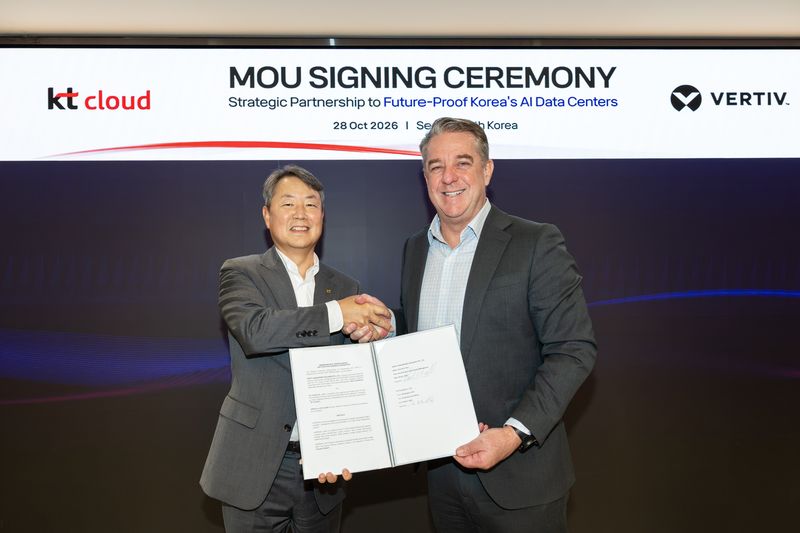
[Financial News] kt cloud is expanding its supply of AI data centers (AIDCs) by combining 25 years of data center operating experience with technologies from specialists in power and cooling. The strategy comes as rising demand for AI data centers makes it increasingly important to secure power and cooling infrastructure capable of supporting high-performance graphics processing units (GPUs). The company plans to secure 1 GW of additional AIDC capacity by 2031 and validate in advance the facilities needed for next-generation GPUs.
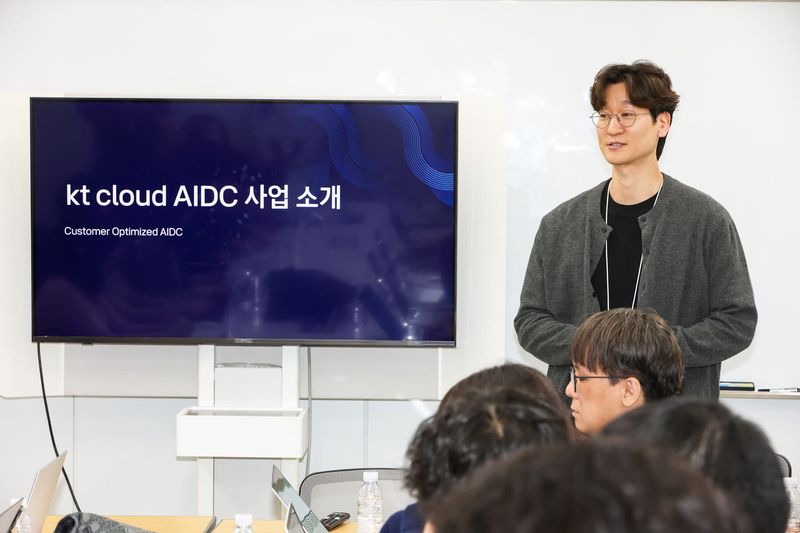
On October 30, kt cloud presented its AIDC technologies and business strategy at the AI Innovation Center inside its Mokdong 2 Data Center in Seoul. Opened last year, the center is a facility for testing core data center technologies, including cooling, power and networking. It uses NVIDIA B200 GPU servers and an in-house-developed load bank to recreate a high-density AI server environment and check equipment performance and stability.
AI servers consume more power and generate more heat than conventional servers centered on central processing units (CPUs). As it becomes more difficult to manage heat using air cooling alone, direct-to-chip (D2C) technology is drawing attention. It places a cooling plate in direct contact with the GPU and circulates coolant through it. kt cloud uses a load bank to reproduce the heat conditions of GPU servers, checking the coolant’s flow rate, pressure and temperature, as well as the stability of coolant distribution units, piping and valves. It is also reviewing designs for next-generation GPUs by recreating power and thermal loads of around 140 kW per rack.
kt cloud is also applying liquid-cooling technology in its commercial operations. At its Gasan AIDC, it provides D2C cooling services to hyperscalers. It has also conducted technical validation of immersion cooling, which lowers temperatures by immersing servers in electrically insulating coolant.
The company is also expanding its partnerships with specialists in power and cooling. It is jointly researching modular data center power infrastructure with LS ELECTRIC Co., Ltd. and pursuing design optimization with Vertiv, taking power, liquid cooling and modular infrastructure into account together. Vertiv’s modular infrastructure solution is planned for use at the Gunsan AIDC.
AI is also being used to automate data center operations. The in-house-developed power equipment management and recovery-route search system “Pathfinder” monitors equipment status and finds recovery routes when failures occur. “DIMS Insight,” an equipment management system analytics tool, analyzes equipment data to detect anomalies and predict failures. Following last year’s validation of an autonomous inspection robot, the company is conducting field inspection trials this year using “Spot,” Boston Dynamics’ four-legged robot.
“It is important to accumulate as data the experience gained through data center operations and analyze it with AI to predict failures in advance,” said Bang Jae-won, head of kt cloud’s AIDC Business Development Team. “We will apply technologies validated at the AI Innovation Center to actual data center operations and provide differentiated services.”
[email protected] Yoon Hong-jip Reporter