AI Training Method That Can Detect Lies Developed ... Validated by Mafia Game Win Rates
- Input
- 2026-11-01 09:00:00
- Updated
- 2026-11-01 09:00:00
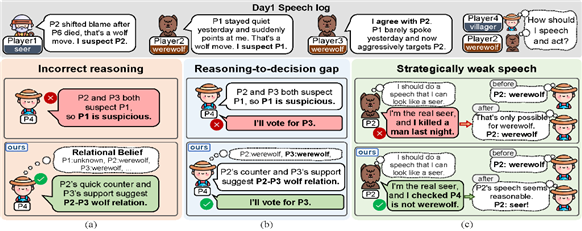
MARBO is a training method that teaches AI to identify opponents’ hidden roles and intentions and to speak and act in line with its own goals when multiple AI agents are cooperating or competing in situations where communication may be poor and information limited, or opponents may deliberately deceive them.
First, the AI is taught to infer an opponent’s role and which other players are on the same side, based on accumulated conversations and actions. These inferences about an opponent’s identity and relationships are called “relational beliefs.” The combinations of AI agents participating are also varied at random so they can experience a range of situations.
The AI receives a positive evaluation only when it correctly identifies an opponent and chooses an action that serves its goal, training it to make similar judgments and take similar actions in comparable situations. Existing training methods rewarded the AI when a mistaken inference happened to lead to a favorable outcome, prompting it to repeat that choice. MARBO, however, can filter out such cases.
The AI is also taught to consider how its opponent perceives it when it speaks. Rather than judging only whether its words fit the situation, it also checks whether the listener’s judgment has shifted in a way that benefits it.
The research team tested the training method by having AIs play against one another in Werewolf and Among Us, both Mafia-style games. Mafia games are “social inference games” in which players have different information and can lie as they try to work out hidden identities. In Werewolf, players seek a werewolf hidden among the citizens; in Among Us, they seek a traitor sabotaging a spaceship’s mission.
After training a language model with 7 billion parameters using MARBO and having it play Werewolf, its average win rate against five types of opponent AI was 65.6%. That was 24 percentage points higher than the 41.6% achieved with existing training methods. It also exceeded the 64.0% win rate recorded by a model with twice as many parameters trained using an existing method.
In Among Us, the win rate of a model with about 2 billion effective parameters rose from 36.4% to 49.0%, while that of a model with about 4 billion effective parameters increased from 40.0% to 59.0%.
Professor Han Seung-yeol said he hoped that “this technology, which enables proper judgments by inferring opponents’ roles and relationships even in situations involving incomplete or deceptive information, could eventually be extended into a foundational technology for improving the reliability and adaptability of systems—such as multi-robot systems, autonomous drones, and human-AI collaboration—in which multiple agents must understand one another’s states and intentions and cooperate.”
The research was accepted at EMNLP (Empirical Methods in Natural Language Processing), a leading international conference in natural language processing. This year’s conference was held in Budapest, Hungary, from October 24 to 29.
[email protected] Yeon Ji-an Reporter