“The logo and the taste are assets”: Food industry steps up IP protection as K-food counterfeits proliferate
- Input
- 2026-11-02 15:07:57
- Updated
- 2026-11-02 15:07:57
[Financial News] As K-food’s global standing has grown, the distribution overseas of products imitating Korean foods and the unauthorized use of trademarks have surged. In response, Korean food companies are aggressively seeking to secure IP across the board, from trademarks to manufacturing technologies.
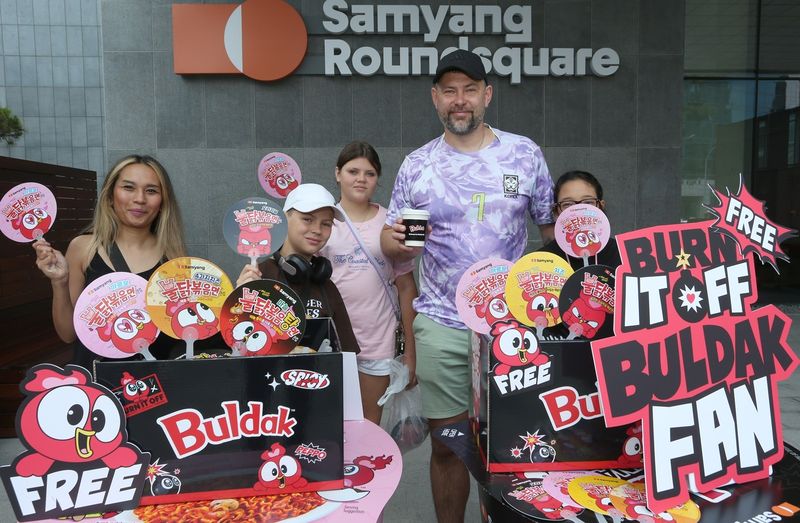
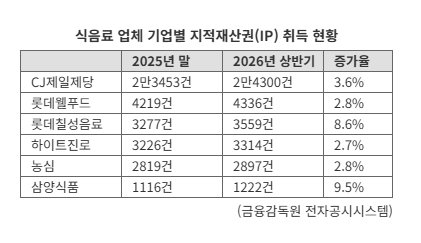
According to the Financial Supervisory Service’s Data Analysis, Retrieval and Transfer System (DART) on the 2nd, six major food companies—CJ CheilJedang, Lotte Chilsung Beverage Co., Ltd., Lotte Wellfood Co., Ltd., NONGSHIM CO., LTD. (Nongshim), HiteJinro Co., Ltd. and Samyang Foods Co., Ltd.—acquired a total of 1,518 new IP rights in the first half of this year. Their combined IP holdings rose 4.0% in just six months, from 38,110 at the end of last year to 39,628 in the first half of this year. By company, Samyang Foods Co., Ltd., whose Buldak Ramen has become popular worldwide, recorded the largest increase in IP. Its IP holdings grew by 106, from 1,116 last year to 1,222 in the first half of this year, a 9.5% increase. In particular, copyright registrations related to the Buldak brand expanded significantly this year after its flagship character was revamped from the former Hochi to PEPPO.
Beverage and liquor companies are also rapidly expanding their IP portfolios. Lotte Chilsung Beverage Co., Ltd.’s IP holdings increased by 282, from 3,277 last year to 3,559 in the first half of this year, up 8.6%. Over the same period, HiteJinro Co., Ltd.’s holdings rose by 88, from 3,226 to 3,314, an increase of 2.7%.
Major diversified food companies have also continued to build up their IP portfolios. CJ CheilJedang’s IP holdings increased by 847, from 23,453 to 24,300 over the same period, up 3.6%, keeping the company among the industry leaders. Lotte Wellfood Co., Ltd. added 117, rising from 4,219 to 4,336, an increase of 2.8%, while Nongshim also added 78, growing from 2,819 to 2,897, up 2.8%.
The food and beverage industry is striving to secure IP because doing so helps protect businesses by registering brand trademarks first and safeguards companies’ distinctive technological edge. In the past, counterfeiting was largely limited to distributing products that simply copied the packaging designs of popular K-food brands, mainly in China. But the practice has evolved: in Southeast Asia, India and elsewhere, local brokers first register Korean companies’ trademarks, then block the original companies from entering those markets and demand hefty royalties or settlements. This exploits a loophole in the current system: even if a trademark is filed in Korea, priority is recognized only if an overseas application is filed within six months.
According to the Korea Intellectual Property Protection Agency (KIPPA), the number of cases detected overseas last year involving the unauthorized preemptive registration of Korean food trademarks and the blocking of online counterfeit products reached record highs, at 738 and 2,884, respectively. Cases of unauthorized preemptive trademark registration rose slightly from 399 in 2023 to 421 in 2024, then surged to 738 last year. Online counterfeit product takedowns also climbed from 883 in 2023 to 2,609 in 2024 and 2,884 last year, more than tripling in two years.
The growing need to protect source technologies in order to maintain an edge in taste and quality in global markets is also driving applications for patents and other IP. A food industry official added, “Securing IP not only helps protect our brands overseas, but also serves as a means of preventing competitors from copying the proprietary technologies we have developed. In the fiercely competitive global food market, obtaining patents at the new-product development stage is no longer optional; it is essential.”
[email protected] Park Kyung-ho Reporter