“A weaker dollar is welcome”: Won strength boosts financial groups’ capital buffers, but year-end exchange rates and interest rates remain key variables
- Input
- 2026-11-08 08:28:08
- Updated
- 2026-11-08 08:28:08
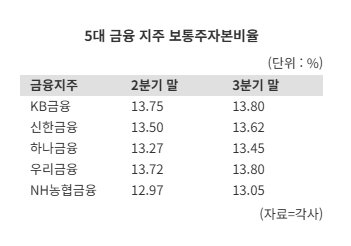
According to financial industry sources on the 8th, the simple average CET1 ratio of the five major financial groups at the end of the third quarter was 13.54%, based on provisional and estimated figures. KB Financial Group and Woori Financial Group had the highest ratios, at 13.80% each. They were followed by Shinhan Financial Group at 13.62%, Hana Financial Group at 13.45%, and NH NongHyup Financial Group at 13.05%.
CET1 is the ratio of common equity capital to RWA and serves as an indicator of a financial company’s capacity to absorb losses and its capital strength. In addition to building up earnings or increasing common equity through capital increases, reducing the RWA burden also helps improve the ratio.
The CET1 ratios of the five major financial groups improved in the third quarter of this year. KB Financial Group’s ratio rose from 13.75% at the end of the second quarter to 13.80% at the end of the third quarter. Over the same period, Shinhan Financial Group’s ratio increased from 13.50% to 13.62%, and Hana Financial Group’s from 13.27% to 13.45%. Woori Financial Group and NH NongHyup Financial Group each rose by 0.08 percentage points.
The won’s strength played a major role in the improvement in financial groups’ capital ratios. The won-dollar exchange rate fell by 196.6 won (12.7%), from 1,549.4 won at the end of June to 1,352.8 won at the end of September. A lower exchange rate can reduce the won value of foreign-currency assets and the associated RWA, positively affecting CET1.
The supply of dollars, fueled by strong semiconductor exports and a trade surplus, is cited as a factor behind the won’s strength. When dollars earned through exports and overseas funding are converted into won, the supply of dollars in the foreign-exchange market increases. In fact, aided by the lower exchange rate and asset management, Hana Financial Group’s RWA at the end of the third quarter fell 3.5% from the previous quarter. Shinhan Financial Group’s fell 1.6%, Woori Financial Group’s 0.7%, and KB Financial Group’s 0.5%.
Improved capital ratios provide a foundation for expanding productive finance, including increasing corporate lending and investment while maintaining financial soundness. They also give listed financial groups room to continue shareholder returns, such as dividends and share buybacks.
However, the effect of a lower exchange rate does not translate fully into higher capital ratios. If market interest rates rise, the valuation of bond holdings falls, potentially putting pressure on capital. Further increases in market rates or a renewed rise in the exchange rate could constrain the improvement in capital ratios.
“With dollar inflows continuing on the back of strong semiconductor exports, the won-dollar exchange rate is expected to fluctuate around its current level for the time being,” said Shin Yuna, a director at Woori Investment & Securities. “However, if U.S. monetary tightening intensifies or foreign capital flows out, the won’s strengthening trend could weaken and upward pressure on the exchange rate could increase.”
[email protected] Ye Byung-jung Reporter