KOSPI tumbles 3.48% on U.S. AI concerns; Samsung Electronics down 3%, SK hynix down 7% [Market Close]
- Input
- 2026-10-30 15:44:22
- Updated
- 2026-10-30 15:44:22
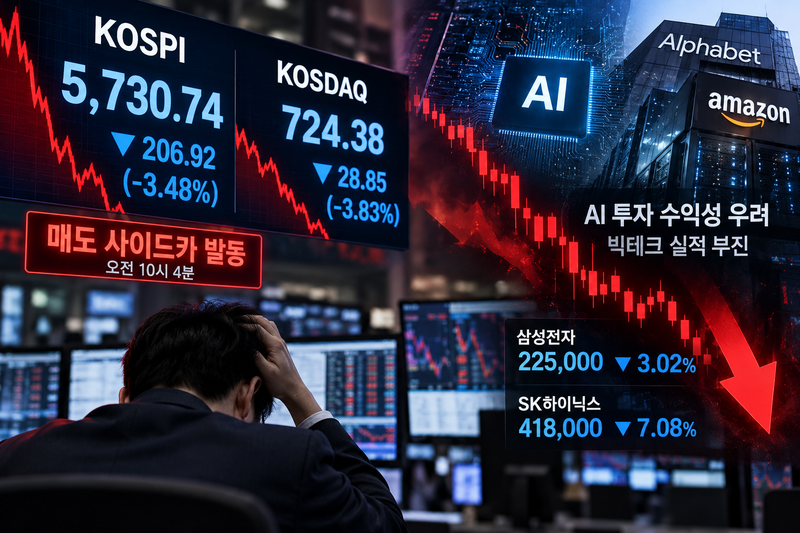
[Financial News] South Korea’s stock market closed sharply lower, shaken by concerns over the sustainability of U.S. big tech companies’ artificial intelligence (AI) investments.
Panic selling flooded the market after the KOSPI plunged more than 5% early in the session, triggering a sell-sidecar. It recouped some losses in the afternoon, but could not avoid a decline in the 3% range as heavy foreign selling and weakness in major semiconductor stocks persisted.
On the 30th, the KOSPI closed at 5,730.74, down 206.92 points (3.48%) from the previous session, according to the Korea Exchange (KRX). The index opened down 2.99% and extended its losses during the session, falling as low as 5,599.42.
At 10:04 a.m., a sell-sidecar was triggered following a sharp drop in KOSPI 200 futures prices. It was the first time a sell-sidecar had been triggered in the KOSPI market in 11 trading sessions.
In the afternoon, buying by individual and institutional investors helped pare losses from the intraday low. However, the rebound was limited as concerns over AI investment, sparked by a sharp drop in U.S. tech stocks, spread to domestic semiconductor shares.
The KOSDAQ also closed lower, shedding 28.85 points (3.83%) to 724.38 from the previous session. The simultaneous sharp declines in the KOSPI and KOSDAQ fueled risk aversion across South Korea’s stock market.
The key factor dragging the market down was a reassessment of the burden of U.S. big tech companies’ AI investments. Overnight on Wall Street, news emerged that Alphabet Inc.’s third-quarter revenue had fallen short of market expectations and that massive investment in AI infrastructure had pushed free cash flow into negative territory.
Amazon also came under scrutiny over concerns that its expanded AI investment would weaken cash flow and that growth in its existing businesses would slow.
Doubts grew over whether expectations for growth in the AI industry could translate into actual corporate profitability and cash-generating ability. The Nasdaq fell 1.38%, while the Philadelphia Semiconductor Index dropped 1.42%, weighing on domestic semiconductor stocks.
Declines were pronounced among semiconductor stocks with large market capitalizations. Samsung Electronics closed at 225,000 won, down 3.02% from the previous session. SK hynix fell 7.08% to 418,000 won. SK Square also dropped 5.88%, while Samsung Electronics preferred shares lost 5.33%. The declines appeared to reflect a combination of profit-taking in semiconductor-related stocks that had been expected to benefit from increased AI investment and weakening investor sentiment.
Foreign selling also exacerbated the decline. Foreign investors net sold 1.8255 trillion won on the KOSPI that day. Individual investors and institutions, by contrast, net bought 871.3 billion won and 716.8 billion won, respectively, seeking bargains. On the KOSDAQ, individual investors net bought 167.9 billion won, while foreign investors and institutions net sold 30.8 billion won and 136.1 billion won, respectively.
Among large-cap stocks, performance varied by sector. Samsung Biologics rose 8.86%, and LG Energy Solution gained 0.98%. However, steep declines were also seen outside the semiconductor sector, with Hanwha Aerospace plunging 8.42% and Kia falling 11.73%.
Joain, a research analyst at Samsung Securities Co., Ltd., said in a market analysis note that “investors have begun to focus less on the scale of AI investment itself and more on whether it is improving returns on investment and cash flow.” The analysis said that if cash flow generated by big tech companies’ existing businesses fails to adequately support the pace of growth in AI capital spending, investment could slow in the future, potentially weighing on the medium- to long-term demand outlook for domestic semiconductor companies.
The analyst also noted that the sharp decline had eased valuation concerns in South Korea’s stock market to a considerable extent. “The recent sharp correction has considerably eased valuation concerns in the domestic stock market,” the analyst said. “A strategy of gradually seeking investment opportunities in sectors and stocks with solid fundamentals appears appropriate.”
The market is expected to focus going forward on whether big tech companies’ AI investment plans can translate into actual improvements in profitability. In the short term, volatility in South Korea’s stock market is likely to persist, depending on earnings and investment outlooks for U.S. tech stocks and shifts in foreign investor flows.
[email protected] Kang Jung-mo Reporter